
Akhenaten and Nefertiti are ancient Egypt's most famous royal couple, and their love was the reason behind the most difficult & choatic times in the history of ancient Egypt. Around 1350 BC they turned the country's religion upside down, replaced hundreds of gods with a single sun disc called the Aten, and built a new capital in the desert. They also left behind something no pharaoh had shown before: images of a king and queen kissing, playing with their children and riding side by side in a chariot.
Their story glows briefly and brightly, like the sun they worshipped, and then vanishes beneath the sand for three thousand years. This guide explains who Akhenaten and Nefertiti were, whether they were siblings, and what their art reveals about their love story. It looks closely at the famous house altar of Akhenaten, Nefertiti and three of their daughters, including its location, size and meaning. It also shows where you can still find their traces in Egypt today.
Who Were Akhenaten and Nefertiti?
The Heretic King
Akhenaten was born Amenhotep IV, the son of Amenhotep III and Queen Tiye, during Egypt's wealthy 18th Dynasty. He ruled for about 17 years, from around 1353 to 1336 BC. In his early years, he built temples to the Aten at Karnak Temple in Thebes, using small stone blocks called talatat.
Around his fifth year, he changed his name to Akhenaten, "the one who is effective for the Aten." He then moved the court to a brand new city, Akhetaten, "Horizon of the Aten," on empty land halfway between Thebes and Memphis. Today it is called Tell el-Amarna. Teams were sent across Egypt to chisel the name of the god Amun off monuments, and temple wealth was redirected to the Aten.
The Beautiful One Has Come
Nefertiti's name means "the beautiful one has come." Her parents are unknown. Many scholars believe she was the daughter of Ay, a senior courtier who later became pharaoh, because Ay's wife Tey was called her nurse.
She became Akhenaten's Great Royal Wife and appears beside him in more scenes than any earlier queen. She is even shown smiting enemies, a pose normally reserved for kings. Only a few royal women, such as Hatshepsut, had held such power before her. The couple had six daughters: Meritaten, Meketaten, Ankhesenpaaten, Neferneferuaten Tasherit, Neferneferure and Setepenre. Ankhesenpaaten later married Tutankhamun, who was most likely Akhenaten's son by another wife.
Were Akhenaten and Nefertiti Siblings?
Probably not. Royal women born to a king carried the title "King's Daughter," and Nefertiti never used it. That strongly suggests she was not a princess by birth, so she could not have been Akhenaten's sister.
The confusion comes from DNA studies of Tutankhamun's family published in 2010. They suggested that Tutankhamun's parents were full brother and sister: the man buried in tomb KV55, usually identified as Akhenaten, and a mummy known as the "Younger Lady." If that is correct, Tutankhamun's mother was one of Akhenaten's sisters, not Nefertiti. The results are still debated.
The Akhenaten and Nefertiti Love Story
A Partnership Shown in Stone
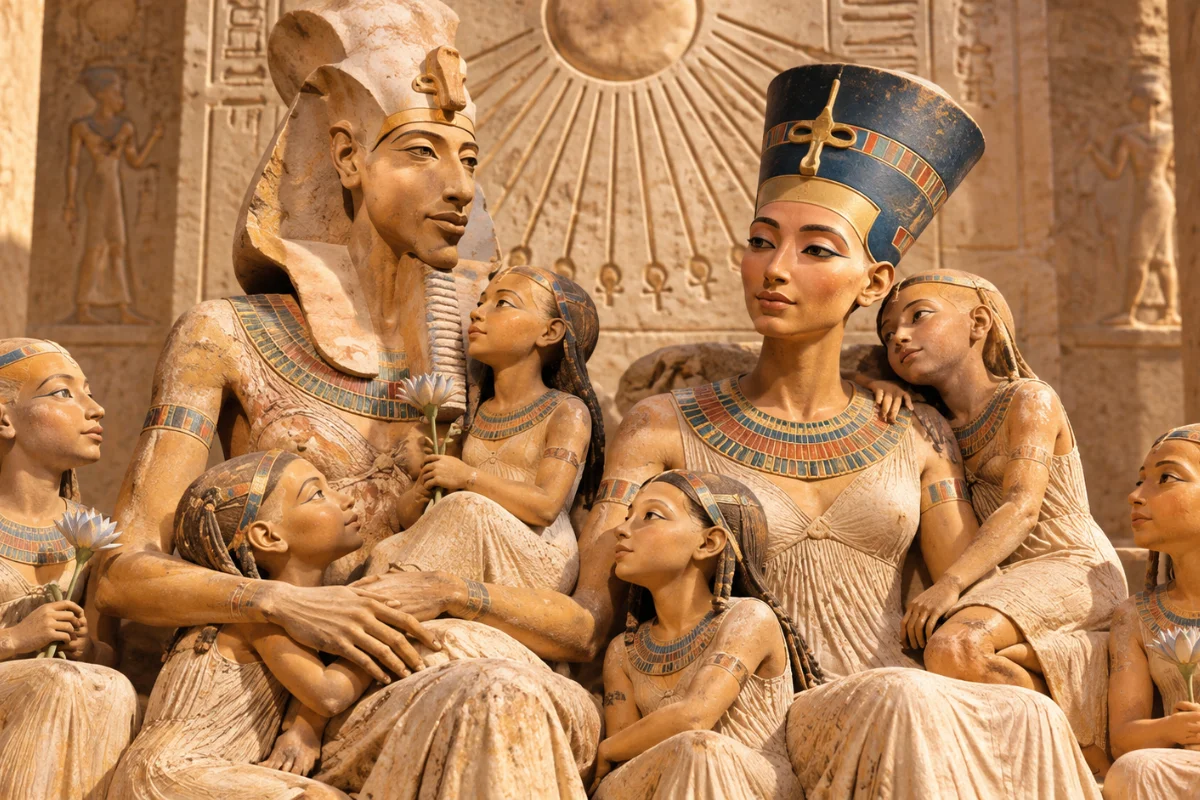
No earlier royal couple was shown with such warmth. In Amarna art, Akhenaten and Nefertiti hold hands, kiss in a chariot, and bounce their daughters on their knees. One of Nefertiti's official titles was "Sweet of Love," and others included "Lady of Grace" and "Great King's Wife, His Beloved." The Egyptologists Colleen and John Darnell call them "Egypt's golden couple."
This tenderness was also theology. In Akhenaten's religion, only the king and queen could speak directly to the Aten. Together they formed a divine trio with the sun god, like the twin creator gods Shu and Tefnut. Their love was presented as the force that kept the world turning, and ordinary people prayed to images of the royal family at home.
Is There an Akhenaten Love Letter to Nefertiti?
Many websites quote an "Akhenaten love letter to Nefertiti," but no such letter has ever been found. The romantic lines often shared online are modern inventions or loose paraphrases.
The closest real words are carved on the boundary stelae, the great inscriptions that marked the limits of Akhetaten. In them, Akhenaten swears an oath on the life of the Aten and on his own joy in "the King's Great Wife and her children." Hymns in officials' tombs at Amarna also praise Nefertiti as beautiful and pleasing to the Aten with her sweet voice.
Nefertiti's Disappearance and the End of Amarna
Nefertiti seemed to vanish from records around Akhenaten's 12th year, and some imagined she had died or fallen from favor. In 2012, an inscription from a quarry at Dayr Abu Hinnis, dated to his year 16, proved she was still alive and still his Great Royal Wife a year before he died. Many scholars now believe she ruled briefly as the female pharaoh Neferneferuaten after his death.
Within a few years, Tutankhamun's court abandoned Amarna and restored the old gods. His reliefs in the great colonnade of Luxor Temple celebrate the return of Amun's festivals. Later kings dismantled Akhenaten's temples and left him off the official king lists, calling him "the enemy." Nefertiti's tomb has never been found.
Akhenaten and Nefertiti Art
The Amarna Style
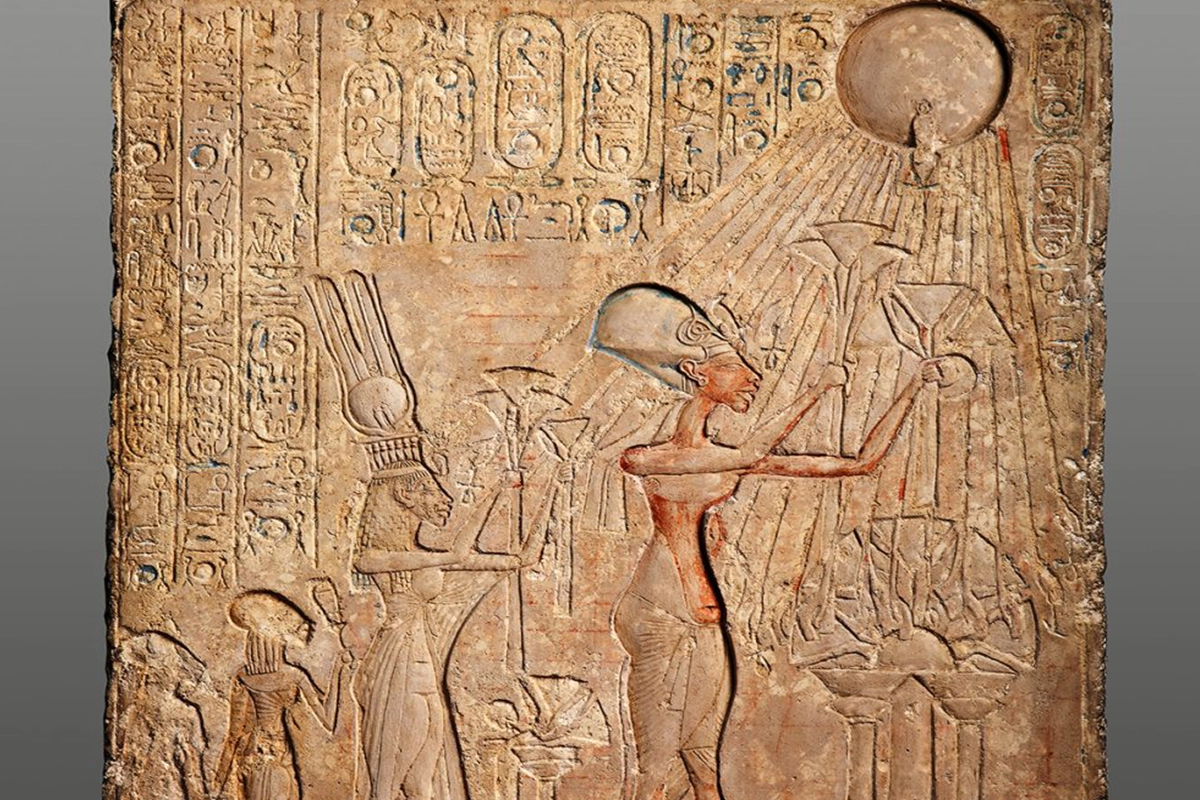
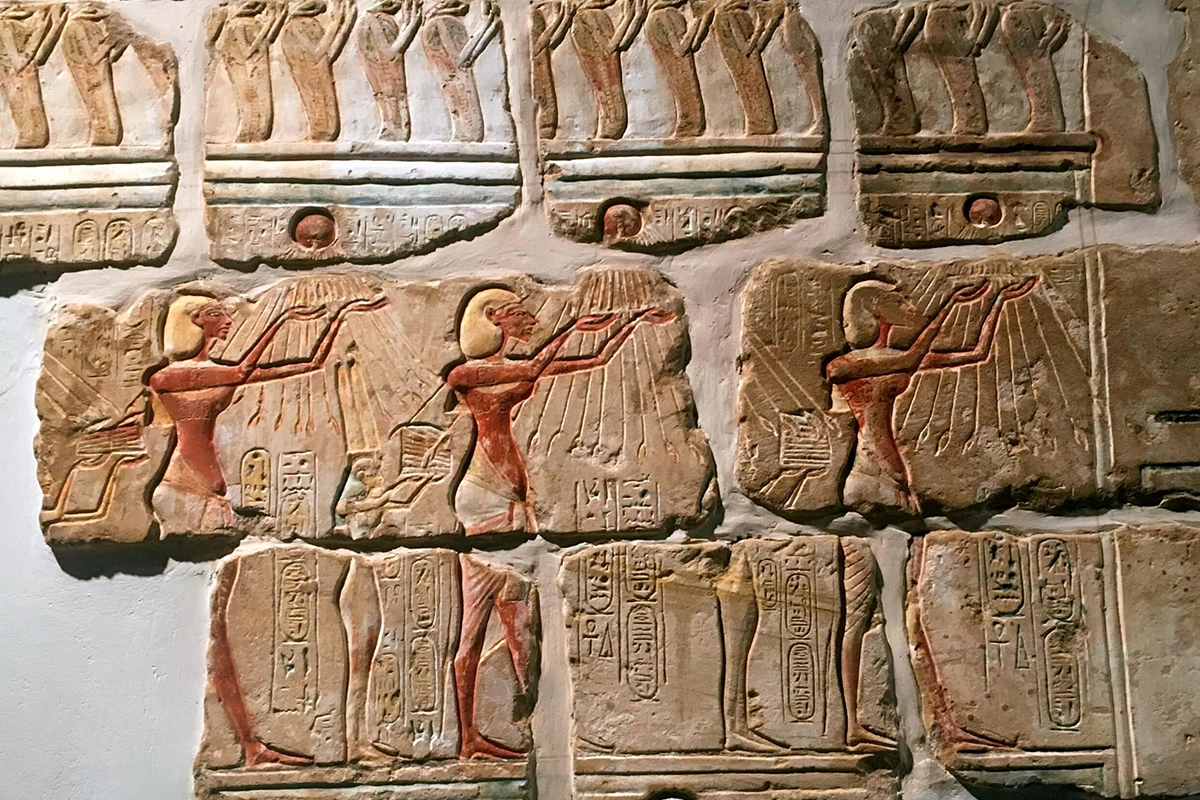
Amarna art broke centuries of rules. Figures have long faces, full lips, narrow shoulders, rounded bellies and elongated skulls. Lines curve where they once ran straight, and scenes show real moments of family life instead of rigid rituals. Most experts read the strange body shapes as a deliberate religious style, not as evidence of illness. The Aten is always shown above the royal family as a disc whose rays end in small hands, offering the ankh, the sign of life.
The House Altar: Location, Size and Meaning
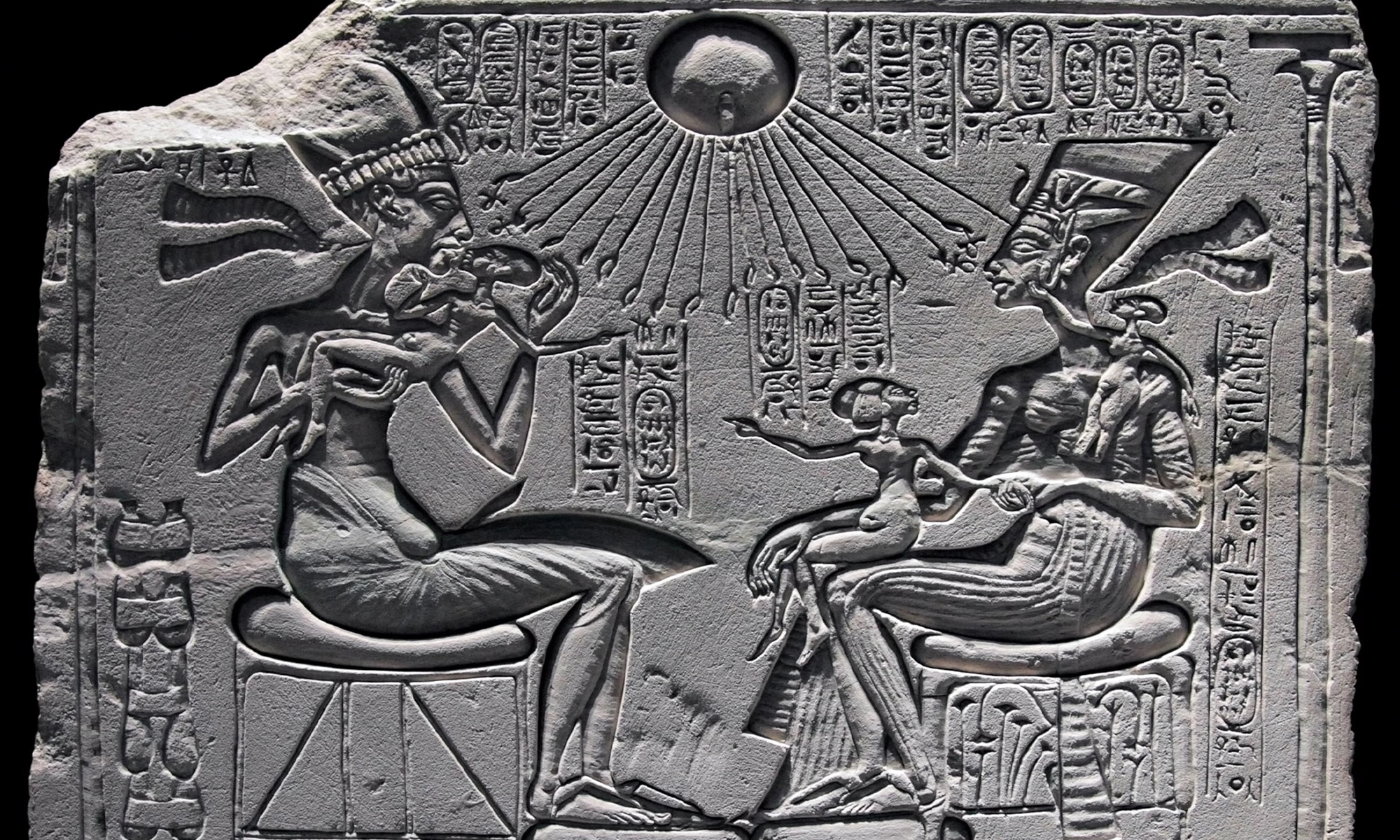
The most famous example is the house altar depicting Akhenaten, Nefertiti and three of their daughters. It is also known as the Akhenaten and his family relief.
- Location: the Neues Museum in Berlin, part of the Egyptian Museum and Papyrus Collection, inventory number ÄM 14145. It came from a house at Tell el-Amarna and was given to the museum by the collector James Simon.
- Size: 33.5 cm high, 39.5 cm wide and 3.5 cm thick, about the size of a large book.
- Material and date: limestone, carved in sunk relief, around 1351 to 1334 BC.
The scene shows Akhenaten on the left, lifting his eldest daughter, usually identified as Meritaten, to kiss her. Nefertiti sits facing him with a second daughter, Meketaten, on her lap. The youngest, Ankhesenpaaten, perches on her shoulder and plays with her earring. Above them, the Aten's rays hold ankhs to the king's and queen's faces.
What does the scene of Akhenaten, Nefertiti and three daughters mean? It was the centerpiece of a small shrine in a private home. Families did not worship the Aten directly. They prayed to the royal family, who passed on the Aten's blessings. The scene shows love and family life as sacred, with the king and queen as equals on matching thrones.
Other Family Reliefs and the Famous Bust
A similar family stela in the Egyptian Museum in Cairo shows Akhenaten handing an earring to Meritaten while two younger daughters sit on Nefertiti's lap. In the Royal Tomb at Amarna, a heartbreaking relief shows the couple mourning their daughter Meketaten, who died young.
The painted limestone bust of Nefertiti was found in 1912 in the workshop of the sculptor Thutmose at Amarna. It is now one of the most famous artworks in the world and stands in Berlin's Neues Museum. Egypt has repeatedly asked for its return.
Where to Find Their Traces in Egypt
Tell el-Amarna
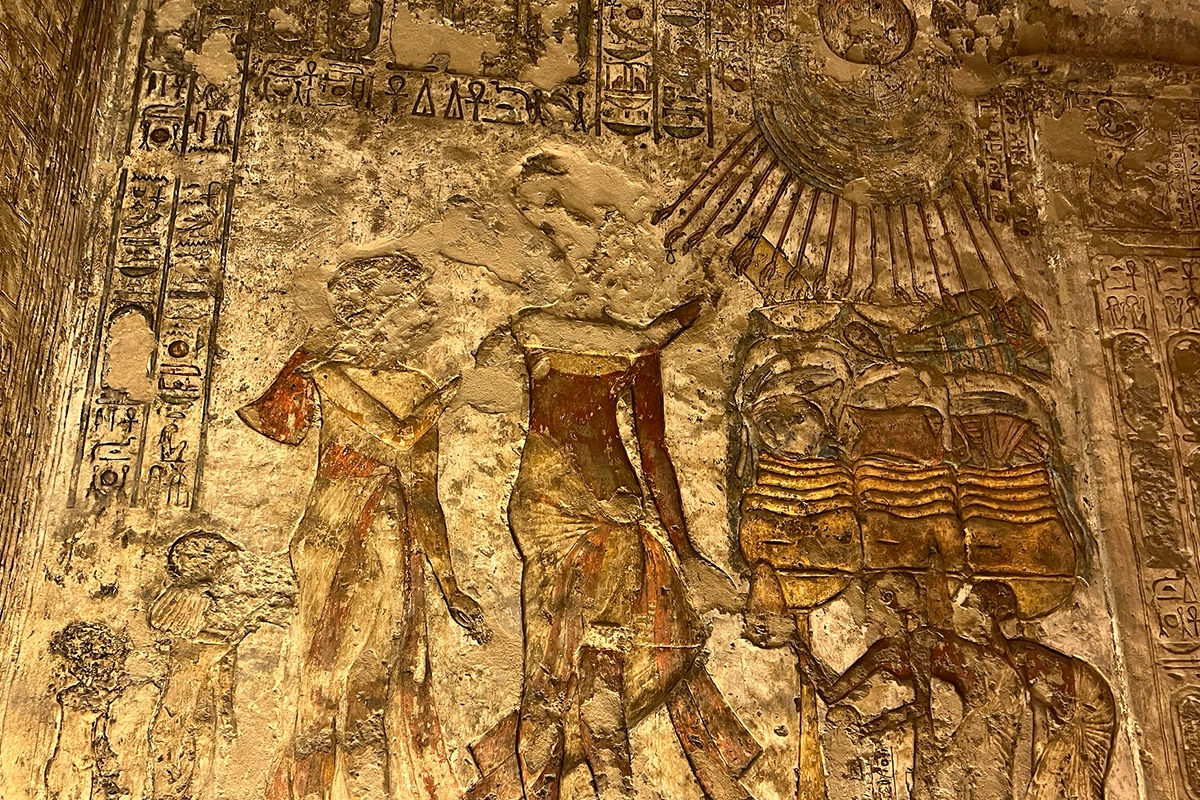
The ruins of Akhetaten lie on the east bank of the Nile, about 300 kilometers south of Cairo, near Minya. Visitors can see the outlines of the Great Aten Temple, palaces and houses, the decorated Tombs of the Nobles cut into the cliffs, the Royal Tomb, and several boundary stelae. It is far off the usual route, but some long Nile cruises from Cairo and long Nile cruise itineraries sail through Middle Egypt.
Luxor
At Karnak, Akhenaten's Aten temples were torn down and their blocks used as filling inside later pylons, where archaeologists found tens of thousands of talatat. The Luxor Museum displays a reconstructed wall of these blocks, showing the king worshipping the Aten and scenes of temple life, alongside colossal heads of Akhenaten. On the West Bank, the Valley of the Kings holds tomb KV55, whose mummy is linked to Akhenaten, and the tomb of Tutankhamun. See our guide to things to do in Luxor to plan your days.
Cairo and Giza
The Egyptian Museum in Cairo holds colossal statues of Akhenaten from Karnak, Amarna reliefs, Akhenaten's restored sarcophagus and the Amarna family stela. The Grand Egyptian Museum displays Akhenaten talatat and the complete treasure of Tutankhamun, the couple's most famous heir. Our article on the curse of King Tut tells the story of that discovery.
Abydos
In the Temple of Seti I at Abydos, the famous Abydos King List names 76 kings, but it skips straight from Amenhotep III to Horemheb. Akhenaten, Tutankhamun and Ay were deliberately left out. Their absence is one of the strongest traces of all.
Uncover the Most Incredible Love Tale Ever Told
Akhenaten and Nefertiti ruled for less than two decades, yet their revolution changed Egyptian art and religion forever. Their images of love, family and light still feel startlingly modern. Their story spans the sculptor's workshop at Amarna, the house altar in Berlin, the talatat of Luxor and the missing names at Abydos, a love story written in stone and then deliberately erased.
Under the same sun they worshipped, the Nile still carries travelers past the places where this golden couple once ruled. To follow their footsteps, explore our Egypt tour packages with a Nile cruise, our Nile cruises for couples, or a tailor made trip. You can also contact our team to start planning.