

High above the Nile Valley, a line of dark doorways runs along a pale limestone cliff. Below them, green fields and palm groves stretch to the river. From a distance, the Beni Hassan tombs look plain. Inside, the walls are crowded with painted wrestlers, hunters, weavers, cattle, birds, and a procession of foreign visitors.
Beni Hassan lies in Middle Egypt, south of the city of Minya. Its tombs belonged largely to Middle Kingdom provincial officials rather than kings, and their paintings are the main reason to come. Beni Hassan is not just a collection of Middle Kingdom tombs. Its walls preserve one of ancient Egypt's richest visual records of work, sport, wildlife, foreign visitors and provincial life.
What Are the Beni Hassan Tombs?
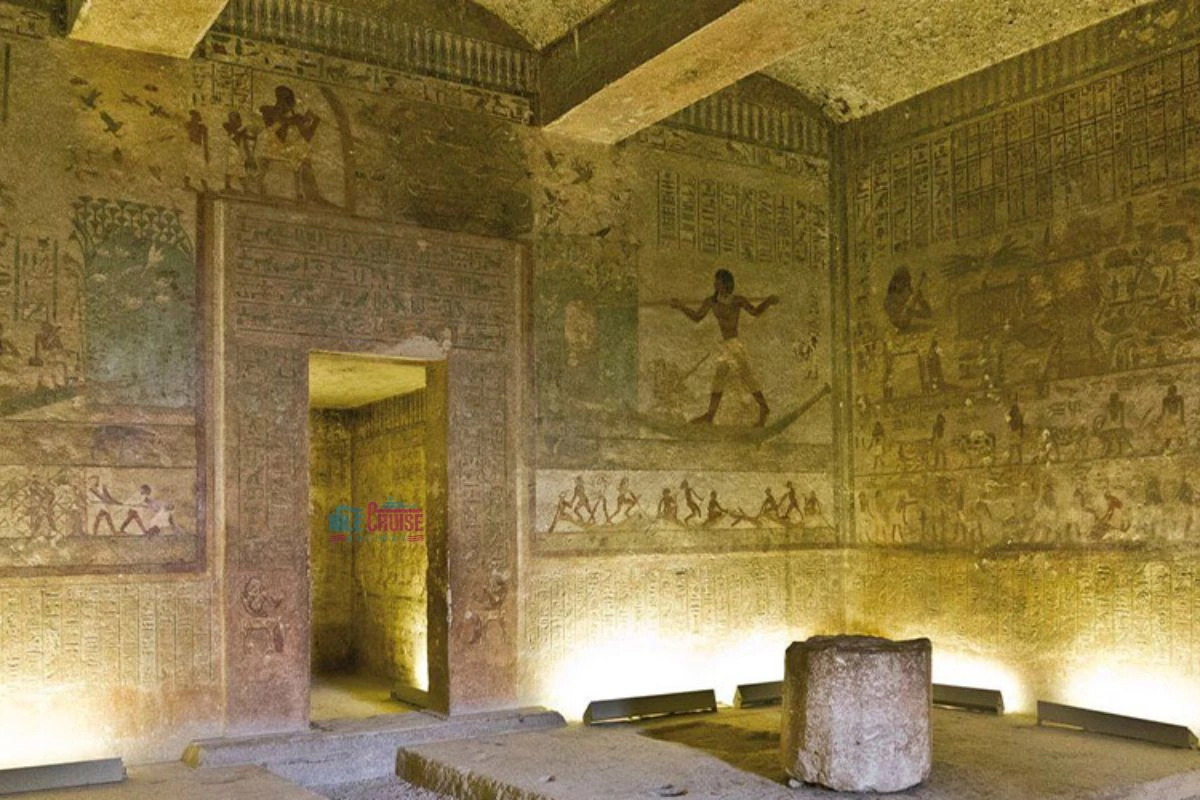
The Beni Hassan rock-cut tombs sit on the east bank of the Nile, about 20 kilometers south of Minya. The upper cemetery contains 39 tombs cut into the cliff, around a dozen of them decorated with painted scenes. The major decorated tombs date largely to the Middle Kingdom, particularly the Eleventh and Twelfth Dynasties, roughly 4,000 years ago.
Many tomb owners were local governors, often called nomarchs, and members of the provincial elite. Several governed the Oryx nome, the sixteenth administrative province of Upper Egypt, named after the desert antelope that served as its emblem.
Why Governors Built Tombs Here
During parts of the Middle Kingdom, provincial governors held real power. They administered land, collected taxes, managed labor and commanded local forces on behalf of the king. Their tombs expressed that status. A grand chapel in the cliff proclaimed the family's importance to everyone in the valley below.
Tombs were also part of preparing for eternity, explained further in our guide to Egyptian burial beliefs. From the cliff, their chapels looked out over the fields they had governed.
Why Beni Hassan Matters
Royal cemeteries tell the story of kings. Beni Hassan tells the story of the provincial elite, which makes it different from the royal tombs of Luxor and closer in spirit to the Tombs of the Nobles in Luxor.
The paintings are unusually detailed. They show daily life, military campaigns, sport, animals, crafts and long biographical inscriptions, all set within carefully carved rock-cut architecture. Above all, Beni Hassan is valuable because it preserves how powerful provincial Egyptians wanted their world to be remembered.
Which Beni Hassan Tombs Should You See?
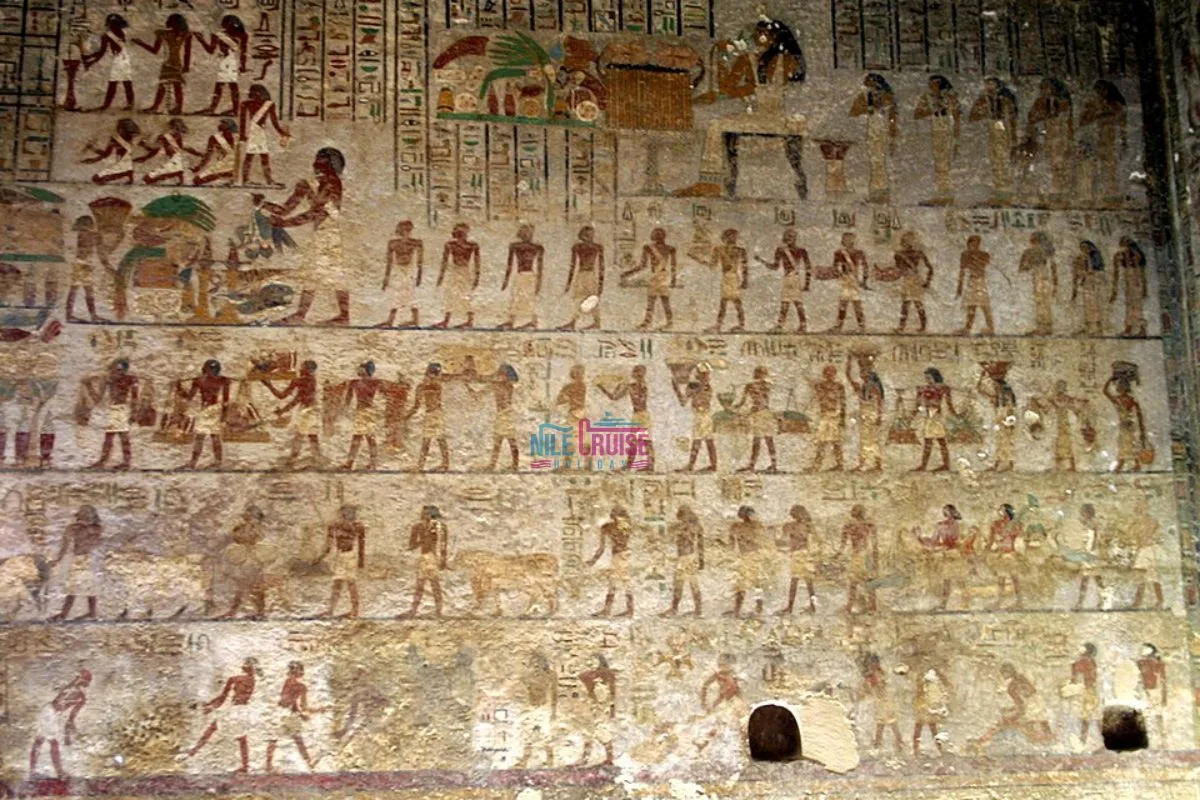
Khnumhotep II in Tomb 3
The tomb of Khnumhotep II is among the most celebrated in Egypt. Its owner served under Senusret II, and a long biographical inscription of more than two hundred columns of text records his family and career. The walls show agriculture, hunting and fowling in the marshes.
Its most famous scene is a procession of West Asian visitors, often described as an Asiatic group, arriving with animals and goods. Fifteen figures are shown, while the accompanying text gives a total of 37. The scene is historically interpreted as foreign visitors bringing goods, including eye paint, and it offers rare visual evidence of contact between Egypt and the Near East.
Amenemhat in Tomb 2
Amenemhat governed the Oryx nome for about 25 years under Senusret I. His tomb, entered through a columned portico, is one of the most complete at the site.
Its walls show agriculture, crafts, workshops, fishing, fowling and daily-life scenes, beneath a painted ceiling that imitates beams and matting. These scenes reveal both the working world of the province and how Amenemhat wished to be seen, as the manager of a well-ordered and productive estate.
Baqet III in Tomb 15
The tomb of Baqet III is famous above all for its wrestling scenes. One wall carries a long cycle of around 220 pairs of wrestlers. In each pair, one figure is painted in a lighter red and the other in dark brown, so the viewer can follow every limb.
The sequence runs through hold after hold, throw after throw. Modern observers have sometimes described it as an ancient wrestling manual, but the original purpose of the full sequence is more complex. Hunting, crafts, animals and a fortress siege also appear on other walls.
Khety in Tomb 17
Khety belongs to the earlier Middle Kingdom. His chapel was originally supported by columns with lotus-flower capitals, though only some survive intact. The walls show desert hunting, fishing, crafts, games, music, military training and around 122 further pairs of wrestlers, along with an assault on a fortress. Some scenes are damaged or faded, so a guide helps pick out what remains.
How to Read the Paintings at Beni Hassan
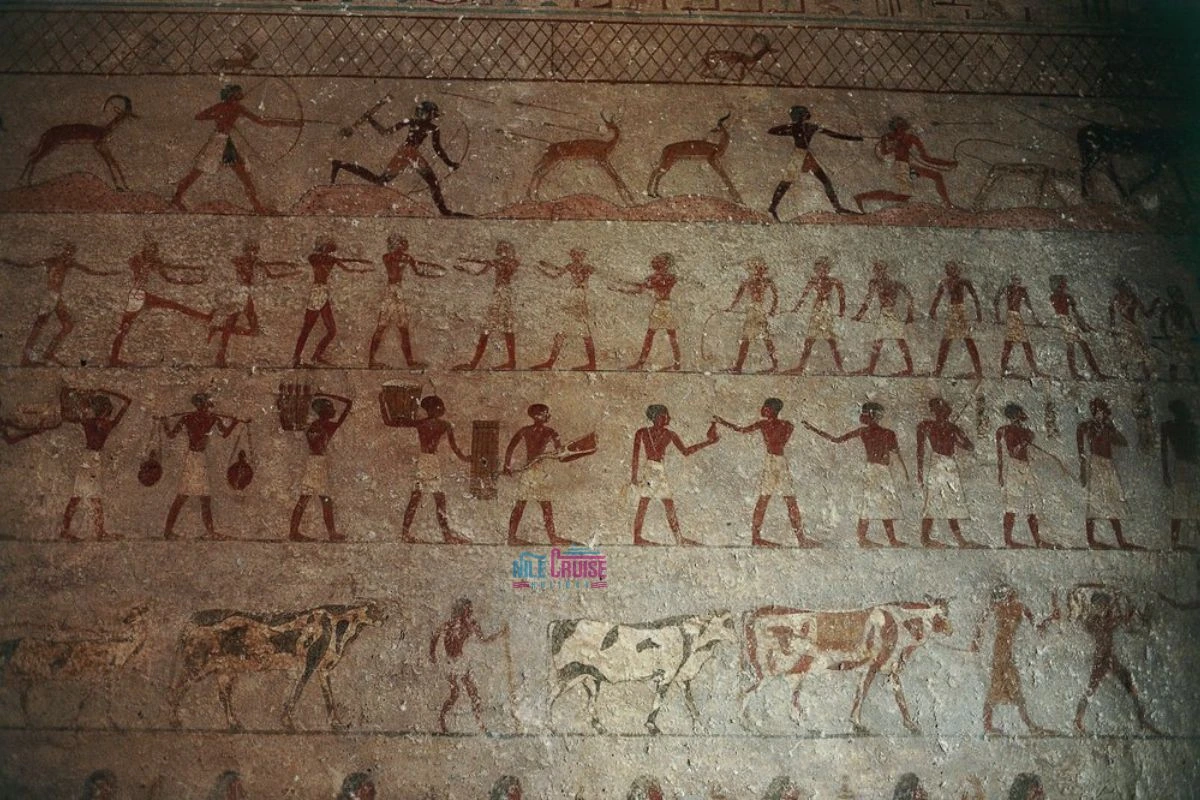
Wrestling and Combat
The Beni Hassan wrestling scenes are famous for their variety and close observation of movement. Pairs of figures grip, twist, lift and fall in dozens of different positions.
The contrasting skin tones are the key to reading them. By tracking the red figure and the dark figure separately, visitors can see exactly which arm holds which leg. Many Egyptologists see the scenes as connected to physical training and military preparation rather than sport alone, especially since siege and battle scenes appear nearby.
Work, Farming and Crafts
The walls show farmers plowing and harvesting, herders driving cattle, carpenters shaping wood, women spinning and weaving, workers building boats and men fishing in the marshes. Scribes record harvests and count livestock, and bakers and brewers prepare the kind of ancient Egyptian food that fed the estate.
These scenes were not simply documentary snapshots. Tomb decoration also expressed abundance, order, wealth, and status, and it helped provide for the owner in the afterlife.
Animals and the Natural World
Beni Hassan is unusually valuable for understanding how Middle Kingdom artists observed nature. Desert hunting scenes show wild animals running across the hills. Domestic livestock appear in herds, and the marsh scenes are crowded with birds and fish.
Artists paid close attention to how animals move. Legs stretch in mid-stride, birds lift from papyrus thickets, and herds bunch together as they are driven.
Foreign Visitors
The procession in the tomb of Khnumhotep II is the best example. Visitors can safely observe several details: clothing with colorful patterned textiles that differ from Egyptian linen, distinctive hairstyles and beards, animals carrying goods, and the group moving forward under a leader.
The scene is evidence of Egypt's connections beyond the Nile Valley. Attempts to link it to biblical figures are unsupported. What the wall shows is clear enough: a provincial governor recorded foreign visitors arriving at his court as a mark of his importance.
How to Visit Beni Hassan from Minya
Getting There
Beni Hassan lies roughly 20 kilometers south of Minya, on the east bank of the Nile. A private vehicle or guided excursion is generally the easiest option, since public transport to the site is limited. The visit fits naturally into a Middle Egypt itinerary, and long cruises such as the 14-day Aswan to Cairo sailing include it.
How Long Do You Need?
Around two to three hours suits most visitors. That allows time for the ascent, the major open tombs, a careful look at the paintings, explanation from a guide and the views over the valley. Which tombs are open on a given day can vary. The 12-day Cairo to Luxor itinerary shows how Beni Hassan fits into a wider day.
Is the Climb Difficult?
The tombs sit high in the cliff, reached by stairs and an uphill path. The climb is manageable for most reasonably fit visitors, but the sun is exposed and shade is limited. Sturdy footwear and water make it more comfortable. Travelers with limited mobility may find the ascent challenging and should plan accordingly. Guests on long cruises from Cairo can ask in advance how the excursion is organized and how much walking it involves.
What to Know Before You Go
Access to individual tombs can change, and photography rules, opening hours, and ticket prices should all be checked locally before visiting. The painted plaster is fragile and must never be touched. Heat builds quickly, so a morning visit is usually more comfortable, and good walking shoes are essential.
At Beni Hassan, access to the paintings matters more than rushing to tick off every tomb number. Spending time with three or four tombs properly is far more rewarding than treating the necropolis as a checklist. A knowledgeable guide makes the difference here, and the case for private vs. group touring is strongest at sites like this.
Visit Beni Hassan on a Long Nile Cruise

Standard Luxor to Aswan cruises focus on Upper Egypt and do not normally reach Beni Hassan. That is true of most standard Luxor sailings. Selected long Nile cruises through Middle Egypt may include it.
A standard Nile cruise is dominated by Egypt's royal monuments. A long Nile cruise can also reveal the provincial world preserved at Beni Hassan. Middle Egypt becomes part of a continuous journey, with fewer isolated hotel and transit arrangements and the same Egyptologist throughout. Depending on the itinerary, Beni Hassan can be paired with Akhenaten's capital at Tell el-Amarna, Tuna el-Gebel, Abydos or Dendera.
Not every long cruise visits all of these. The long Nile cruise guide explains the wider route, and the temple of Dendera is a common later stop.
Current long Nile cruise itineraries show which programs include Beni Hassan.
Southbound travelers can compare the 15-day Cairo to Aswan route, which reaches Middle Egypt early in the trip.
NCH specializes in planning Middle Egypt properly, from matching the right route to arranging private Egyptologists for harder-to-reach sites. Travelers interested in deeper Egyptology can start with a tailor-made Middle Egypt journey.


