Every year travelers with limited mobility sail between Luxor and Aswan, stand before the columns of Karnak and watch the sun drop behind the West Bank from a deck chair. It takes more planning than most holidays, because many nile cruises and some temples were never built with wheelchairs in mind, but the right boat and the right ground team make it entirely possible.
The river itself is the easy part. It moves slowly, the sailing is smooth, and for thousands of years it has carried travelers past the same golden temples without asking anything of them but time.
This guide explains which ships work for wheelchair users and why, how accessible each major temple is, and how to plan flights, transfers, timing, and equipment for a wheelchair accessible Nile cruise.
Can Wheelchair Users Take a Nile Cruise?
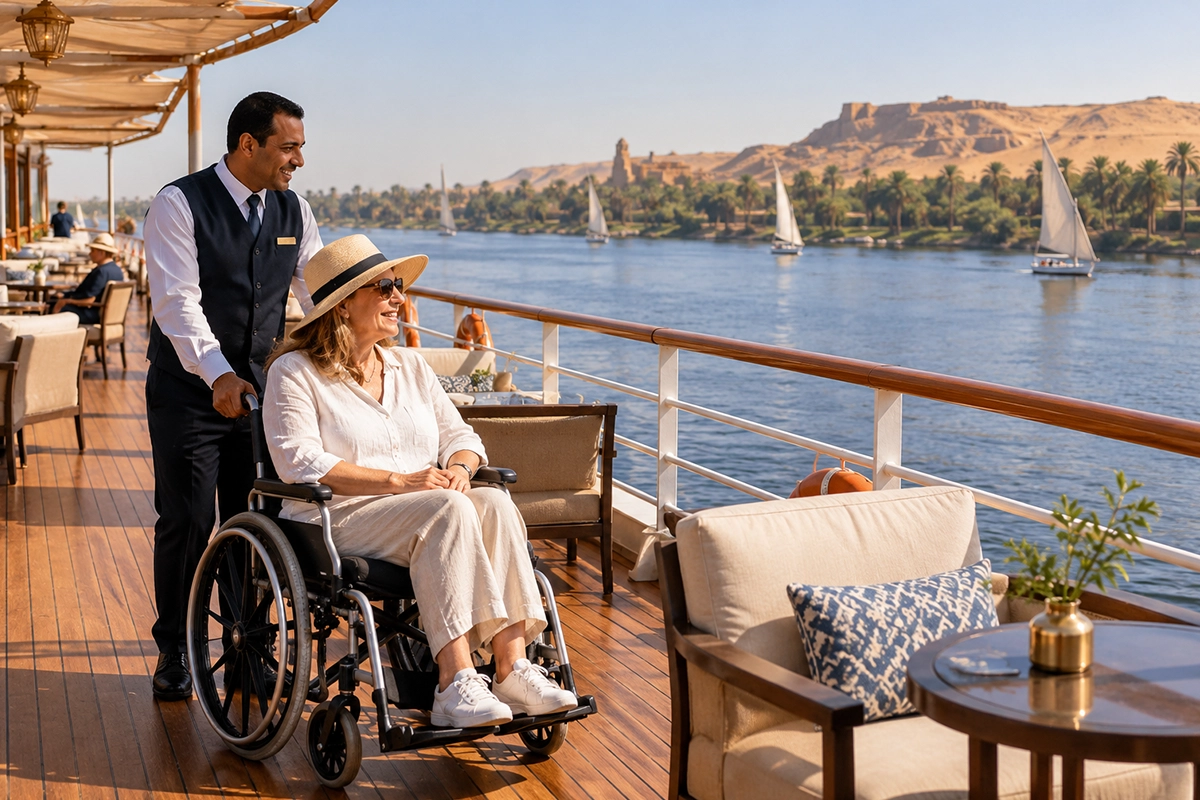
A wheelchair accessible Nile cruise is very possible, but not on every ship. Most Nile vessels are small floating hotels carrying roughly 50 to 150 passengers, and many older ones have no lift, narrow cabin doors and steps between decks. A handful of ships have been designed or refitted with lifts, wider doors and accessible cabins, and those are the ones to book.
So the question is never "Can I cruise?" but "Which ship, and which cabin?" Get those two answers right and the rest falls into place.
Common Barriers on Board
Knowing the obstacles helps you ask the right questions:
- No lift. On many standard ships, the restaurant, lobby, cabins and sun deck sit on different decks linked only by stairs.
- Narrow doors. Cabin and bathroom doors on older ships are often narrower than a standard wheelchair needs.
- High thresholds. Bathrooms frequently have a raised step at the door and a shower tray rather than a level floor.
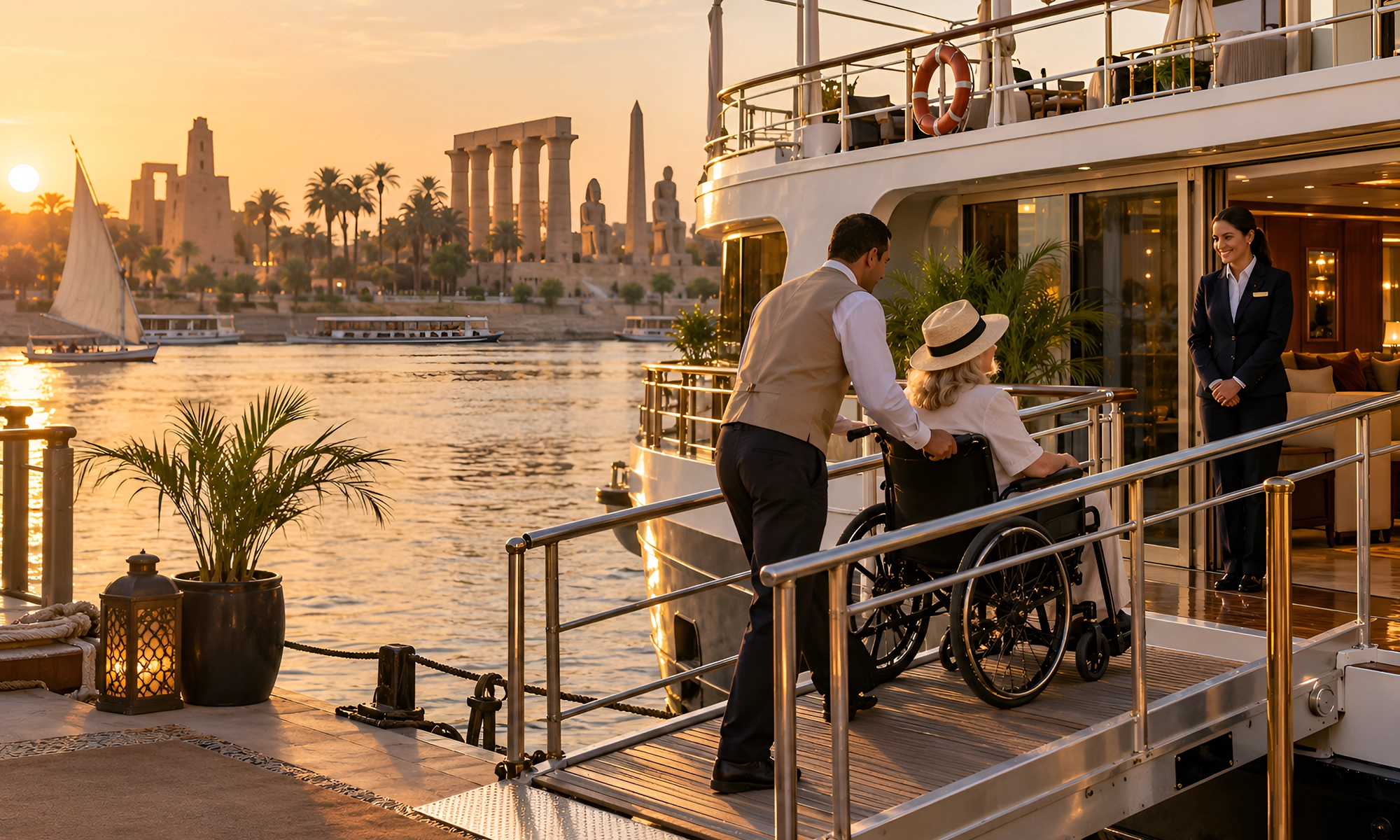
- Changing gangways. The slope of the gangway changes with the water level, so boarding can be gentle one day and steep the next.
- Ships moored side by side. In busy months, boats in Luxor and Aswan often dock side by side. Passengers on an outer ship may walk through the lobbies of two or three other ships to reach the shore, often over small steps.
What an Accessible Ship Looks Like
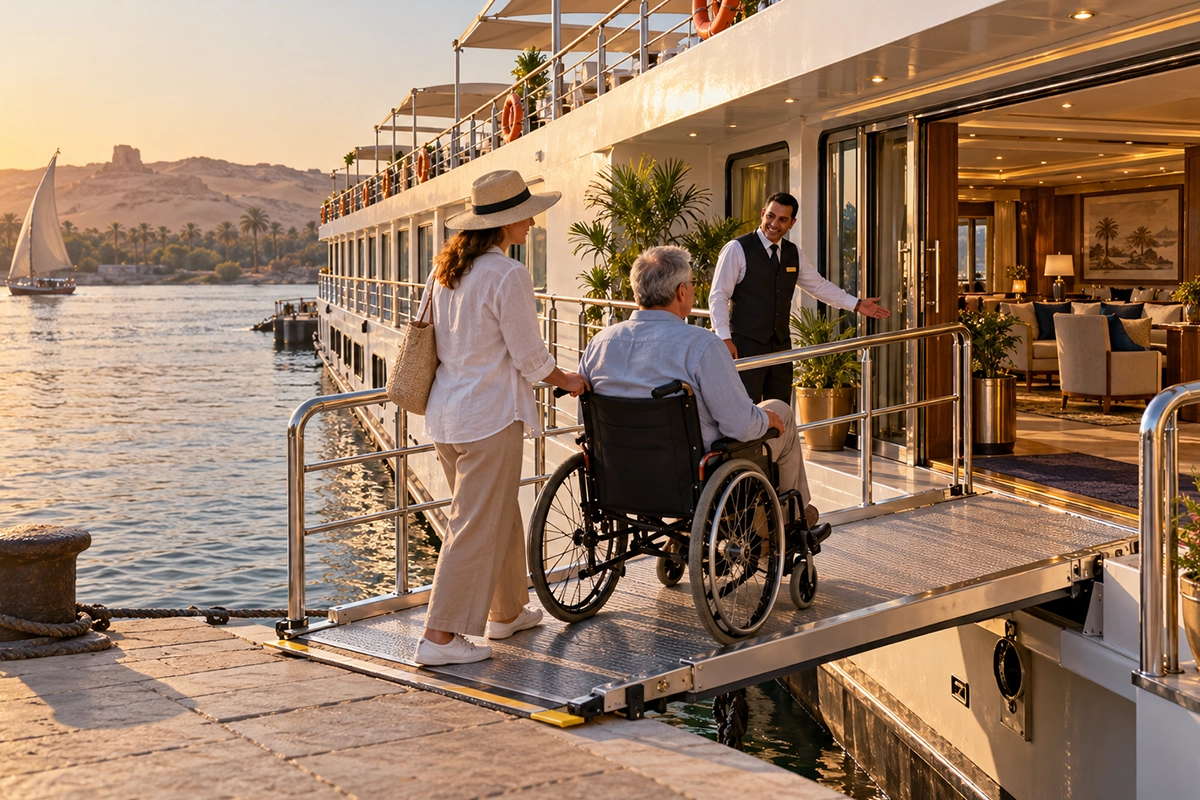
A genuinely accessible Nile ship has a lift serving the main passenger decks, at least one cabin with a wide door, turning space beside the bed and a roll-in shower, step-free routes to the restaurant and lounge, and a crew trained to help with boarding. Some operators also lay wooden boarding ramps or ask the port to berth the ship directly against the shore when possible.
Accessible cabins are scarce, usually only a few per ship, and they are often priced the same as a standard double. Book them months ahead, especially for winter departures.
An Example: MS Acamar
The MS Acamar is one ship often recommended for travelers with limited mobility. It has a working lift between its main passenger decks and a doctor on call, and sails 3, 4 and 7 night routes between Luxor and Aswan. Specialist operators also describe dedicated wheelchair cabins and boarding ramps on board, but cabin layouts and availability change, so always confirm the exact cabin before paying. You can compare other ships in our ultra deluxe Nile cruises and luxury Nile cruises collections.
Choosing the Right Boat for Limited Mobility
Larger Ships Versus Small Ones
Larger, newer ships are more likely to have lifts, wider corridors and a bigger crew to help. They are busier, with more passengers on the gangways at excursion time, but for most wheelchair users they are the practical choice. Smaller boutique ships feel calmer, yet many of them squeeze cabins into narrow hulls with no room for a lift.
Dahabiyas and Feluccas
A dahabiya is a traditional sailing boat with a handful of cabins. It is beautiful and quiet, but most have steep internal stairs, compact bathrooms and moorings on open riverbanks with no jetty. Our guide to dahabiya versus Nile cruise explains the differences in detail.
A felucca is a small open sailboat with no ramp and no toilet. A short sunset felucca ride in Aswan is still possible if the crew can help you from the dock into the boat, but overnight felucca trips are not suitable.
Questions to Ask Before You Book
Send these questions in writing and keep the answers:
- Does the ship have a working lift, and which decks does it serve?
- How wide are the cabin and bathroom doors?
- Is there a roll-in shower with grab rails, or a shower tray with a step?
- Is the restaurant step-free from the lift?
- How will I board when the ship is moored behind other boats?
- Can the crew help carry a manual chair on the gangway?
A company that answers clearly, rather than simply saying "accessible", is the one to trust. Our advice on how to book a Nile cruise and why to use a travel agent covers the wider booking process.
Wheelchair Access at the Temples and Tombs
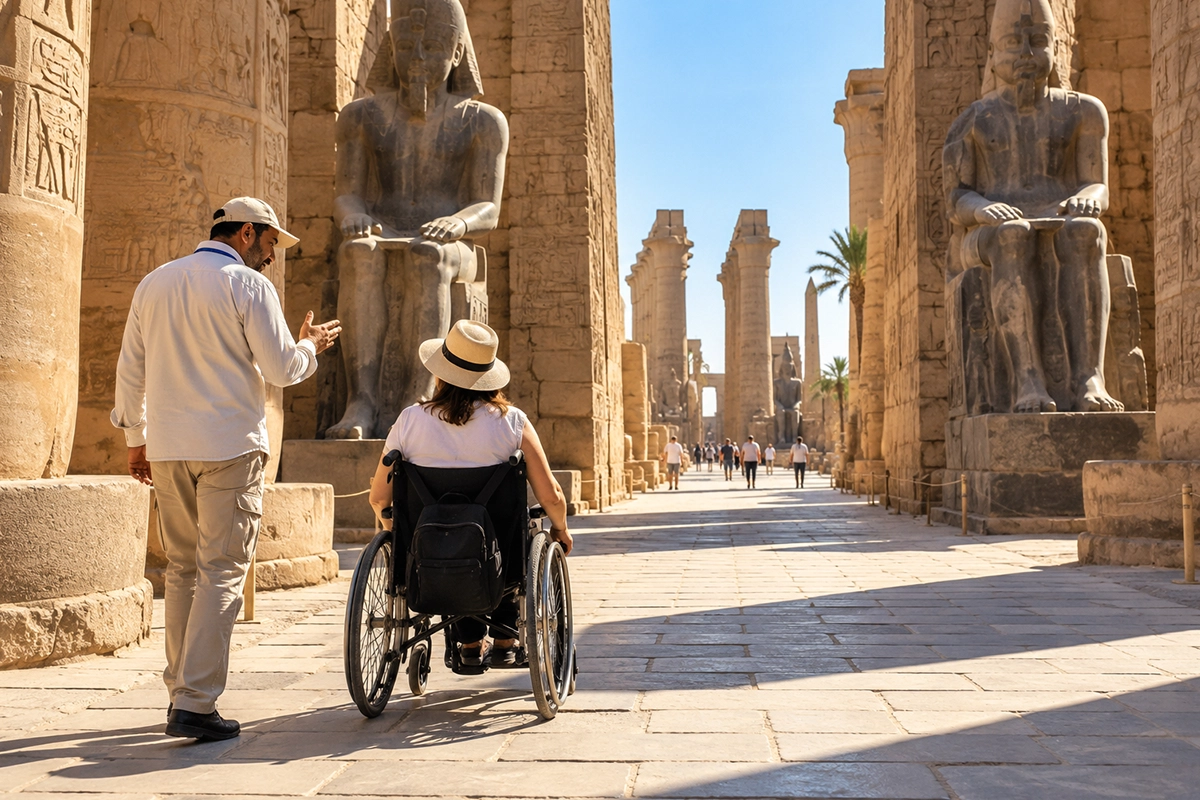
Most of the great sites on a Nile cruise are manageable in a wheelchair with some help. Ancient stone floors are uneven, and a few places involve stairs, so a private guide who knows the smoothest routes makes a real difference.
Karnak and Luxor Temple
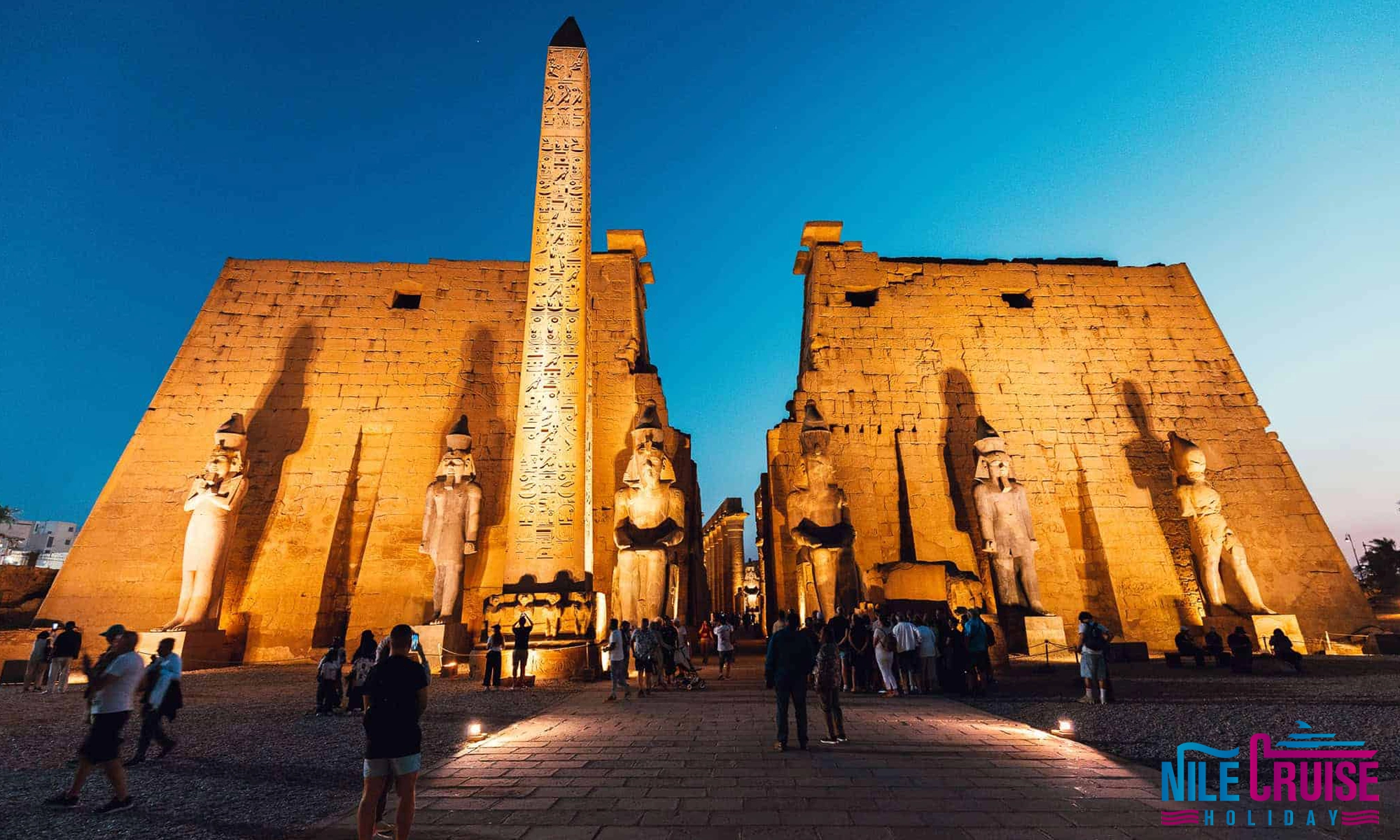
Karnak Temple is largely flat, with paved paths, wooden walkways and ramps through the main areas, including the Great Hypostyle Hall with its 134 columns. Some inner courts have rough paving and small steps. Luxor Temple is mostly accessible at ground level and looks especially fine when lit at night.
Valley of the Kings and Hatshepsut Temple
At the Valley of the Kings, electric trams carry visitors from the visitor center to the tomb area. The tombs themselves are cut into the rock and reached by sloping corridors and steps, so entering one usually means being helped down or viewing from the entrance. Your guide can choose the tombs open that day with the gentlest access.
The Temple of Hatshepsut at Deir el-Bahari has a long ramp up to its terraces, and electric carts run from the gate to the temple. It is one of the more wheelchair-friendly sites in Luxor.
Edfu and Kom Ombo
At Edfu, visitors usually ride horse carriages from the dock to the temple. Ask your operator for a car or van instead. Edfu Temple has a large, mostly level forecourt, with a few thresholds inside. Kom Ombo Temple sits right beside the river landing on mostly level ground, which makes it one of the easiest stops of the cruise.
Aswan and Philae
Philae Temple stands on an island and is reached by small motorboats with no ramp. Boatmen and your guide will lift the chair and help you aboard, which some travelers find easy and others prefer to skip. The High Dam and the Unfinished Obelisk are simpler drive-up visits. Our list of things to do in Aswan suggests more options.
Abu Simbel
The Abu Simbel temples have a paved approach from the visitor center to the facades, which are fully viewable from a wheelchair. Entering the inner halls involves some steps. The trip from Aswan is long, about three hours each way by road, so plan a rest afterwards.
Adding Cairo and Giza
Many travelers begin in Cairo. The Giza Pyramids can be enjoyed from paved viewing areas, with a vehicle taking you close to the monuments across the sand. The passages inside the pyramids are steep and narrow and not suitable for wheelchairs. The Grand Egyptian Museum is modern, with lifts and ramps, and is the most accessible major museum in Egypt. See our Cairo and Nile cruise tours for combined trips.
Planning an Accessible Nile Cruise Holiday
Getting to Luxor and Aswan
Fly rather than take the train. Egyptian trains have narrow corridors and steps at the doors, while domestic flights from Cairo take about an hour and airlines provide wheelchair assistance if you request it when booking. Our Cairo to Luxor flight guide and Cairo to Aswan flight guide explain the options.
Transfers and Guides
Public transport and taxis in Egypt are rarely wheelchair friendly. Book private transfers in an adapted, air-conditioned van with a ramp or lift, and share your chair's dimensions and weight in advance. A private Egyptologist guide can set the pace, choose smooth routes and plan rest and restroom stops. Our comparison of private and group tours shows why private touring suits travelers with limited mobility.
Best Time to Go
From May to September, daytime temperatures in Upper Egypt regularly pass 35°C, and pushing a chair across stone courtyards in that heat is hard work for everyone. October to April is far more comfortable, with November to March the most popular window. Read our guide to the best time to cruise the Nile or browse November Nile cruises.
Your Wheelchair, Equipment and Insurance
A lightweight, folding manual chair is the most practical choice, because crew and guides can lift it on gangways and boats. Power chairs and scooters are heavy and hard to carry onto small boats, so check airline battery rules early if you bring one. Pack a small repair kit with spare inner tubes or a puncture kit.
Choose travel insurance for Egypt that covers pre-existing conditions, medical evacuation and damage to mobility equipment. Our Nile cruise packing list covers the rest of your bag, and a tailor-made itinerary lets you build in rest days.
Other Accessibility Needs
Travelers who are blind or have low vision can ask a private guide for detailed descriptions and, where permitted, touch-friendly experiences. Deaf and hard of hearing travelers can ask guides to face them, repeat key points and write down times. Older travelers with limited stamina will find more ideas in our Nile cruises for seniors page and our guide to Egypt tours for seniors.
Enjoy the Most Enjoyable and Smooth Wheelchair Accessible Nile Cruises
A wheelchair accessible Nile cruise asks for careful choices: a ship with a lift and a proper accessible cabin, private transfers, a patient guide and a cooler month to travel. Make those choices, and almost every highlight of the classic route, from Karnak to Kom Ombo, is within reach.
The Nile has always welcomed travelers at its own unhurried pace, and that pace suits anyone who needs a little more time. When you are ready, browse our Luxor and Aswan Nile cruises or contact us and tell us exactly what you need, so we can match you with the right ship.