
Hathor is often introduced as Egypt's goddess of love, but that label barely captures her. She could appear as a mother, musician, celestial cow, protector of kings, guardian of the dead, and even the fierce Eye of Ra.
She is also one of the easiest deities to spot. At Dendera, her main cult center north of Luxor, her calm, cow-eared face looks down from the tops of columns, and her figure, crowned with curved horns and a sun disk, repeats across wall after wall.
Calling Hathor only the "goddess of love" misses much of her identity. This guide explains who the Hathor goddess was, why she could be both nurturing and dangerous, and how to recognize her in a temple.
Who Was Hathor?
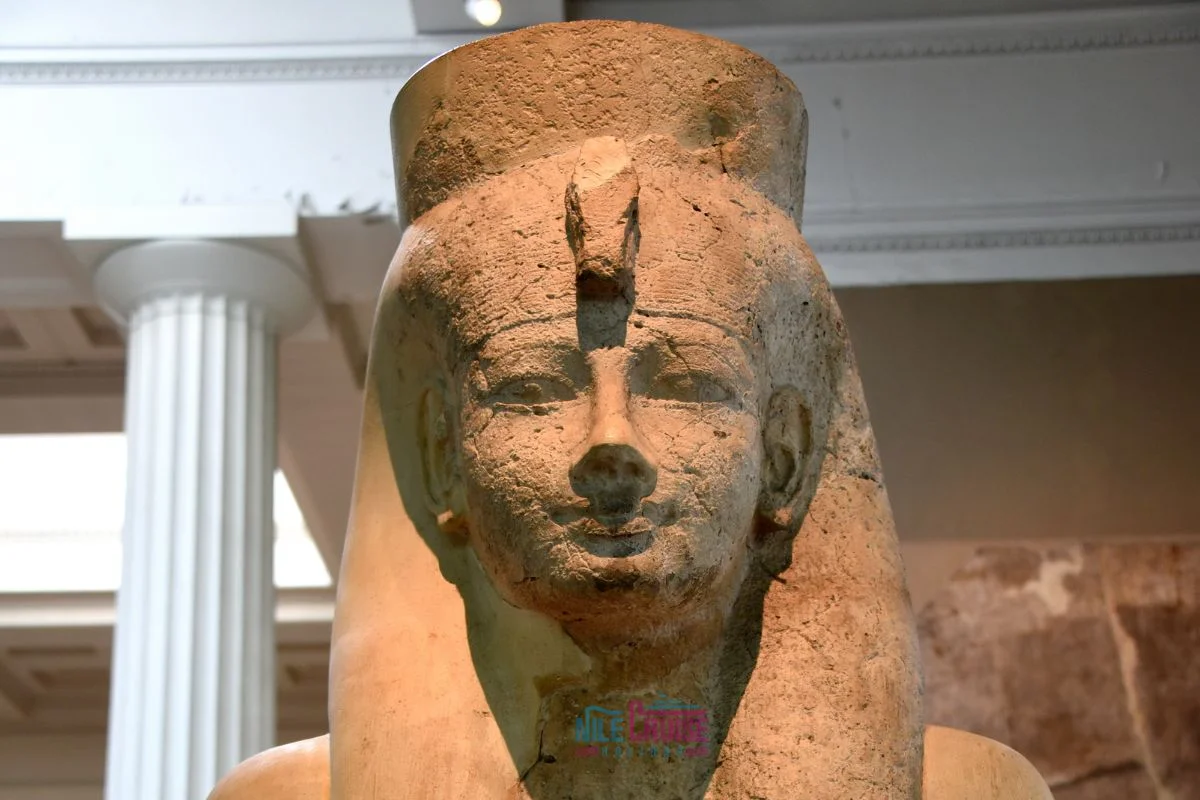
Hathor was one of the major goddesses of ancient Egypt, worshipped across roughly three thousand years, from the Old Kingdom to the Roman period. Her cult was strongest at Dendera, but Egyptians honored her throughout the country. She appears in many of the best temples on a Nile cruise.
Among her roles were love, music, joy, motherhood, and the sky. She also carried solar, royal, and funerary roles, and her identity varied with the period, the place, and the religious setting.
|
Fact |
Hathor |
|
Main Roles |
Love, music, joy, motherhood, and sky |
|
Major Cult Center |
Dendera |
|
Common Form |
Woman with cow horns and solar disk |
|
Animal Form |
Cow |
|
Solar Role |
Eye of Ra |
|
Dendera Consort |
Horus of Edfu |
|
Dendera Child |
Ihy |
|
Key Symbols |
Cow horns, sun disk, sistrum, and menat |
These are simplified headline associations, not her only roles. Hathor's Egyptian name is commonly interpreted as "House of Horus." The name reflects her deep connection with Horus and with kingship, since the king was identified with Horus. It should not be used to force one single family relationship, because Egyptian traditions described their bond in different ways.
What Was Hathor the Goddess Of?
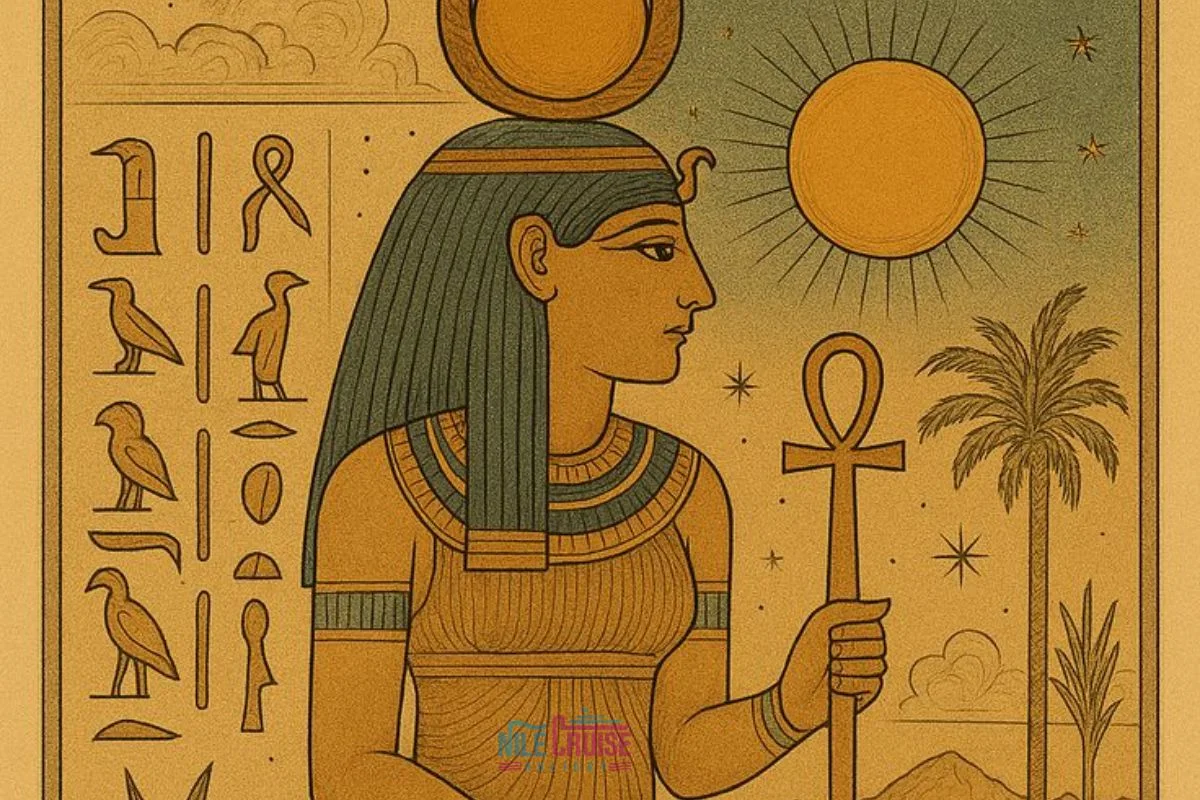
Love, Beauty and Sexuality
Hathor was commonly associated with love, attraction, beauty and sexuality, and with fertility more broadly.
This was not a modern romance goddess, though. Her sexuality belonged to a wider idea of creation, renewal and the continuation of life. Greek writers later compared her with Aphrodite, but that was a later cultural comparison, not an equivalence.
Music, Dance and Joy
Music, dance and celebration were among Hathor's most distinctive domains. Her festivals included singing, rattling instruments, dancing and, in some traditions, ritual drunkenness, and she was honored as the "Lady of Drunkenness."
In temple terms, this joy had religious significance. Music and festivity were believed to please and pacify the goddess, and through her to keep the world in balance.
Motherhood and Royal Protection
As a mother goddess, Hathor could take the form of a cow nourishing the king, an image of divine milk and protection. Kings shown being suckled by her gained legitimacy and divine support.
In some traditions, she was the mother of Horus; in others, his consort or divine counterpart, so no single relationship applies everywhere. She was also a sky goddess, sometimes imagined as a great celestial cow.
Hathor's Fierce Side as the Eye of Ra

Hathor could also act as the Eye of Ra, the sun god's female counterpart and agent. The Eye represented solar power and protection, a force that defended Ra and the ordered world. That same force could be destructive toward enemies.
For Egyptians, protective and dangerous were not contradictory qualities. A goddess powerful enough to protect was also powerful enough to destroy.
One well-known myth, often called the Destruction of Mankind, tells of a solar goddess sent against rebellious humanity. Ra later stops the slaughter by tricking her with beer dyed red to look like blood, and she is pacified. In the story, the raging goddess and the calmed one are closely linked with Hathor and Sekhmet.
Was Hathor the Same as Sekhmet?
There is no simple yes or no. Both goddesses could represent the fierce power of the Eye of Ra, and some traditions connect them so closely that one seems to become the other. Yet Sekhmet, the lioness goddess associated with Memphis, kept her own cult, imagery, and identity, and so did Hathor.
Hathor and Sekhmet could overlap in Eye-of-Ra traditions, but they remained distinct goddesses in many cult and temple contexts. Egyptian deities could overlap in role without becoming permanently identical.
Hathor Symbols and How to Recognize Her
Cow Horns and the Solar Disk
The most recognizable Hathor goddess symbol is her headdress: a pair of curved cow horns, shaped like a lyre, holding a red or gold solar disk between them.
That headdress is not proof on its own. In later periods, Isis and other goddesses often wore the same horns and disk, so the hieroglyphs beside the figure, the temple setting, and her other attributes are the safest way to confirm who she is.
Cow Form and Hathoric Face
Hathor could appear fully as a cow, sometimes with a sun disk between her horns and a collar around her neck.
Her other unmistakable image is the Hathoric face: a woman's face shown from the front, which is rare in Egyptian art, with broad cow ears and a heavy, curling wig. It appears on column capitals, sistrums, mirrors, and amulets. Inside a temple, a calm face with cow ears looking straight out at you is very likely Hathor.
Sistrum and Menat Necklace
The sistrum is a ritual rattle strongly associated with Hathor. It has a handle, often topped by her face, and a loop or shrine-shaped frame with metal rods that jingled when shaken. The sound was thought to please the goddess and calm her fierce side.
The menat is a heavy beaded necklace with a long counterweight that hung down the back. It appears in scenes where priestesses and queens offer music to the gods.
Other associations appear too. Polished bronze mirrors often had handles shaped like Hathor; she was honored as the Lady of the Sycamore, and Hathor-headed columns turn whole buildings into her emblem.
Hathor at Dendera and Other Egyptian Temples

Dendera, Hathor's Main Cult Center
Dendera was one of Hathor's principal cult centers for most of Egyptian history. The temple standing today was built mainly in the late Ptolemaic and Roman periods, on a site with far older origins.
Inside the hypostyle hall, rows of columns are topped with Hathoric faces on all four sides, shaped like giant sistrums. Many faces were later damaged, but their cow ears and curling wigs remain easy to read. Reliefs show Hathor with Horus of Edfu and their child Ihy, a young god often shown playing the sistrum. Architectural detail and the ceiling belong to our Dendera Temple guide, and the site is easiest to include on longer Nile cruise itineraries.
Edfu and the Sacred Marriage Festival
At Dendera and Edfu, Hathor and Horus form a divine couple, but Egyptian religion preserved other traditions about their relationship as well. Here, Hathor of Dendera was the consort of Horus of Edfu, and Ihy completed the Dendera triad.
Temple texts describe a festival in which Hathor's statue traveled south by boat from Dendera to Edfu to be reunited with Horus for several days of celebration. The festival tied two Nile temples together, and a Luxor and Aswan cruise follows part of that same stretch of river.
Other Places to Recognize Hathor
At Hatshepsut's temple at Deir el-Bahari, a chapel to Hathor has Hathor-headed columns and reliefs of the goddess as a cow. In the Sinai, at Serabit el-Khadim, Egyptians honored her as the Lady of Turquoise near the mines.
In Nubia, the smaller temple at Abu Simbel is dedicated to Hathor and to Queen Nefertari, as explained in our story of Ramses II and Nefertari. Hathor-headed columns and images of the queen wearing Hathoric headgear stand side by side.
Hathor, Death and the Western Horizon
In funerary religion, Hathor was the "Lady of the West." The west was the direction of sunset, and most cemeteries lay on the west bank of the Nile, so the western horizon came to stand for the passage into the afterlife.
Hathor could welcome the dead into that new existence. Funerary papyri show her as a cow emerging from the western mountain to receive the deceased. In the Theban hills she was closely tied to the necropolis, and at Deir el-Medina, the village of the royal tomb builders, a Ptolemaic temple honors Hathor and Maat.
She also appears among the deities in royal and noble tombs, including painted scenes in the Valley of the Queens. For ancient Egyptians, love, fertility, joy, and death were not necessarily opposite categories. Hathor could represent renewal and welcome across the boundary between life and the afterlife.
Travelers who want to recognize Hathor and other deities in context can ask NCH to pair Dendera, Edfu, and other temple visits with a private Egyptologist as part of a tailor-made Egypt journey.