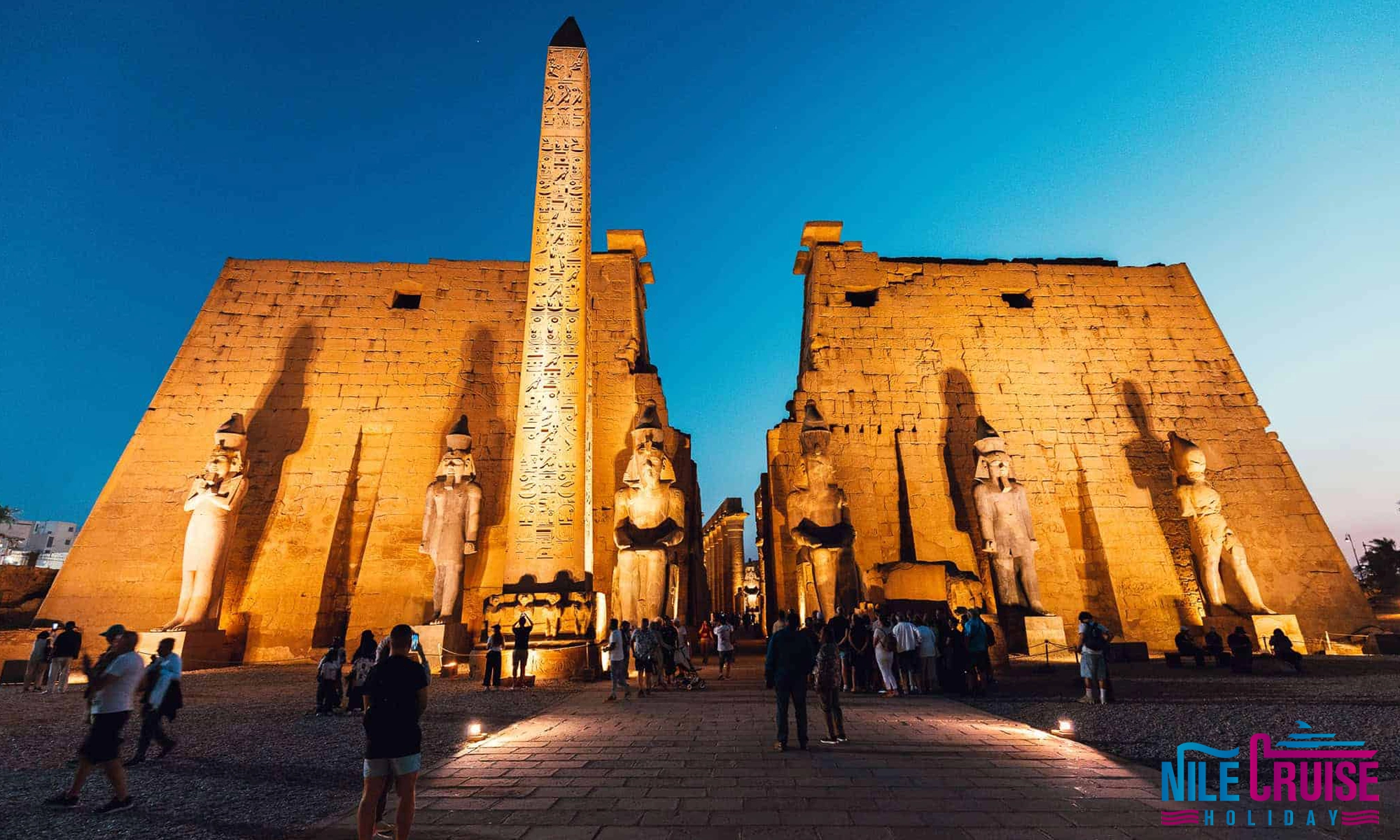
Tell el-Amarna does not rise from the desert like Karnak, Edfu or Abu Simbel. Arriving visitors see a wide crescent of sand and low cliffs on the east bank of the Nile. Across it run the faint lines of foundations, ancient roads and scattered fragments of stone. High in the cliffs, the dark doorways of rock-cut tombs look down over the plain.
Yet this quiet landscape preserves the footprint of one of ancient Egypt's most radical experiments, a capital city built from nothing and abandoned within a generation. Tell el-Amarna rewards travelers who understand what they are looking at before they arrive. This guide explains what the city was, what survives, what visitors can actually see, and how to organize a realistic visit.
What Is Tell el-Amarna?

Tell el-Amarna is the modern name for the site. Its ancient name was Akhetaten, commonly translated as "Horizon of the Aten." The city was founded during the reign of Akhenaten in the fourteenth century BCE as a purpose-built royal and religious capital. It was largely abandoned soon after his reign.
Why Akhenaten Built Akhetaten
Akhenaten broke sharply with Thebes, modern Luxor, where the god Amun and his powerful temples had dominated royal life for generations. His reign placed the Aten, the sun disc, at the center of royal ideology. This Aten-centered worship is often described as an early form of monotheism, although scholars continue to debate how far that label really fits.
A new religion needed a new stage. Akhenaten chose a stretch of previously undeveloped desert where no earlier god had a claim. The location carried symbolism too. The eastern cliffs form a natural horizon, and many Egyptologists interpret the dip in those cliffs, where the sun rises, as a deliberate link to the Aten and to the city's name.
Why the City Disappeared
After Akhenaten's death, the royal court moved away. Under Tutankhamun, whose story is told in our guide to the tomb of Tutankhamun, traditional temples and priesthoods were restored. Later rulers dismantled parts of Akhetaten and reused its stone blocks elsewhere.
The city did not vanish overnight, but occupation declined quickly. That short life is exactly what makes it valuable to archaeologists. Because the site was never rebuilt over by later cities, the desert preserved the plan of an entire ancient capital unusually well. The royal family's story is covered in depth in Akhenaten and Nefertiti.
What Can You See at Tell el-Amarna?
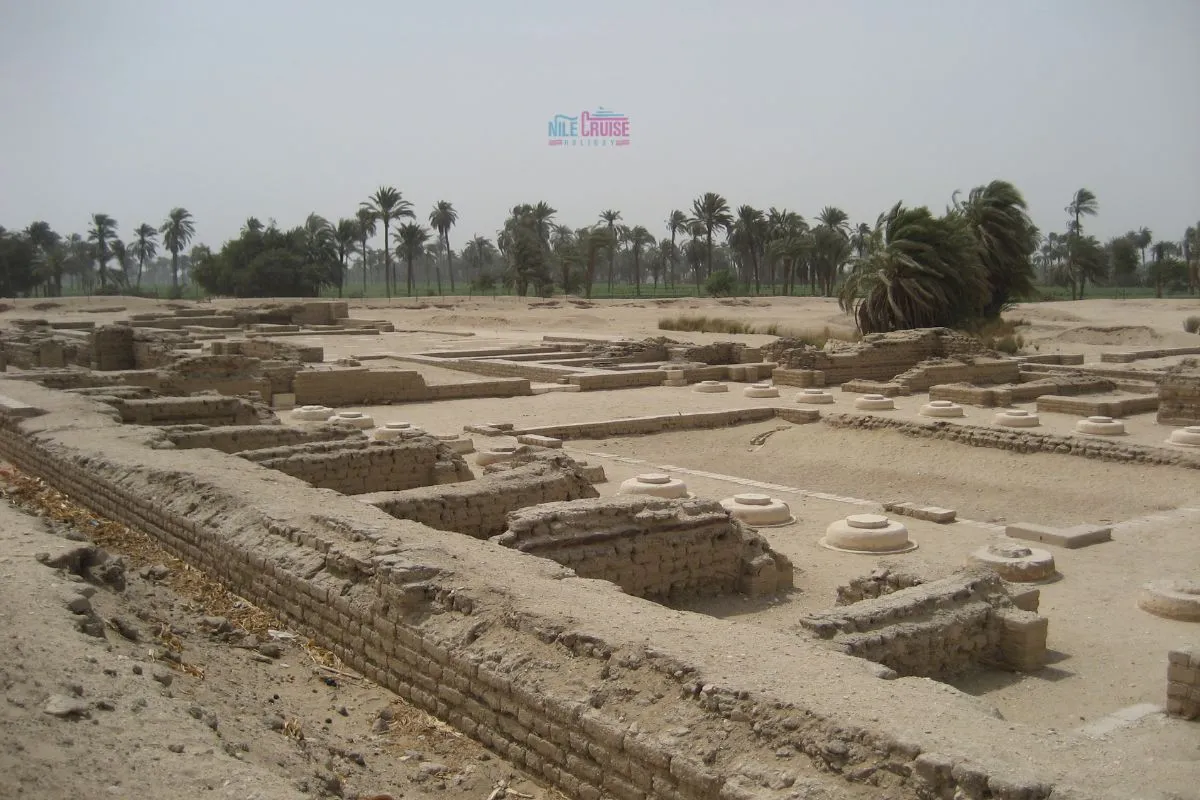
The Tell el-Amarna archaeological site is huge, stretching for several kilometers along the river, and not every monument survives as standing architecture. Knowing which areas are most rewarding makes all the difference.
North Tombs and South Tombs
The rock-cut tombs in the cliffs belonged mainly to officials connected with Akhenaten's court. Among the best known are those of Meryre, a high priest of the Aten, and Ay, who later became pharaoh himself.
These Tell el-Amarna tombs matter more for their scenes than their size. Walls show the royal family making offerings beneath the rays of the Aten, along with depictions of palaces, temples and city streets. Some preserve versions of the famous hymn to the Aten. Many tombs were left unfinished when the city was abandoned, which tells its own story. From the terraces outside, the view over the plain helps visitors read the city's layout.
Central City and Aten Temples
The heart of Akhetaten lay along the Royal Road, a long processional route running parallel to the Nile. Around it stood the Great Aten Temple, the Small Aten Temple, palace areas, administrative buildings and residential districts.
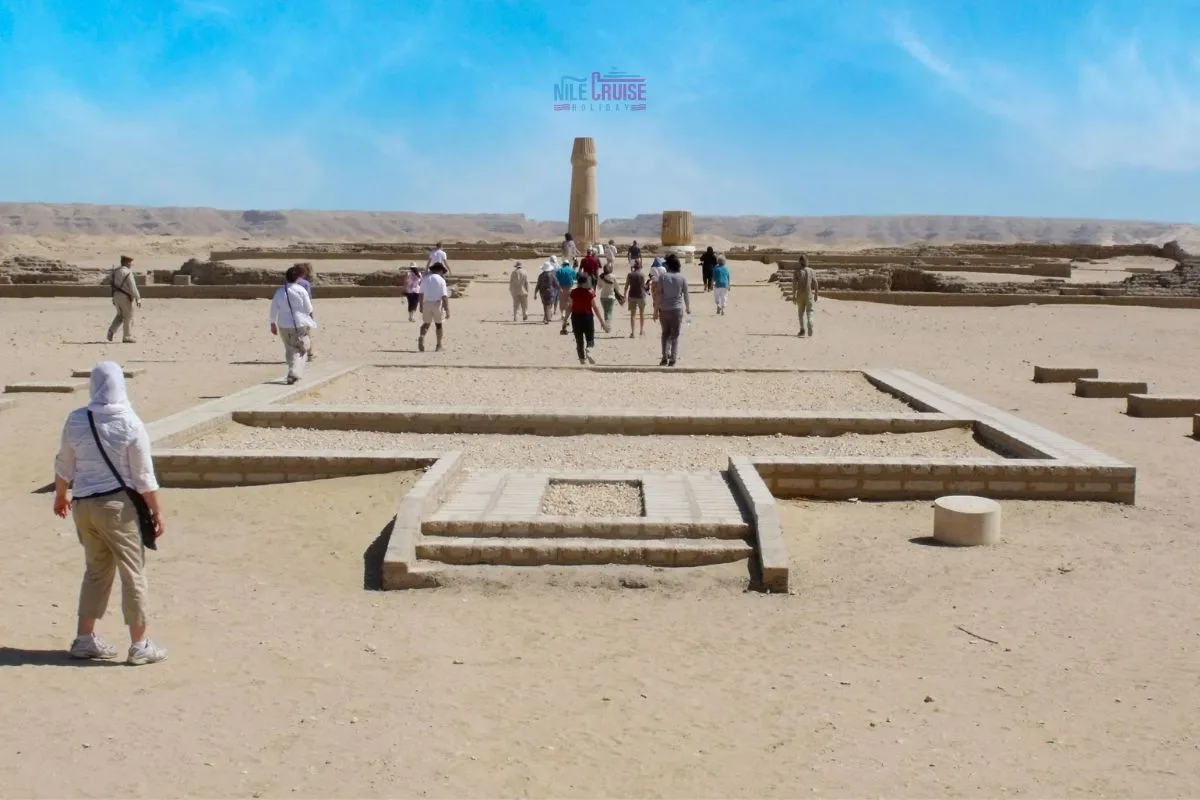
Honesty matters here. Most of these structures survive mainly as foundations, low walls and reconstructed archaeological plans. Some temple areas have been partly marked out with modern blocks to show their outline. Visitors should not expect intact columns or roofed halls. Many of the city's finest objects are now displayed in the Egyptian Museum in Cairo.
Royal Tomb and Boundary Stelae
A long desert valley, the Royal Wadi, leads east into the cliffs to the Royal Tomb, intended as Akhenaten's burial place. Damaged reliefs inside include scenes of mourning. Its later burial history is still debated by Egyptologists.
Around the edges of the city stand the boundary stelae, large inscriptions carved into the cliffs that mark the limits of Akhetaten. Their texts record the king's decision to found the city and describe its boundaries, which makes them fundamental to understanding the foundation. Boundary Stela U, at the northern end, is among the most accessible. Access to individual areas can vary and should be confirmed locally.
Start at the Amarna Visitor Centre
At Amarna, context is part of the attraction. The visitor centre near the Nile at el-Till is the best first stop. English and Arabic panels introduce the site and Akhenaten's reign, models show famous Amarna artifacts, and a full-size replica of an official's house lets visitors walk through a reconstructed home.
The models and reconstructions matter more here than at most Egyptian sites. They help travelers mentally rebuild structures that now survive mainly as low walls. After half an hour inside, the foundations outside make far more sense. Visitors who also plan time at the Grand Egyptian Museum will find that the two visits complement each other.
How to Visit Tell el-Amarna
Base Yourself in Minya
Minya is the main practical base for travelers exploring Middle Egypt and Tell el-Amarna. The site lies roughly 60 kilometers south of the city, on the east side of the Nile, according to the Amarna Project. Access typically requires road transport and some local coordination, with entry from the east bank near the town of Mallawi.
The archaeological zone is too large to explore on foot. A private vehicle for the whole day, a licensed Egyptologist, and an early start make the visit far more comfortable. Moving between the North Tombs, the central city and the Royal Wadi takes time, so transport planning is as important as the sites themselves.
One Day or Two?
One full day suits travelers who want the principal highlights. A typical plan covers the visitor centre, selected North Tombs, the central city and, depending on access and time, the Royal Tomb or a boundary stela.
Two days suit serious archaeology travelers. The extra time allows slower exploration and access to areas such as the South Tombs. Access and conditions can change, so plans should stay flexible. Some itineraries, such as the 12-day Cairo to Luxor itinerary, build Amarna into a wider Middle Egypt program.
Do You Need a Guide?
For most international visitors, a knowledgeable Egyptologist is strongly worth it. The ruins require interpretation, the sectors are geographically spread out, the tomb scenes need historical context and finding individual areas can be confusing. Local access arrangements may also vary. The value of private vs group touring is especially clear at a site this complex.
What to Expect Before You Go
Tell el-Amarna is exposed, desert-based and spread across a large archaeological landscape. It is less visually monumental than Luxor and more demanding to interpret. Shade is limited, the terrain is uneven, and the North Tombs and some boundary stelae are reached by steep staircases.
Preparation is simple but important. Sun protection, plenty of water, sturdy walking shoes, and conservative clothing suitable for Egypt all help. The heat can be intense outside winter, which makes early starts especially valuable. Travelers with limited mobility will find parts of the site difficult.
Nobody should arrive expecting Karnak. Tell el-Amarna is not about gigantic standing columns. Its power comes from standing inside the landscape Akhenaten chose, understanding the city plan, seeing the tombs, reading the boundary inscriptions and reconstructing a capital that existed for a remarkably short period.
Visit Tell el-Amarna on a Long Nile Cruise
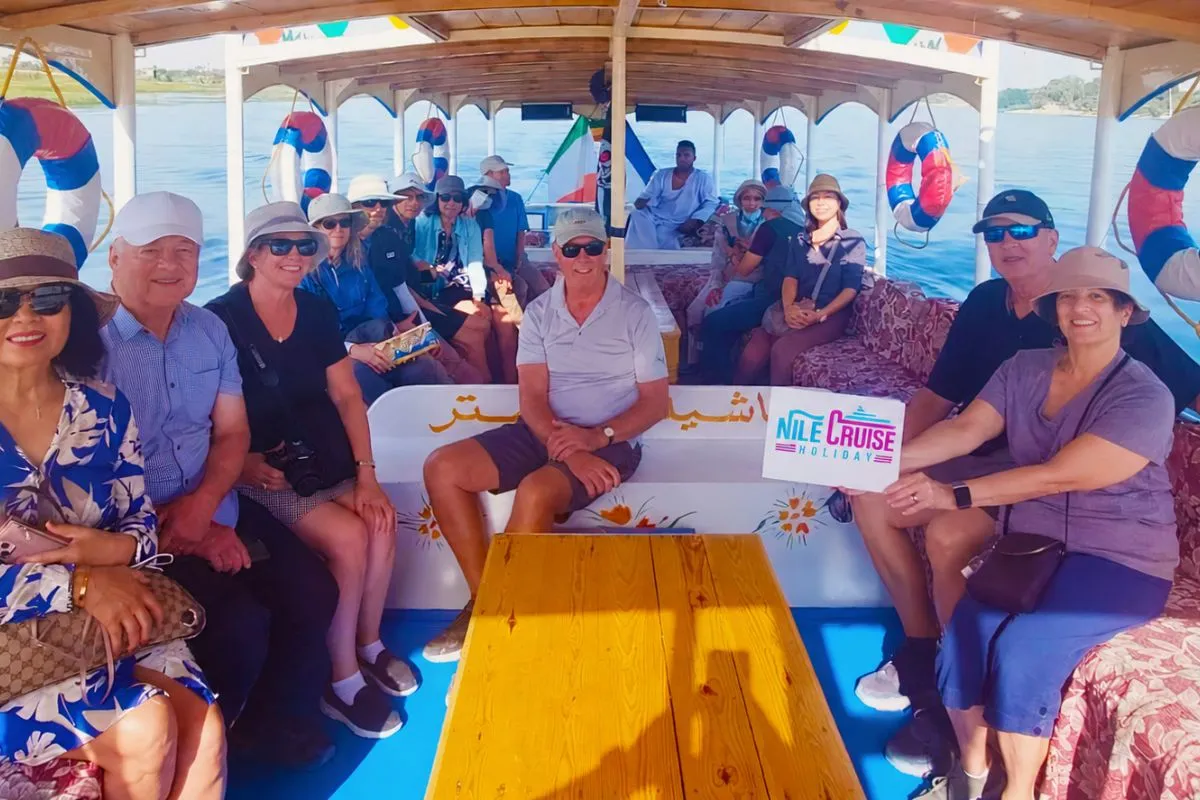
Standard Luxor to Aswan cruises focus on Upper Egypt and do not normally include Middle Egypt. That holds for most standard sailings from Luxor and Aswan. Selected long Nile cruises and extended Middle Egypt journeys, however, can include Tell el-Amarna as part of a longer route.
Approaching Amarna this way brings real advantages: fewer separate hotel changes, continuity of transport and easier access to lesser-visited archaeological areas. Depending on the program, it can be combined with the Middle Kingdom tombs of Beni Hassan, the necropolis of Tuna el-Gebel, Abydos and Dendera. Not every long cruise includes all of these.
Our long Nile cruise guide explains the wider route. Current long Nile cruise itineraries show which programs include Amarna.
Examples include the 15-day route from Cairo to Aswan, which visits Amarna on the way south.
Travelers heading north can look at the 14-day sailing from Aswan to Cairo, which reaches Middle Egypt in the second week.
For travelers who want more than the standard Luxor and Aswan corridor, Tell el-Amarna becomes far easier to include when Middle Egypt is planned as part of the journey rather than as an isolated detour. NCH can match the route, coordinate private Egyptologists and drivers for harder-to-reach sites, and plan the whole trip as a tailor-made Middle Egypt journey.