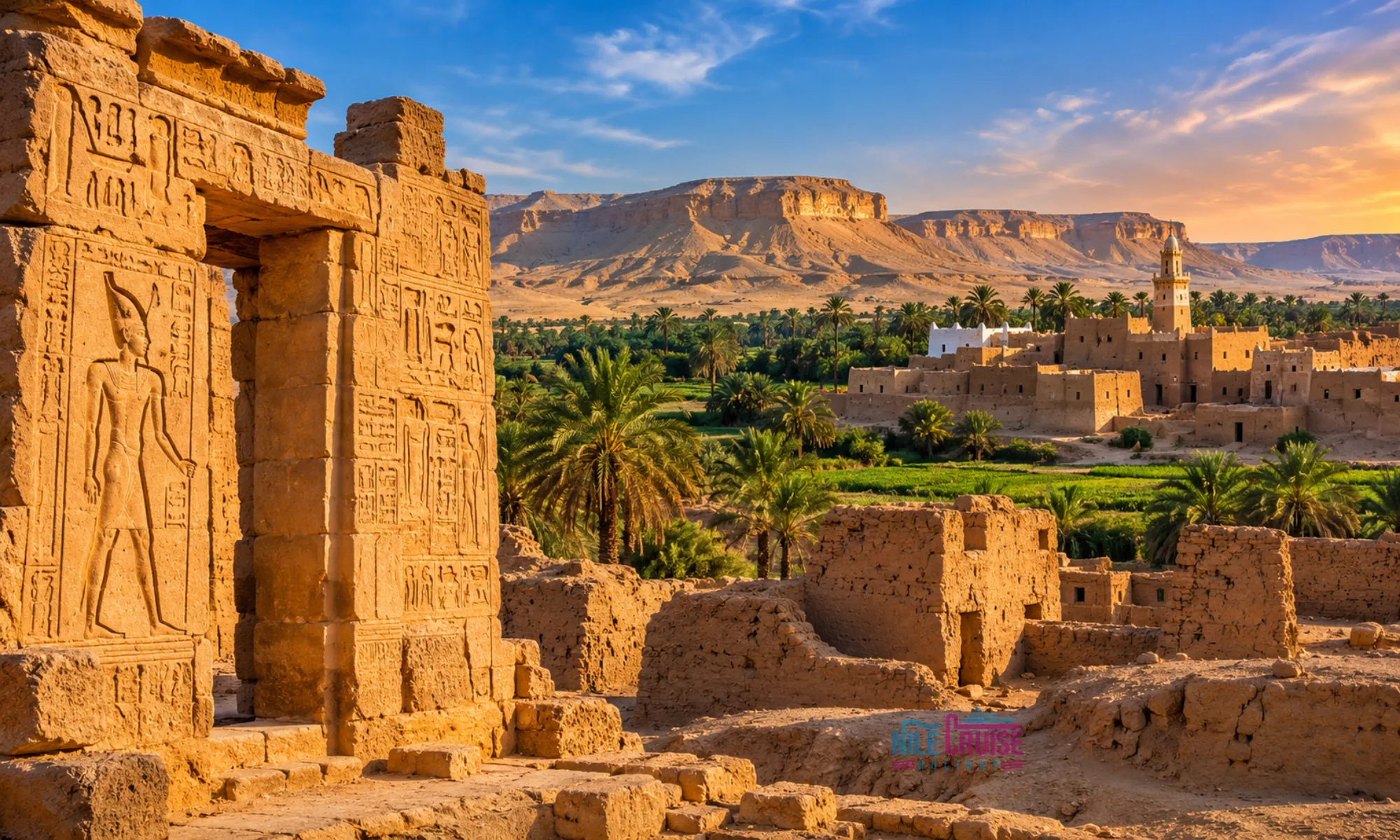

Dakhla Oasis is not one town or one monument. It is a chain of villages, fields and archaeological sites spread across Egypt's Western Desert, where Old Kingdom governors, Roman settlers and medieval communities all left traces in the same oasis basin. Along the main road, green fields give way to palm groves, bare sand and mud-brick villages, with a pale limestone escarpment running along the northern horizon.
The oasis lies in the New Valley Governorate, far from the Nile, and its modern center is the town of Mut. Around it sit dozens of villages and some of the most varied archaeology in the desert: a governor's town from the age of the pyramid builders, a temple carved for Roman emperors in Egyptian style, painted Roman tombs, the remains of early Christian churches and a medieval village where people still live.
That range sets Dakhla apart, and it explains why the oasis works best as part of a longer journey through Kharga that returns to the Nile Valley at Luxor, where Luxor attractions and a Nile cruise can pick up the story.
What Is Dakhla Oasis?
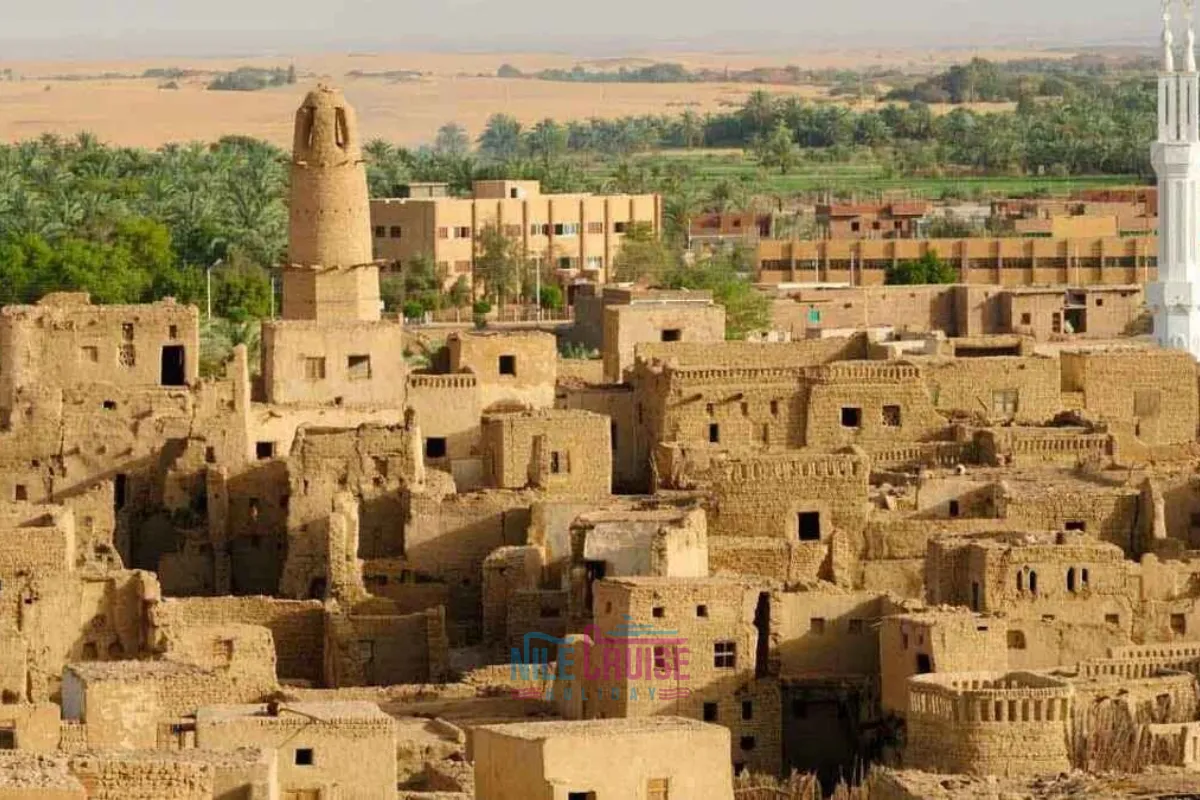
Dakhla Oasis is a large depression in Egypt's Western Desert, roughly level with the Nile Valley at Luxor but several hundred kilometers to the west. It is not a single settlement. The basin holds a string of towns and villages linked by one main road, with open desert on every side.
Water is the reason any of this exists. Dakhla sits above deep groundwater, and springs and wells have fed its fields for thousands of years.
| Fact | Dakhla Oasis |
|---|---|
| Region | Western Desert, Egypt |
| Governorate | New Valley |
| Main town | Mut |
| Known for | Archaeology, mud-brick villages, desert landscapes |
| Major historical periods | Prehistoric to Islamic |
| Key sites | Al-Qasr, Balat, Deir el-Hagar, Amheida, Muzawwaqa |
The landscape changes quickly. Donkey carts piled with clover share the road with pickup trucks, and a few minutes later eroded hills take over. In the evening, the escarpment turns gold, then pink.
Why Is Dakhla Oasis Historically Important?
Dakhla matters because almost every major phase of Egyptian history left something here, often within a few kilometers of the last. The long-running Dakhleh Oasis Project, working in the oasis since the late 1970s, has traced that story across the whole basin.
Prehistoric Dakhla
People were living in and around the Dakhla basin long before the pharaohs. Stone tools show occupation reaching back far into the Palaeolithic, and later prehistoric groups lived here when the climate was wetter, and the desert held more grassland and seasonal lakes.
Old Kingdom Dakhla
By the late Old Kingdom, around 4,300 years ago, Dakhla was firmly tied to the Egyptian state. Three names are often confused here, and they are not the same place.
Balat is the modern village and the wider area at the eastern end of the oasis. Ayn Asil is the Old Kingdom town near Balat, which served as the seat of the governors who ran the oasis for the king. Qila el-Dabba is the cemetery nearby, where several of those governors were buried in large mud-brick mastaba tombs.
Together they show that Dakhla was not a remote outpost but an administered province. Its governors controlled farmland and watched over desert routes linking the oases with the Nile Valley.
Roman and Christian Dakhla
Dakhla reached a high point under Roman rule, when wells and irrigation supported new towns and farms. This was the period of Deir el-Hagar, an Egyptian-style temple built under Roman emperors, and of large towns such as Amheida (ancient Trimithis) and Kellis, known today as Ismant el-Kharab. Painted tombs at Muzawwaqa belong to the same world. In the fourth century, Christianity spread through the oasis, and Kellis has produced some of the earliest church buildings known in Egypt.
Medieval and Islamic Dakhla
After the Roman towns declined, life in Dakhla continued in villages built of mud brick. The best-known is Al-Qasr, at the northern edge of the oasis. Its houses were rebuilt, extended, and repaired over many centuries, so it shows a settlement that kept adapting rather than one moment preserved.
Best Places to Visit in Dakhla Oasis
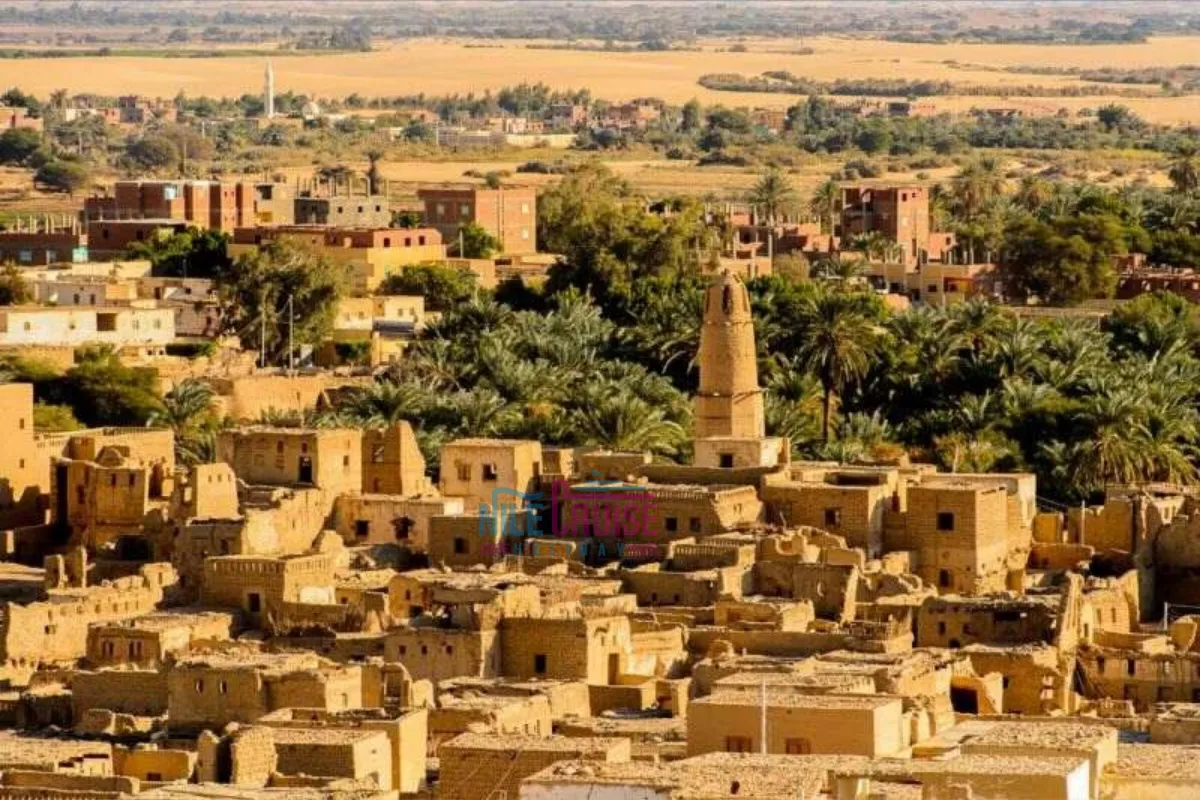
The sites below are spread along the length of the oasis.
Al-Qasr
Al-Qasr is a historic mud-brick settlement on a slight rise in the north of the oasis, and it is the most atmospheric place in Dakhla to walk. Narrow lanes, some roofed against the sun, wind between tall houses, and carved wooden lintels above some doorways carry inscriptions and dates.
The minaret of the old mosque rises above the rooftops, and parts of the town have been restored. Al-Qasr is not abandoned. Some of the old quarter is empty and crumbling, while families still live in parts of it and in the modern village around it.
Balat, Ayn Asil and Qila el-Dabba
These three names belong together but describe different things. Balat is the living village, with its own lanes of older mud-brick houses. Ayn Asil, close by, preserves the remains of the Old Kingdom governors' town, including traces of its enclosure walls and administrative buildings.
At Qila el-Dabba, a short distance away, the mastaba tombs of the governors stand as low, weathered mounds of mud brick on the desert edge. A guide helps here, because the remains are subtle and easy to misread.
Deir el-Hagar Temple
Deir el-Hagar is a Roman-period Egyptian temple at the western end of the oasis. It was built in the first century AD and decorated in the names of Roman emperors, including Nero, Vespasian, Titus and Domitian, who appear in the reliefs dressed and posed as Egyptian kings. It is far smaller than the best temples to see on a Nile cruise, but it follows the same Egyptian tradition.
The temple was dedicated mainly to the Theban gods Amun, Mut and Khonsu, the same three gods honored at Karnak Temple in Luxor. Reliefs and inscriptions survive on its sandstone walls. It shows Roman rulers keeping Egyptian religion running in the provinces, which is why it is not a Pharaonic temple.
Amheida, Ancient Trimithis
Amheida is the site of Trimithis, one of the largest Roman towns in the oasis. Excavations led by New York University have uncovered streets, houses, baths and public buildings, along with earlier layers going back much further.
The most famous find is a wealthy house with painted walls, including scenes from Greek mythology, and nearby a room where students practised Greek verses written on the walls. Amheida is an active research site, so access and what can be seen vary from season to season.
Kellis at Ismant el-Kharab
Kellis, at the modern site of Ismant el-Kharab, was a Roman town studied by teams from Monash University. Its thousands of texts on papyrus and wooden boards, from household letters to religious writings, together with temple remains and early churches, make it a rare window into daily life and religious change in late Roman Egypt. The site is primarily a research area rather than a prepared visitor attraction, so access should not be assumed.
Muzawwaqa Necropolis
Muzawwaqa is a Roman-period cemetery cut into a low hill in the west of the oasis. Its best-known tombs, belonging to men named Petosiris and Sadosiris, have painted interiors that mix Egyptian funerary scenes with Roman-style portraits and details.
The colors are still strong in places, which is rare for painted tombs in the desert. Opening conditions can change, so the tombs are best checked locally before a visit.
Mut
Mut is the main modern town of Dakhla and the administrative center of the oasis. It has most of the services travelers need, including hotels, shops, and fuel, and it sits roughly in the middle of the oasis road.
From here, Al-Qasr and Deir el-Hagar lie to the northwest, and Balat and the road to Kharga lie to the east.
Recent Archaeological Discoveries in Dakhla Oasis
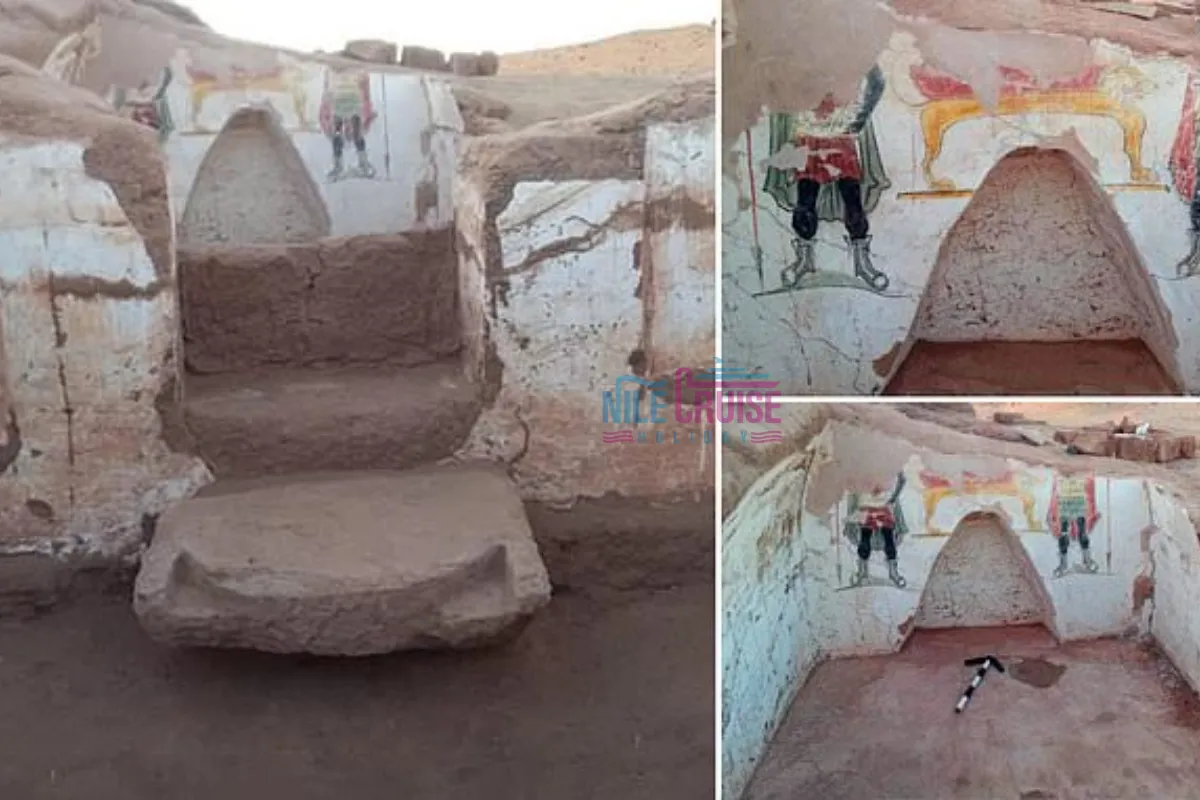
Excavation in Dakhla is ongoing, and new finds are announced regularly. The most notable recent one comes from Bir Al-Shaghala, close to Mut.
2026 Bir Al-Shaghala Tomb Discovery
On September 24, 2026, Egypt's Ministry of Tourism and Antiquities announced that an Egyptian archaeological mission had uncovered a Roman-period mud-brick tomb with a pyramid-shaped superstructure at Bir Al-Shaghala. The site itself is not new. It belonged to the cemetery of ancient Mothis, the Roman-era capital of the oasis near modern Mut, and Egyptian excavations there have been running since 2002.
The tomb is believed to have been built for a man and his wife. Beneath the pyramidal superstructure lies a vaulted mud-brick hall with two burial chambers, reached through a sandstone entrance in Egyptian style. The entrance carries a winged sun disk with two cobras, hieroglyphic funerary texts and a scene drawn from the Egyptian books of the netherworld.
The finds include a sandstone offering table, a purification basin, pottery and a bronze coin bearing the image of the emperor Constantine. A stone stele carries a 19-line funerary poem in Greek, commemorating a man named Pisechtes (also rendered Bisichthes in some reports), who may have been a judge.
Why the Discovery Matters
The tomb brings three cultures into one burial. Its imagery is Egyptian, its poem is Greek, and its coin and setting place it in the late Roman world, around the late third or early fourth century AD. Local families could commission traditional Egyptian funerary scenes, mourn their dead in Greek verse, and live within the Roman economy, all at the same time.
How to Plan a Visit to Dakhla Oasis
How to Get to Dakhla Oasis
Most travelers reach Dakhla overland. It sits on the Western Desert oasis route, which links Cairo with the oases of Bahariya, Farafra, Dakhla and Kharga before returning to the Nile Valley. Distances between oases are long, and road conditions and travel requirements can change, so they should be checked close to departure.
How Many Days Do You Need?
Two to three nights can cover the main sites, while a longer stay suits travelers who want slower village exploration, additional archaeological stops or more desert time. This is planning guidance rather than a fixed rule, and travelers continuing to the Nile should keep a day or two spare for things to do in Luxor.
Where to Stay
Mut is often the practical base because of its location and services. Accommodation across the oasis is limited and generally simple, with a small number of hotels and eco-lodges rather than large resorts. Rooms should be arranged in advance, especially in the busier cooler months.
Best Time to Visit
The cooler months, roughly October to April, are the most comfortable for desert sightseeing. Days are usually warm and bright, while nights can turn surprisingly cold in midwinter. Summer heat in the Western Desert is intense, which makes long site visits hard work in the middle of the day.
Archaeological Site Access
Access to excavated sites can vary because of restoration, archaeological work, local arrangements, or current opening conditions. Al-Qasr, Deir el-Hagar, the Balat area and Muzawwaqa are the sites visitors most often see. Amheida, Kellis, and active excavation areas, including Bir Al-Shaghala, should not be counted on, and access may need to be confirmed locally.
How Dakhla Fits into a Wider Egypt Journey
Dakhla rarely makes sense as a quick standalone excursion. It works far better as one stage in a larger route.
One common route runs Cairo, then Bahariya and Farafra with the White Desert, then Dakhla, then Kharga, and finally Luxor for a Nile cruise. Other versions run in reverse.
Dakhla and Kharga
Kharga is the natural partner to Dakhla, lying to the east along the same oasis road. Where Dakhla's strength is its villages and range of periods, Kharga adds monuments such as the Temple of Hibis and the Christian cemetery of Bagawat.
Dakhla and Luxor
The road from Kharga reconnects with the Nile Valley near Luxor, and this is where the journey turns. Karnak honored the same Amun who appears at Deir el-Hagar, so the connection between desert and river is more than a route on a map.
Luxor rewards a day or two on its own. Its sights are spread across both banks of the river, and a guide to the Luxor East Bank and West Bank helps decide where to start.
From there, a Luxor and Aswan Nile cruise continues the journey south past Esna, Edfu and Kom Ombo to Aswan.
How Nile Cruise Holiday Fits In
The difficult part of a Dakhla journey is not any single site. It is everything between them: long drives, limited accommodation, varying site access, and the handoff back to the Nile. Nile Cruise Holiday can turn Dakhla from an isolated desert detour into part of one connected Egypt itinerary, coordinating the oasis route, accommodation, archaeological visits, and the final handoff into Luxor and the Nile cruise.
In practice, that means a private desert vehicle and driver, a route sequence planned around current conditions, accommodation in Mut and Kharga, and local guides or an Egyptologist where they add the most. The team times site visits, handles the transfer into Luxor and the cruise boarding, and plans Luxor sightseeing before or after sailing, with no commission shopping stops along the way. Site access and travel requirements remain set by the authorities, and the team plans around them.
Travelers who want Dakhla to be more than an isolated desert detour can ask Nile Cruise Holiday to build it into a wider Egypt journey, linking Western Desert archaeology with Luxor and the Nile through coordinated transfers, guides and accommodation. A tailor-made Egypt trip can shape the whole route around your interests.
For travelers who prefer a ready framework, the oasis can also lead into one of the Egypt tour packages with a Nile cruise, extended with the desert days.