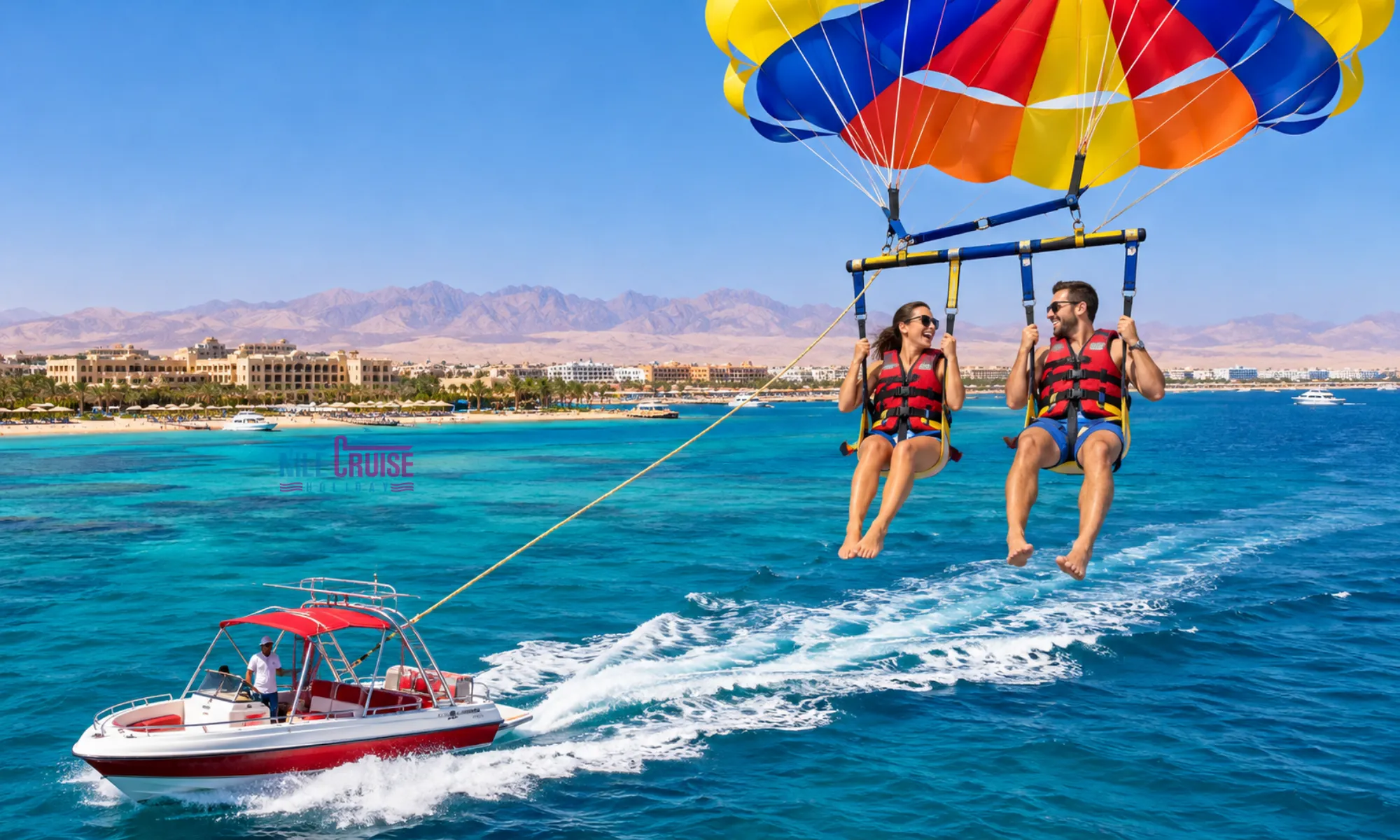
Hurghada parasailing looks simple. A speedboat accelerates, the canopy fills with a soft thump, and within moments you are rising above the turquoise water of the Red Sea, the boat's engine fading to a hum below you. For the passenger, very little technical skill is required.
What matters most happens around you: weather checks, harness fit, equipment condition, and whether the crew is prepared to delay the flight when conditions are not suitable. For most first-timers, Hurghada parasailing requires no previous experience, but it remains an adventure activity and is never completely risk-free.
This guide covers safety, the trip itself, booking limits, prices, and operator choice. For broader ideas across the country, the guide to what to do in Egypt is a good starting point.
What Is Parasailing in Hurghada Like?
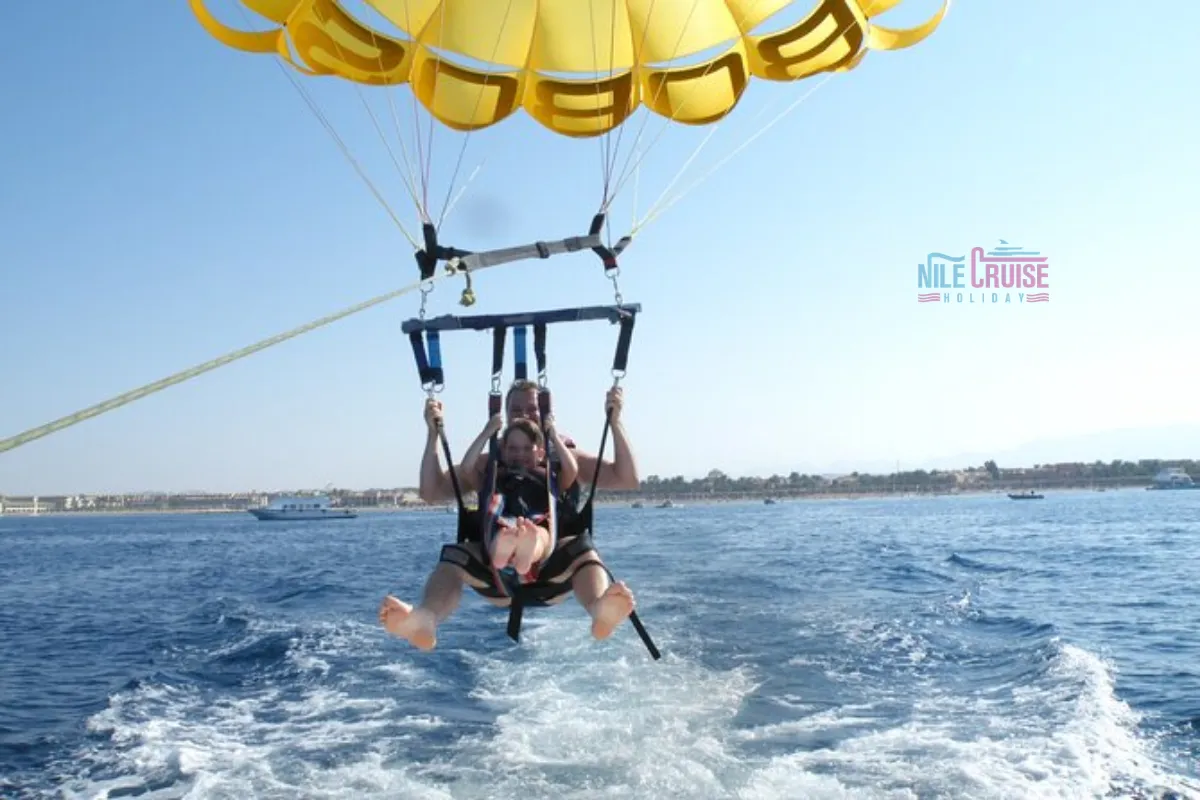
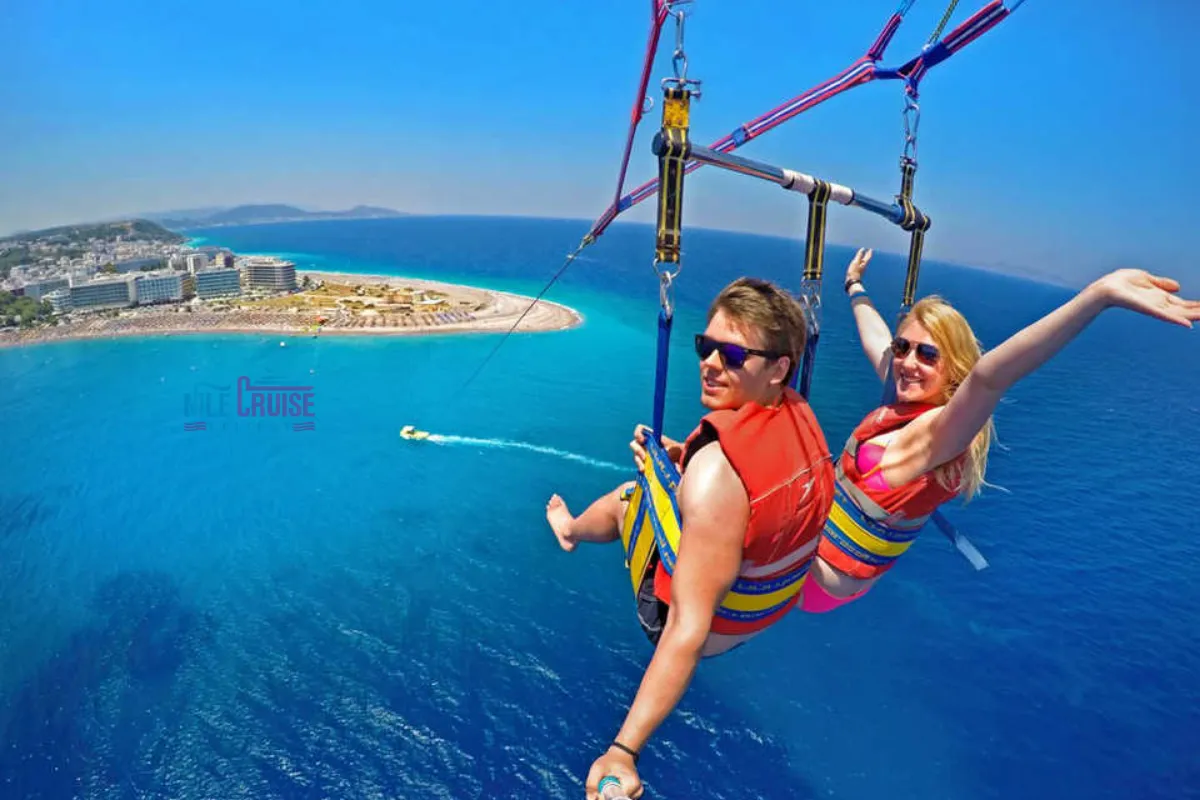
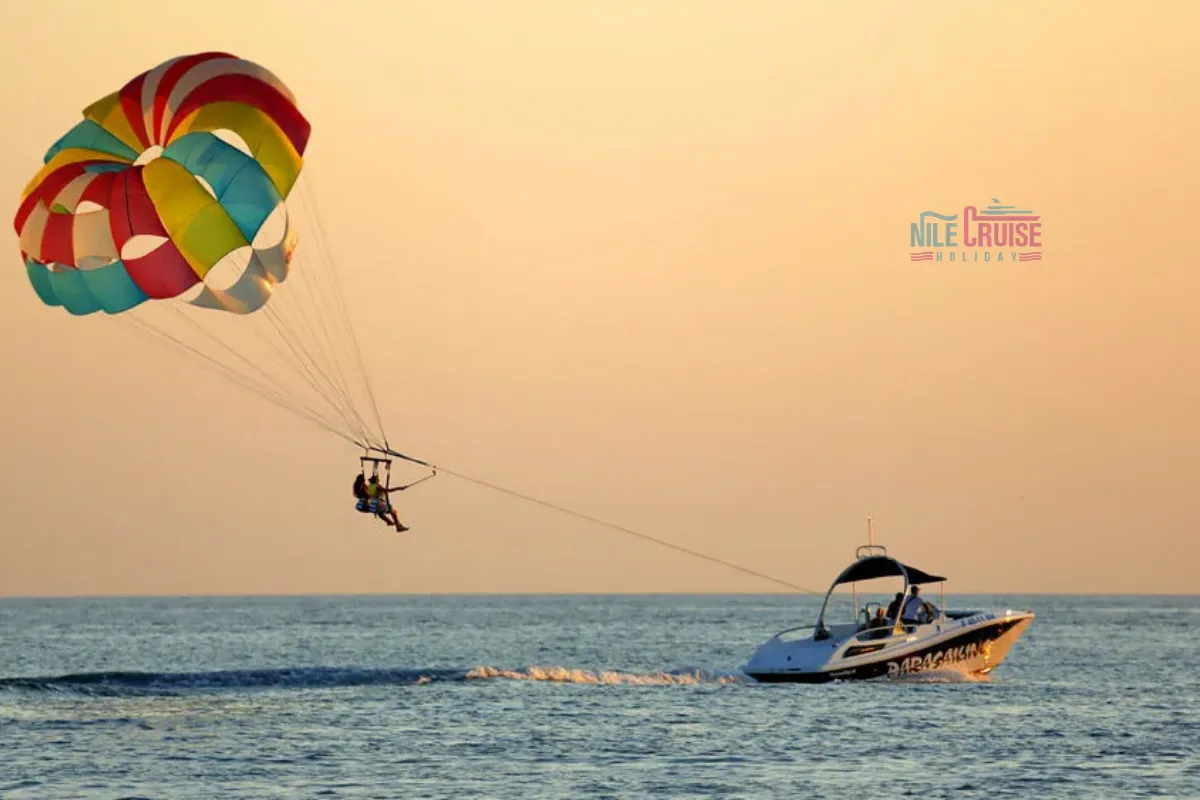
Parasailing in Hurghada means being towed behind a boat while attached to a parachute-style canopy. You wear a harness and a life jacket, and the crew clips the harness to the parasail, which is connected to the boat by a towline, usually let out and reeled in by a winch.
As the boat gathers speed, the canopy produces lift, and you rise gradually from the launch platform at the back of the boat. Within a minute or two, the coastline opens up: hotels along the shore, the shallow reefs showing pale green against deeper blue, and offshore islands on the horizon.
At the end, the winch draws you back in for a controlled descent, usually onto the same platform. Depending on the operator, the weight of the riders, and the conditions, you may fly alone or with a partner. It is one of the shortest things to do in Hurghada.
| Fact | Typical Hurghada Parasailing |
|---|---|
| Previous experience | Usually not required |
| Actual airtime | Varies by operator and package |
| Solo or tandem | Both may be offered |
| Takeoff | Usually from the boat |
| Landing | Usually back on the boat |
| Hotel transfer | Often available, not universal |
| Weather dependent | Yes |
Is Parasailing in Hurghada Safe?
Parasailing can be operated safely when weather, equipment, crew training, and passenger procedures are handled properly, but no adventure activity is risk-free.
There is no single global rulebook. International parasailing safety guidance, such as the US industry standard ASTM F3099 and the parasailing guidance of the Australian Maritime Safety Authority, emphasizes the same core ideas: assess the weather before every flight, inspect equipment daily, keep passenger weight within the equipment's limits, and brief every rider. These are external benchmarks for good practice, not Egyptian law, but they give travelers a useful yardstick.
Weather Comes First
Weather is the biggest variable in parasailing. Wind speed, gusts, and sudden wind changes affect how the canopy behaves, while thunderstorms, rough seas, and poor visibility all make launch and recovery harder.
A responsible operator should be willing to postpone or cancel rather than force a flight in unsuitable conditions.
Equipment Checks Matter
A well-run operation uses a properly fitted harness, a life jacket or other flotation, a towline in good condition, a canopy suited to the load, and a winch and tow system in working order. It must also match the weight being flown, which is why operators ask for passenger weights.
Travelers are not expected to inspect equipment technically. Visible damage, badly fitting harnesses, or unclear answers about equipment limits are reasons to ask questions before flying.
Crew and Safety Briefing
A proper briefing should explain body position, what happens during takeoff, ascent, and landing, how the crew communicates with riders in the air, emergency signals and instructions, and what riders should avoid touching or adjusting. Not every Hurghada provider follows the same formal script, but every rider should understand these basics before leaving the platform.
Red Flags Before You Fly
Any of the following is a reason to pause, ask questions, or decline, although no single sign proves an operator is unsafe.
- No briefing at all
- No flotation device offered
- A harness that obviously does not fit
- Visible damage to ropes, canopy, or harness
- Refusal to explain weight rules
- Crew dismissing a clear change in weather
- Pressure to fly despite poor conditions
- An overcrowded or chaotic boat procedure
- An unclear cancellation or weather policy
What Happens on a Hurghada Parasailing Trip?
1. Hotel Pickup or Meeting Point
Some operators include a hotel transfer, while others ask riders to meet at a marina or beach activity point. Hotels further from central Hurghada may carry a supplement, so pickup should never be assumed.
2. Boat Boarding
Riders often share the boat with other customers and wait their turn while others fly. That waiting time is part of the outing. Parasailing still takes only part of a day, unlike a full-day trip to Mahmya Island.
3. Safety Briefing
The crew explains the procedure, the signals, and any restrictions on weight, age, or health before the first flight.
4. Harness and Life Jacket
The crew should fit and check each rider's harness and life jacket.
5. Takeoff
Riders sit or stand on the launch platform while the boat accelerates. The canopy lifts them gently as the winch lets out the line.
6. Flight
Actual airtime is not the same as total excursion duration. Current Hurghada offers vary considerably: some advertise only several minutes in the air, others longer. The most important question before booking is how many minutes you will actually be airborne.
7. Descent and Landing
The winch reels riders back to the boat for a landing on the platform. Some providers offer a brief dip into the water on the way down. Others keep riders dry. It is best to ask in advance rather than assume either.
Age, Weight, Tandem Flights and Who Should Check First
Weight Limits
There is no single universal Hurghada parasailing weight limit. The safe load depends on the parasail and equipment specifications, wind conditions on the day, solo or tandem flying, operator policy, and the combined weight of the riders. As one example from a listing checked in November 2026, an operator set a combined maximum of 150 kg for two riders. That is one company's rule, not a standard.
Tandem Parasailing
Tandem flights are commonly offered but not guaranteed. Combined weight, equipment rules, and the day's wind all decide whether two people can fly together, and a crew may separate riders if conditions change.
Minimum Age
Minimum age varies between operators and may also depend on conditions and whether the child flies with an adult. One listing checked in November 2026 gave a minimum age of 5, with younger children flying alongside an adult, but other operators set their own limits.
Who Should Check Before Participating?
Some travelers should seek advice first, including those who are pregnant, have significant heart or circulation conditions, have had recent surgery, have serious neck or back problems, have mobility issues that affect harness fit, or may find it hard to follow safety instructions. Travelers with relevant health conditions should ask both the activity provider and their clinician before participating.
Hurghada Parasailing Prices and What They Include
The price of parasailing in Hurghada depends on the operator, the actual airtime, solo or tandem flying, whether a hotel transfer is included, the hotel's location, photos or video, whether parasailing is part of a combined watersports package, the season and any fees.
Current Hurghada parasailing listings can vary significantly, so treat any online price as a current operator quote rather than a permanent market rate. As an illustration, one online listing checked in November 2026 started at around US$40 for 10 to 13 minutes of flight within a trip of about two and a half hours, while another advertised 5 to 7 minutes of flight within about two hours. Some packages also bundle parasailing with other activities, such as snorkeling in the Red Sea.
The headline price matters less than what it includes. Details worth confirming:
- Actual flight time
- Total excursion duration
- Whether a transfer is included
- Any tandem supplement
- Any hotel-zone supplement
- The cost of photos or video
- Taxes and fees
- Refund and weather rescheduling terms
How to Choose a Parasailing Operator in Hurghada
Questions to Ask Before Paying
- How long is the actual flight?
- How long is the total excursion?
- Is hotel pickup included?
- Where does the boat depart?
- What are today's weight limits?
- Can two people fly together at our combined weight?
- What is the minimum age?
- What happens if weather conditions change?
- Is a safety briefing provided?
- Are flotation devices provided?
- Are photos or videos included or extra?
- What is the cancellation or rescheduling policy?
- Is the operator currently authorized to provide the activity under applicable local requirements?
Clear, specific answers are a good sign.
How Parasailing Fits into a Hurghada and Nile Journey

Because it is short, parasailing usually fits around a beach day, hotel time, snorkeling, or a desert safari. The main thing to avoid is stacking it onto a full-day sea excursion or the morning of a long transfer.
Many travelers pair the Red Sea with the Nile. A combined Nile cruise and Red Sea trip usually means a road transfer between the coast and Luxor.
That drive is covered in the guide to the Hurghada to Luxor route, and parasailing works best on a relaxed beach day rather than on the day of the transfer.
Travelers who prefer to start sailing straight from the coast can look at Nile cruises from Hurghada, which include the transfer to the cruise in Luxor.
How Nile Cruise Holiday Fits In
Nile Cruise Holiday can fit parasailing into a Hurghada stay without letting a short watersport disrupt the rest of the trip, coordinating activity timing around hotel transfers, Red Sea plans and the onward journey to Luxor or a Nile cruise.
In practice, that means confirming availability and inclusions, arranging pickup with a private driver and sequencing Red Sea activities so they do not clash. The team then handles the Hurghada to Luxor transfer and the handoff to cruise boarding, with Egyptologist guides waiting on the Nile side and no commission shopping stops along the way.
The activity provider remains responsible for equipment, on-water operation, and day-of safety decisions, including whether a flight goes ahead in the conditions on the day.
Travelers who want to include parasailing without disrupting the rest of their Red Sea and Nile journey can ask Nile Cruise Holiday to coordinate it within a tailor-made Egypt trip, built around hotel transfers, Hurghada sightseeing and the onward route to Luxor or a Nile cruise.