How were the pyramids built? has been the impossible question in the world of history, archaeology, and ancient architecture & consturction. For more than 4,500 years, travelers have stood at the foot of the Great Pyramid of Giza and asked the same question. The answer is no longer a total mystery. Quarry ramps, a papyrus diary written by one of the builders, a lost branch of the Nile, and the town where the workers lived have each solved part of the puzzle. Other parts are still argued over by engineers and Egyptologists.
Raised block by block for a king who wished to join the stars, the pyramids remain the most magnificent proof of what organized human hands can achieve. This guide sets out the facts behind the Great Pyramid, where its stone came from, the main pyramid construction theories from ramps to levers, who the builders really were, the myths that refuse to die, and where you can see the evidence for yourself on a trip to Egypt.
The Great Pyramid in Facts and Figures
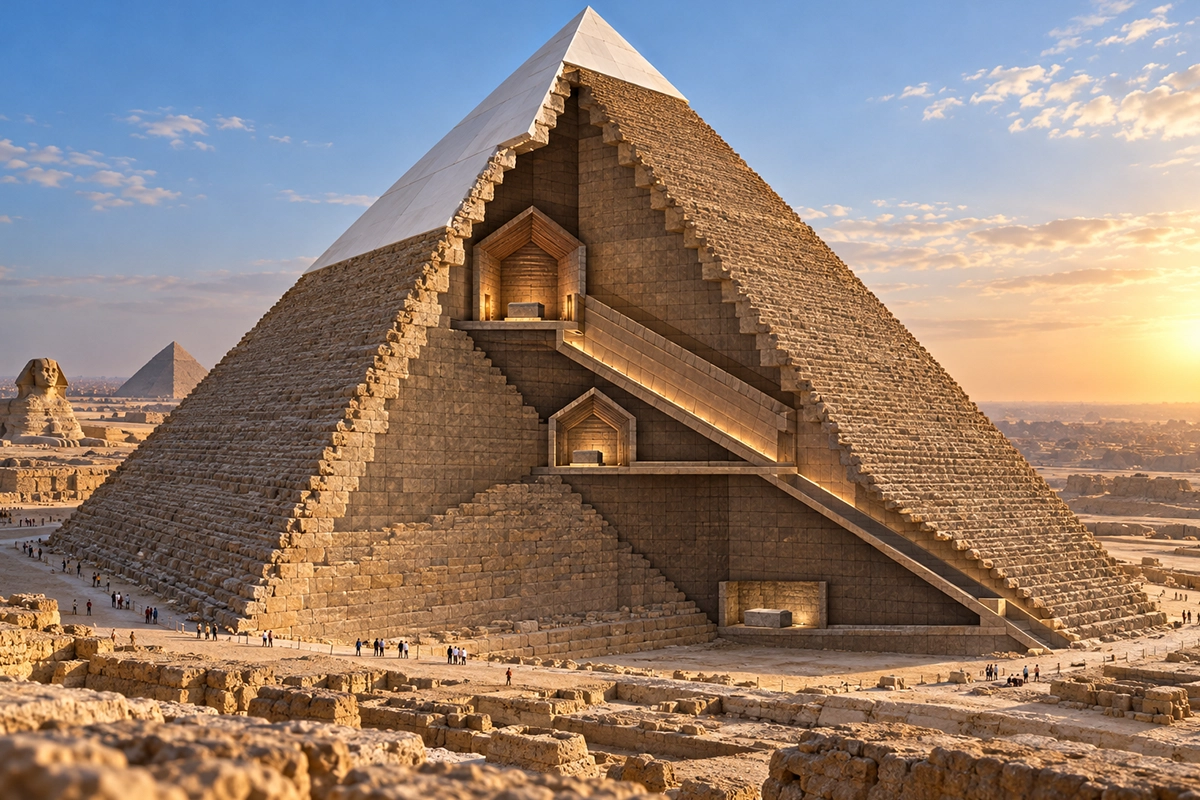
The Great Pyramid was built for Khufu, the second king of the Fourth Dynasty, and was completed around 2560 BC. Most estimates give a building time of about 20 years.
- Height: about 146.6 meters (481 feet) when finished. It is about 138.5 meters today, because its outer casing has been stripped away.
- Base: each side measures about 230 meters, covering roughly 5.3 hectares.
- Blocks: an estimated 2.3 million stone blocks, most weighing around 2.5 tons. The granite beams above the King's Chamber are far heavier, at an estimated 25 to 80 tons each.
- Record: it was the tallest human-made structure on Earth for about 3,800 years.
Its sides face true north, south, east and west, with an error of only a small fraction of a degree. The base is level to within a few centimeters across its whole width.
From Step Pyramid to True Pyramid
The Great Pyramid did not appear from nowhere. Around a century earlier, the architect Imhotep designed the Step Pyramid of Djoser at Saqqara. It was built from six stacked layers and is often called the first large stone building in the world.
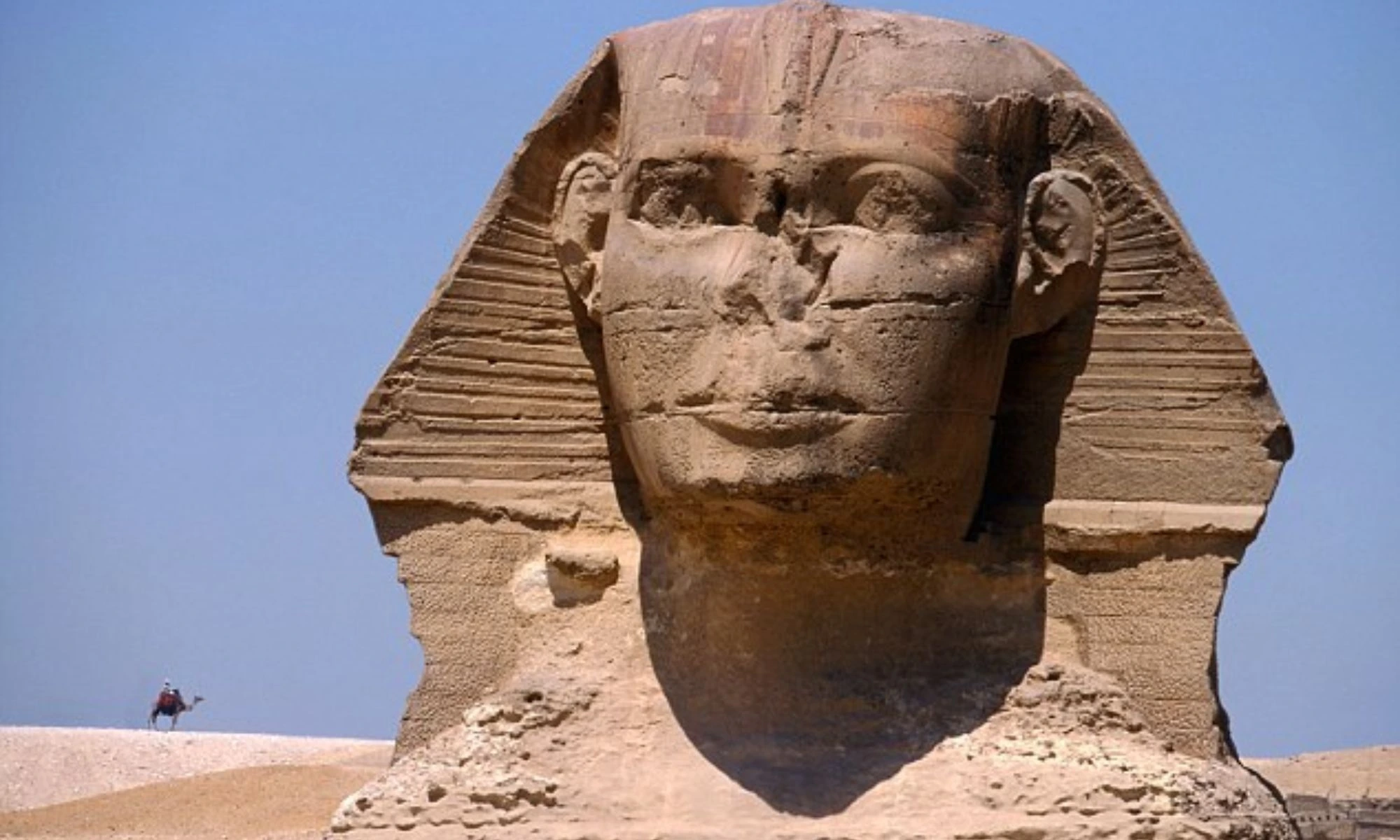
Khufu's father, Sneferu, then experimented. At Meidum, his builders filled in the steps of a step pyramid. At Dahshur, the Bent Pyramid changed angle halfway up because the slope proved unstable. The Red Pyramid, also at Dahshur, finally achieved a true smooth sided pyramid at a gentler angle of about 43 degrees. Khufu's engineers inherited all of those lessons. Later, Khafre and Menkaure added the second and third pyramids at Giza, along with the Great Sphinx and the Valley Temple of Khafre.
Where the Stone Came From: Quarries, Tools and the Nile
Three Kinds of Stone
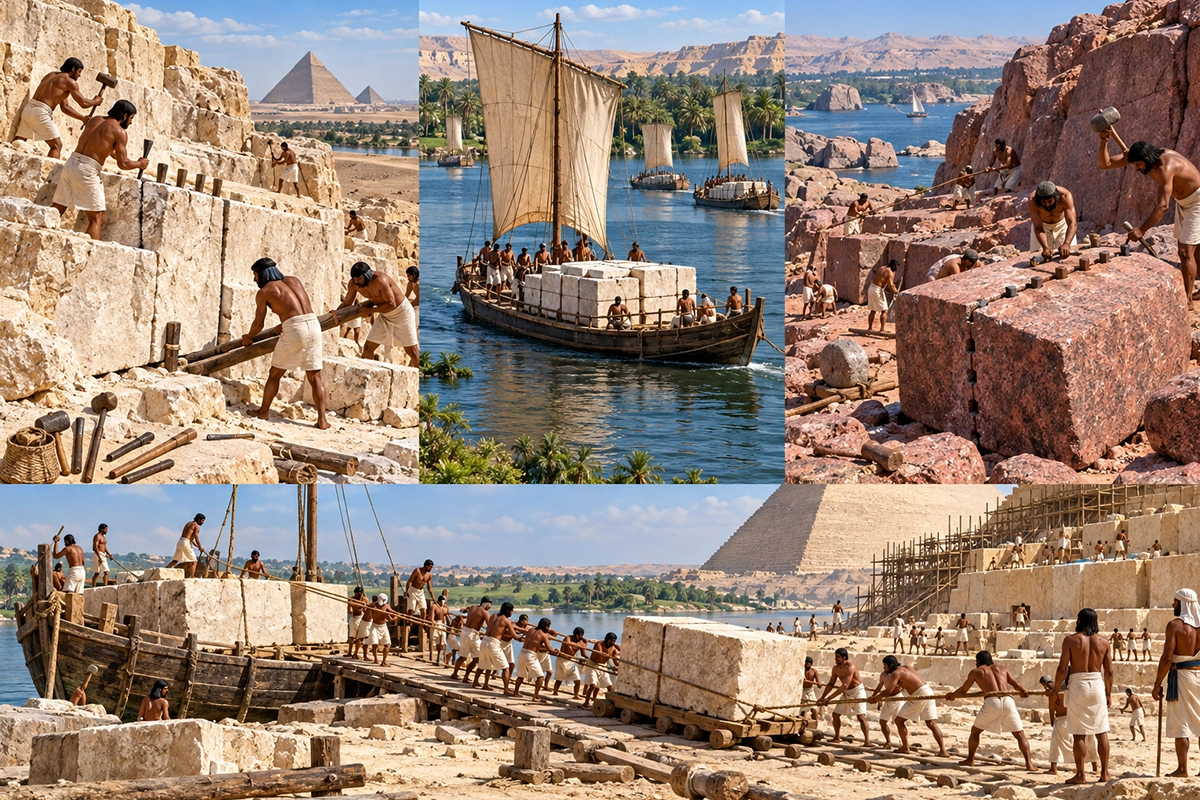
Most of the Great Pyramid's core blocks were cut from limestone quarries on the Giza Plateau itself, just a few hundred meters from the building site. The fine white limestone for the smooth outer casing came from Tura, across the river near modern Cairo. The pink granite for the King's Chamber came from Aswan, about 800 kilometers to the south.
Copper Tools and Stone Pounders
Workers cut limestone with copper chisels, wooden mallets and saws, with sand used as an abrasive. Granite is far too hard for copper, so it was shaped by pounding it with balls of dolerite, an even harder stone. You can see these methods at the Unfinished Obelisk in Aswan. It cracked while it was still being carved from the bedrock, and the pounding marks are still visible on the stone.
The Diary of Merer
In 2013, a French team led by Pierre Tallet found the oldest inscribed papyri ever discovered, at Wadi al-Jarf on the Red Sea coast. Among them was the logbook of an official named Merer. He led a team of about 40 men in Khufu's final years. His diary records boat trips carrying Tura limestone down the Nile and through canals to a harbor at Giza.
A Lost Branch of the Nile
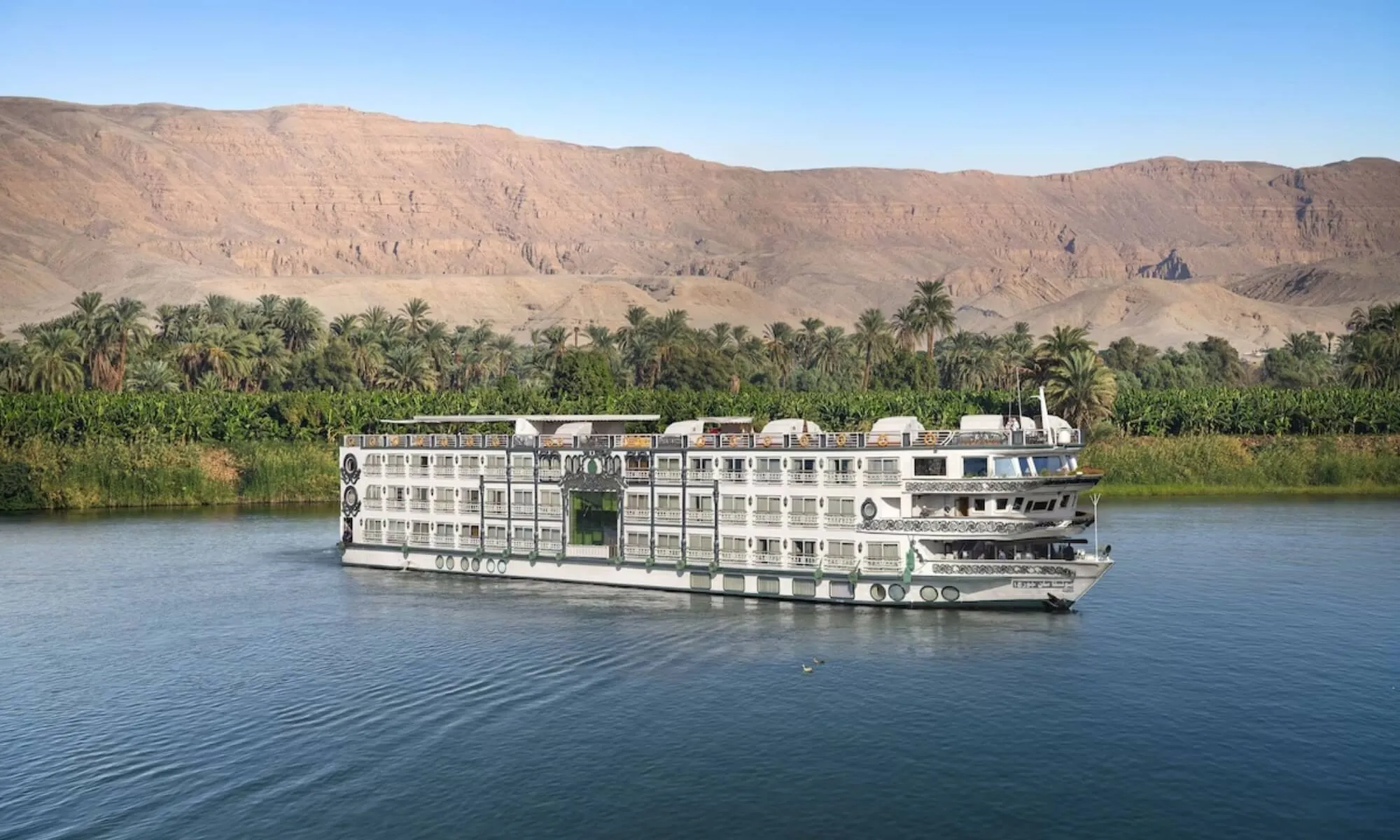
In 2024, a study led by Eman Ghoneim in Communications Earth & Environment mapped a buried branch of the Nile about 64 kilometers long. The researchers named it the Ahramat Branch, from the Arabic word for pyramids. It ran beside 31 pyramids, including Giza. Many pyramid causeways end at its old banks, which suggests the river delivered stone and supplies close to each building site. You can still follow that river on a Nile cruise from Cairo.
How Were the Pyramids Built? The Main Theories

Moving the stone is well understood. Lifting it is where the theories begin.
Sledges and Wet Sand
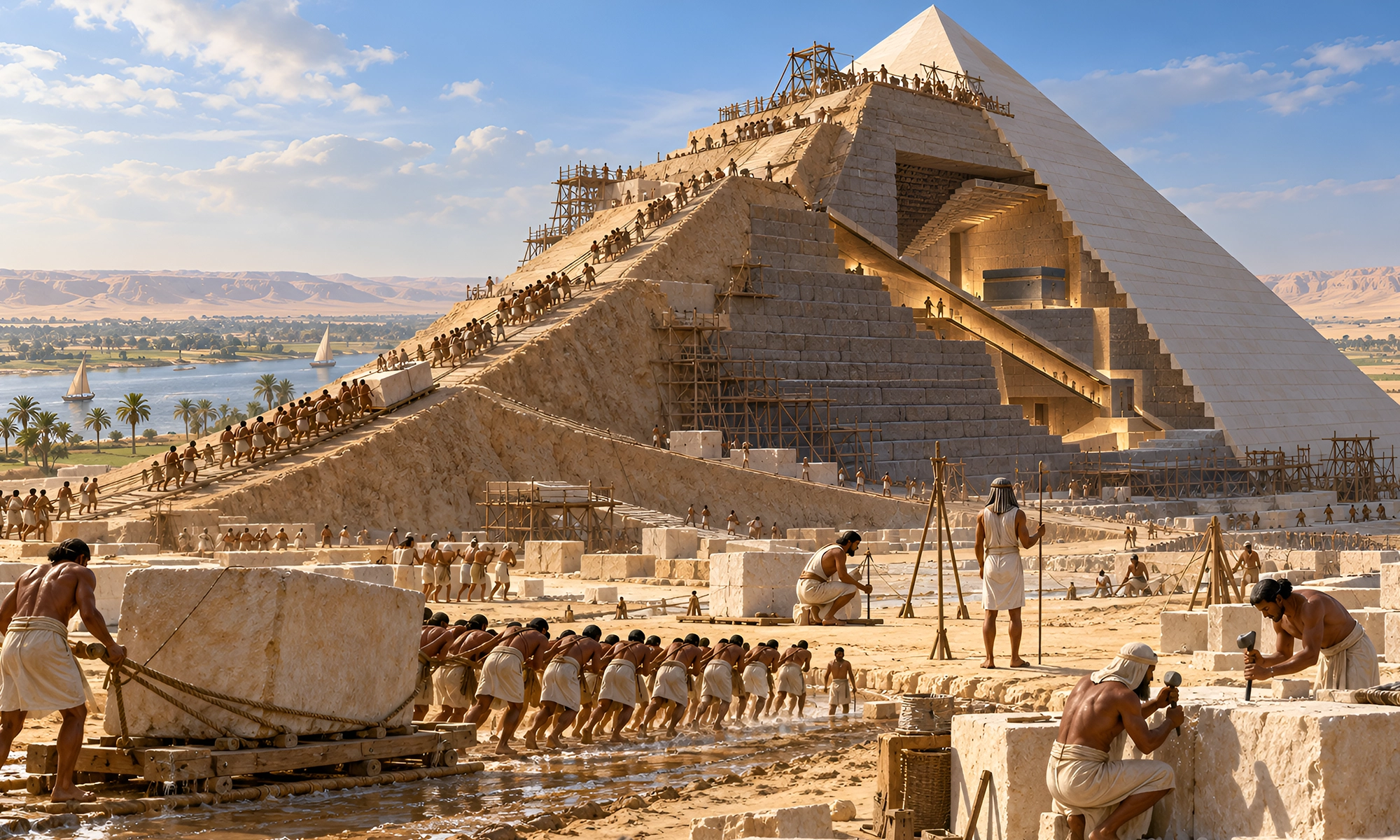
Blocks were dragged on wooden sledges. A painting in the tomb of Djehutihotep at Deir el-Bersha, dated to around 1900 BC, shows about 170 men pulling a colossal statue on a sledge while one man pours water on the sand in front. In 2014, physicists at the University of Amsterdam showed that sand with the right amount of water needs about half the pulling force of dry sand.
Straight, Zigzag and Spiral Ramps
Most Egyptologists agree that ramps were used, but they disagree on the shape:
- A straight ramp up one side works in the lower levels. Near the top, however, it would need to be almost as large as the pyramid itself.
- A zigzag ramp would climb one face of the pyramid in switchbacks.
- A spiral ramp would wrap around the pyramid as it rose.
Real evidence came in 2018. At the Hatnub alabaster quarry, a team from the French Institute for Oriental Archaeology and the University of Liverpool found a ramp dating to Khufu's reign. It has a steep central slope with a staircase on each side lined with post holes. Ropes looped around the wooden posts helped haul sledges up gradients of 20 percent or more.
The Internal Ramp Theory
In 2007, French architect Jean-Pierre Houdin proposed that the lower third of the pyramid was built with an external ramp and the rest with a ramp spiraling inside the pyramid itself. Since 2015, the ScanPyramids project has used cosmic ray imaging to find hidden voids in the Great Pyramid, including the North Face Corridor. Most experts think these spaces helped relieve stress on the structure rather than serve as hidden ramps, so the theory remains unproven.
Levers and Counterweights
The Greek historian Herodotus, writing about 2,000 years after the pyramid was built, described machines made of short wooden planks lifting stones from step to step. In November 2025, Brad Porter and Jay Douglas proposed a modern version on Medium. In their idea, a team of workers rides down on one end of a large lever, like a shaduf, to raise a block on the other end, with many small stations working at once. It is a thought experiment, not a peer-reviewed study, and there is no archaeological evidence for it yet. Most researchers believe levers were used for the final positioning of blocks, alongside ramps.
Water Power and Other Ideas
In 2024, a team led by Xavier Landreau suggested in the journal PLOS ONE that a water-powered lift may have raised stones inside Djoser's Step Pyramid. Their study is debated, and it does not apply to Giza. The idea that the blocks were cast from limestone concrete has largely been rejected, because the blocks contain fossils and layering that are typical of natural quarried stone.
Getting It Perfectly Level and Square
The builders probably cut a grid of shallow channels into the bedrock and filled them with water to find a level line. To find true north, they likely watched the stars circling the celestial pole or tracked the sun's shadow.
Who Built the Pyramids? Workers, Not Slaves
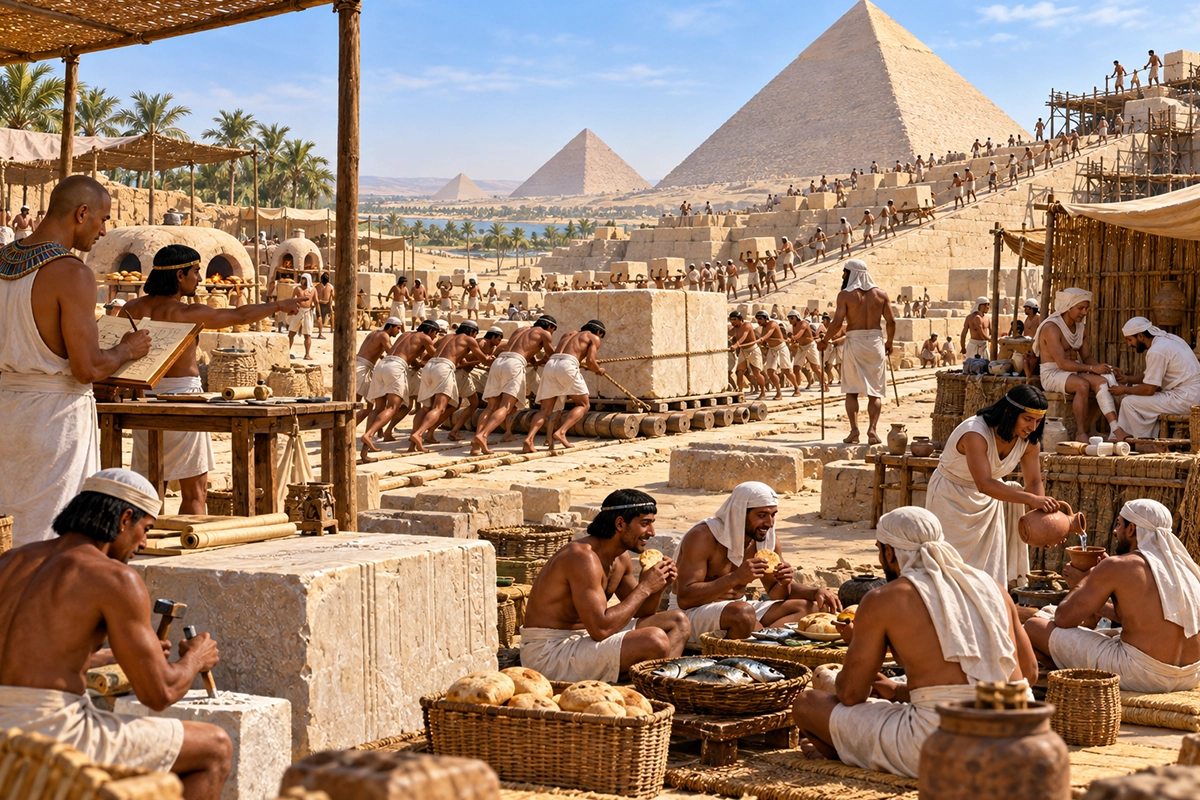
The pyramids were not built by slaves. In 1990, a horse stumbled on a mud brick wall near Giza, leading Zahi Hawass to the tombs of the pyramid builders. They were buried with honor near the king they served, which slaves would never have been. The archaeologist Mark Lehner went on to excavate their town, now called the Lost City of the Pyramid Builders. He found bakeries, breweries, long barracks and the bones of cattle, sheep and goats brought in to feed them.
Most experts estimate a core workforce of about 20,000 to 30,000 people. Skilled craftsmen worked year round. Larger crews of farmers rotated in for a few months, especially during the Nile flood season when fields were under water. Skeletons show healed fractures and even signs of surgery, so injured workers received medical care. Crews scratched their team names into the stone, such as "Friends of Khufu." As Lehner put it, the real advance was in organizing people.
Later royal workers left a similar village at Deir el-Medina in Luxor, home to the craftsmen who cut the tombs in the Valley of the Kings.
Pyramid Myths and Common Questions

The pyramids attract wild theories, from aliens to lost civilizations. None of them has evidence behind it. The quarries, tools, ramps, papyri, workers' tombs and the slow evolution from Djoser to Khufu all point to the same answer: Egyptians built the pyramids.
Other legends grew around the Giza monuments over time, as our article on what happened to the Sphinx's nose shows. Medieval builders also took the Great Pyramid's casing stones to use in Islamic Cairo, which is why its surface is stepped today.
How long did it take to build the Great Pyramid? About 20 years. That means the crews had to place a block every few minutes during daylight throughout the whole project.
What was inside the Great Pyramid? It has three main chambers, the King's Chamber, the Queen's Chamber and an unfinished chamber cut into the bedrock, joined by the tall Grand Gallery. Khufu's mummy and treasures were lost to robbers in ancient times.
Why did the Egyptians stop building pyramids? Pyramids were expensive and easy for robbers to find. By the New Kingdom, kings were buried in hidden rock-cut tombs in the Valley of the Kings instead, such as the tomb of Tutankhamun.
Seeing How the Pyramids Were Built in Egypt

You can follow the whole story in person. Start at the Giza Pyramids Complex, where you can see quarry cuts on the plateau, the remains of the workers' town and the granite of the King's Chamber. Our guide to things to do in Giza helps you plan the day. At Saqqara and nearby Memphis, you can see where the pyramid age began.
The Grand Egyptian Museum now displays Khufu's boat, a cedar vessel about 43 meters long that was buried beside the Great Pyramid. The Egyptian Museum in Cairo is home to the tiny ivory statue of Khufu, about 7.5 centimeters tall and the only complete statue of the king known to survive.
Head south on a Nile cruise and the story continues. Stone was still moved by river centuries later, which you will see at Karnak Temple with its granite obelisks. In Aswan, the Unfinished Obelisk and the granite quarries sit close to Elephantine Island. Our guides to the top tourist attractions in Egypt and the best temples to see on a Nile cruise help you plan the route.
Uncover the Oldest Mystery in Existence with Our Grand Tours
So how were the pyramids built? With limestone cut on the spot, casing stone and granite floated down the Nile, sledges dragged over wet sand, ramps that grew with each course, levers for the final lift, and a well-fed, well-organized workforce of Egyptians. The great achievement, though, is clear: it was people, not mystery, who built them.
Standing beside those weathered blocks, you feel the immortal ambition of a civilization that believed its king could climb to the stars. To see it for yourself, explore our Cairo and Nile cruise tours, the 8 Days Cairo and Nile Cruise package, or a tailor made trip, and contact our team to plan your journey.