For most of the last two thousand years, the Temple of Esna was a dark, soot-blackened hall sunk below the streets of a busy market town. Today it is one of the most colorful ancient interiors in Egypt. A restoration project led by Egyptian conservators and the University of Tübingen has cleaned its ceiling and columns, revealing painted gods, a complete zodiac and hundreds of hieroglyphic texts that no modern eye had seen clearly. Standing beneath that ceiling now, with blues, reds and golds glowing where there was only black, feels like watching an ancient world wake up.
The temple is dedicated to Khnum, the ram-headed god who shaped humankind on his potter's wheel, and it is also known as the Khnum Temple. This guide covers where Esna Temple is, when it was built, how the restoration worked, what the before and after looks like, what to see inside, and how to visit from Luxor or on a Nile River cruise, including opening hours and tickets.
Discovering Esna Temple Location and History
Where Is Esna Temple Located?
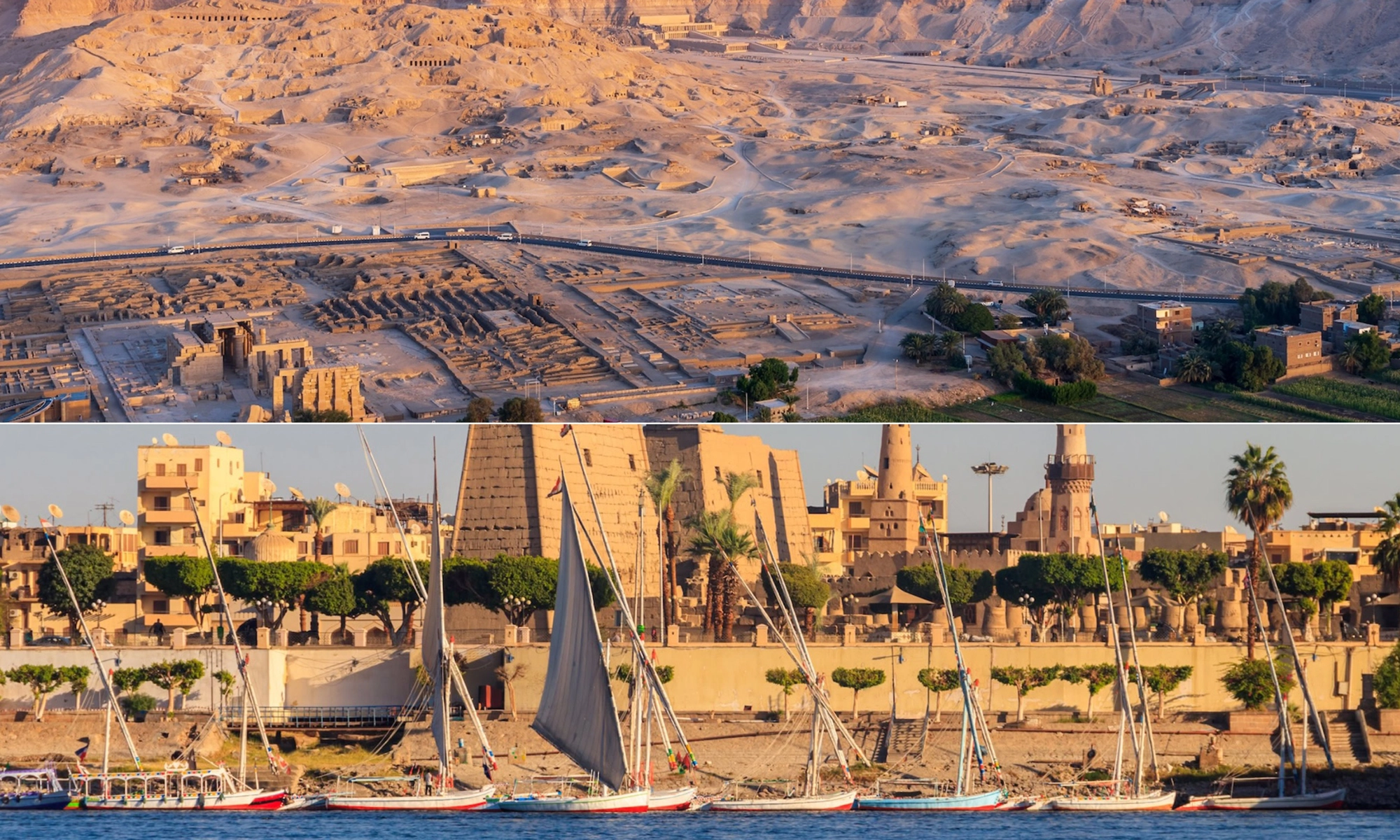
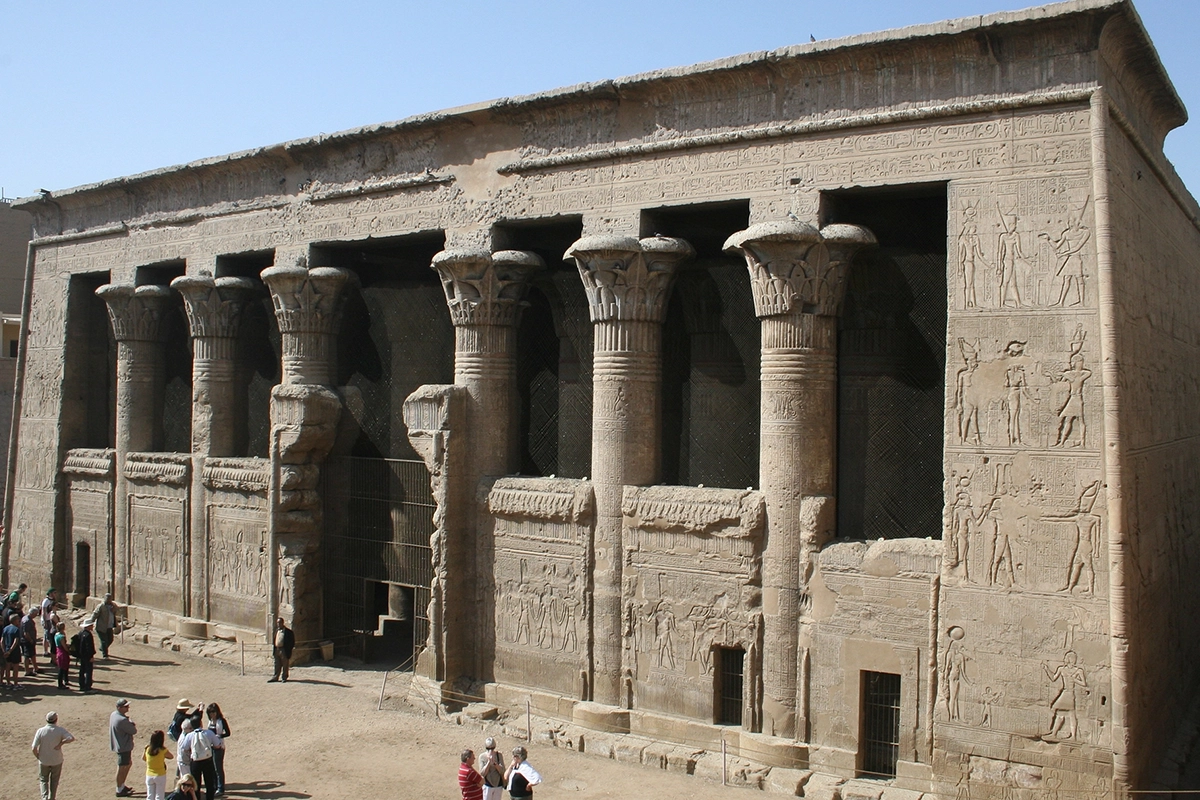
Esna Temple stands in the town of Esna on the west bank of the Nile, about 55 km south of Luxor by road and roughly halfway between Luxor and Edfu Temple. It sits in the middle of the old town, a short walk from the Nile corniche, at the bottom of a pit about 9 meters below today's street level. That depth shows how much the ground has risen around it over the centuries.
When Was Esna Temple Built?
A sanctuary to Khnum stood at Esna long before the present building, and some sources trace its origins to the New Kingdom pharaoh Thutmose III. The temple you see today, however, is much later. Work on the Ptolemaic temple began in the 2nd century BC under Ptolemy V and Ptolemy VI, and the great columned hall was added in the Roman period, probably under the emperor Claudius (AD 41 to 54).
Decoration continued for two more centuries. The latest securely dated emperor named at the temple is Decius, who reigned from AD 249 to 251, which makes Esna's inscriptions among the latest large hieroglyphic texts ever carved in Egypt. The Greeks called the town Latopolis, after the Nile perch, the lates fish, that was sacred there.
Khnum, the Potter God
Khnum was one of Egypt's oldest gods, linked to the source of the Nile flood and to creation itself. Egyptians believed he formed every person and their spiritual double on his potter's wheel before birth. At Esna he was worshipped with the goddesses Neith and Menhit, the goddess Nebtu, and Heka, the god of magic. Our guide to the story of Isis and Osiris introduces more of the gods you will meet along the river.
Buried, Forgotten and Rediscovered
After the temple fell out of use, the town grew up around and over it. Only the front hall, the pronaos, survived; the sanctuary behind it was lost or still lies beneath modern houses. In the 19th century the hall was used as a cotton store, which helped protect it, before it was cleared for visitors. Fires lit inside it over the centuries left the thick layer of soot that hid its colors until recently.
The Tale of Esna Temple Restoration
Who Restored the Temple and When
Cleaning began under the conservation department of Egypt's antiquities ministry. In 2018 the University of Tübingen, led by Egyptologist Christian Leitz, launched a joint project with Egypt's Ministry of Tourism and Antiquities, working with Hisham El-Leithy of the ministry's documentation center. An Egyptian conservation team carries out the hands-on work, and a team of around 30 people has been involved. Funding has come partly from the American Research Center in Egypt (ARCE) and German foundations.
How the Soot Was Removed
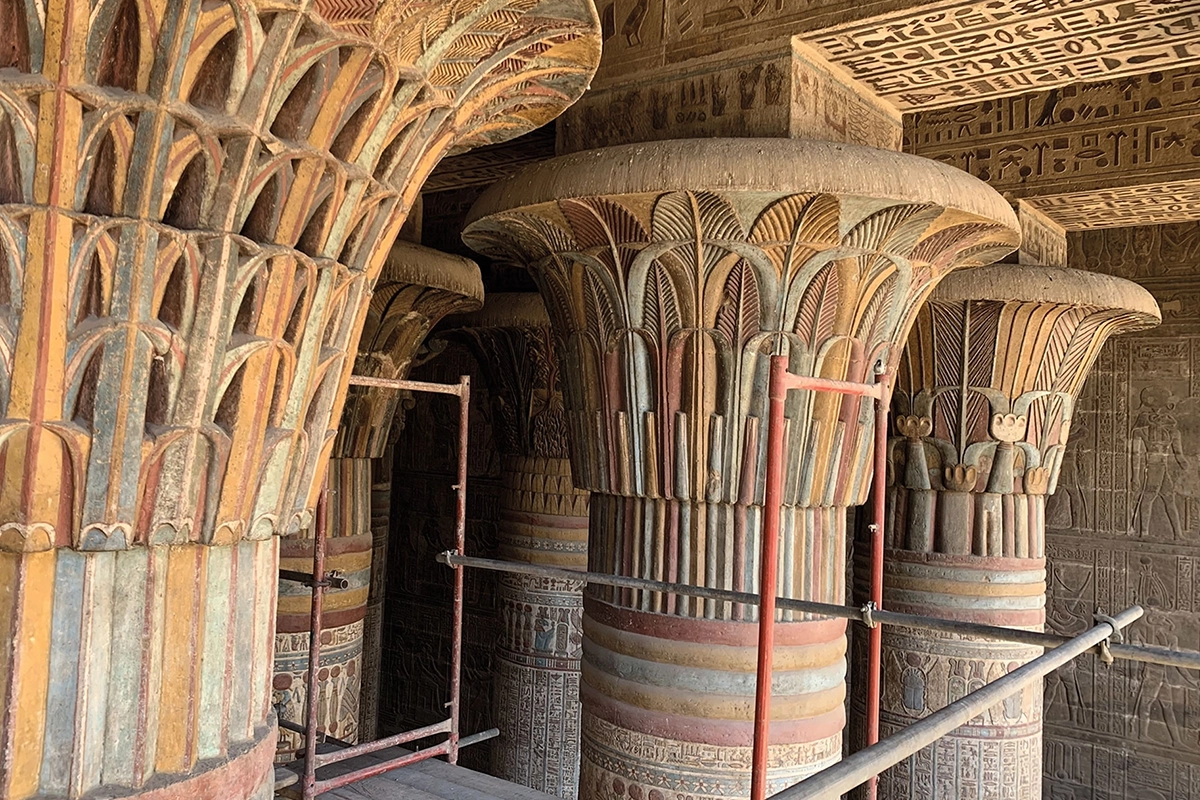
The work is slow and careful. Conservators lift soot with special sponges, remove old dirt and bird deposits with brushes, scalpels and even toothpicks, and use cotton dampened with distilled water to bring out the colors. Metal spikes are being fitted on the column tops to stop pigeons from nesting and damaging the reliefs again. Leitz has pointed out that the same soot that hid the paintings also protected them, which is why the colors survived so well.
Esna Temple Before and After
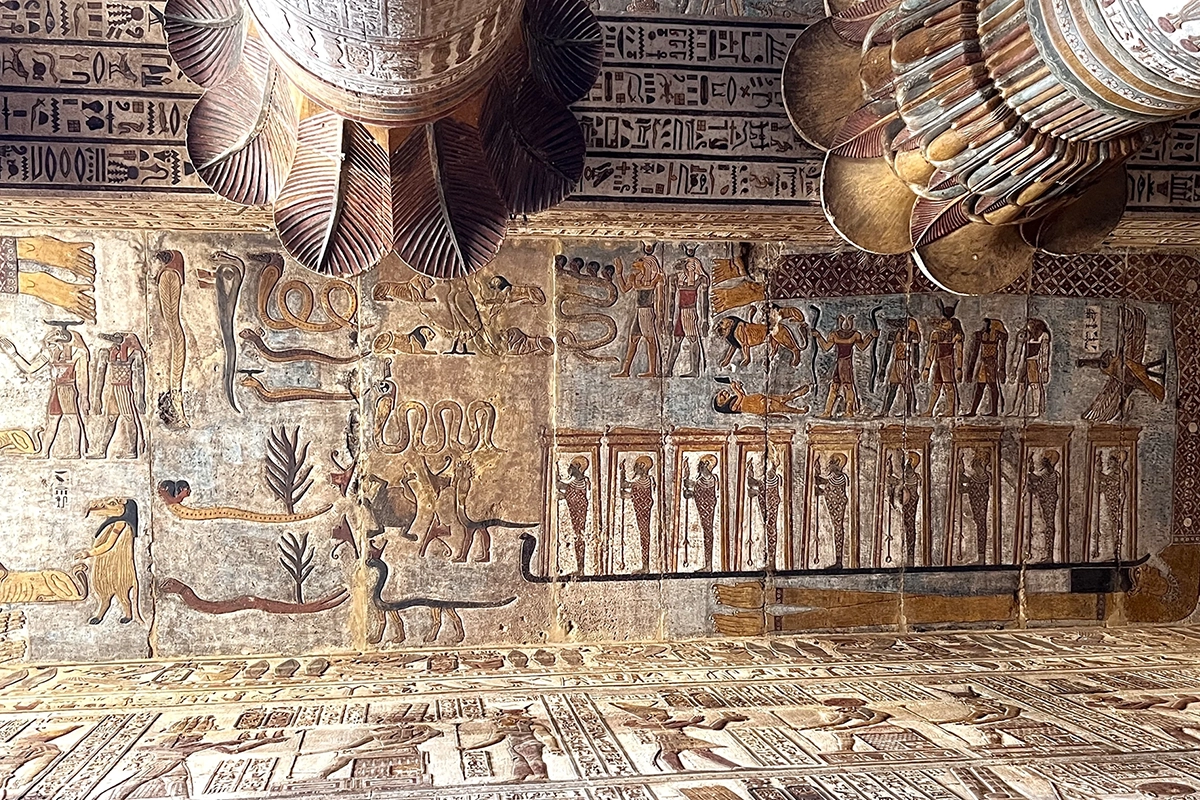
Before the restoration, visitors saw a dim gray hall. The ceiling looked almost uniformly black, and the column texts were hard to read. After cleaning, the ceiling shows rich blue backgrounds, red and yellow figures and fine details such as a winged lion with a ram's head. Fifteen of the eighteen freestanding columns have been fully restored, and parts of the hall still under treatment let you compare cleaned and uncleaned stone side by side, which is a striking sight.
New Discoveries on the Ceiling
Cleaning revealed far more than color. In 2023 the team announced that the ceiling holds a complete set of the twelve zodiac signs, along with the planets Jupiter, Saturn and Mars. They have also found around 200 previously unknown painted inscriptions, a rare southern constellation shown as a double-headed goat, and a central band of 46 vultures representing the protective goddesses Nekhbet and Wadjet. Painted texts on the undersides of the stone beams were so blackened that the French scholar Serge Sauneron, who published the temple's inscriptions from the 1960s, could not read them at all. The work continues, and the team expects to need several more years to finish.
Learn What to See Inside Esna Temple
The Hypostyle Hall and Its Columns
The surviving hall measures about 37 meters long, 20 meters wide and 15 meters high. Its roof rests on 18 columns and 6 half-columns built into the front wall. The capitals at the top are carved as palm fronds, lotus flowers, papyrus and even bunches of grapes, and no two are exactly alike. Many visitors compare the hall to the much larger columns of Luxor Temple and Karnak Temple, but Esna's interior is better preserved and far more colorful.
The Astronomical Ceiling and Zodiac
Look up first. The ceiling is divided into long painted bands showing the sky goddess Nut, stars, decans, constellations, planets and the zodiac. Only the ceiling of Dendera Temple rivals it for astronomical detail in Egypt. Bring a phone or camera with a wide lens, and stand in the center aisle to see the bands run the length of the hall.
Roman Emperors as Pharaohs
The walls and columns show Roman emperors dressed as pharaohs and offering to the gods of Esna. Names you can find include Claudius, Vespasian, Domitian, Trajan, Hadrian, Commodus, Septimius Severus, Caracalla and Decius. On the north wall, a well-known scene shows Commodus and Khnum pulling a net filled with fish and birds. In some places, the names of the emperor Philip the Arab were erased and replaced with those of Decius, who overthrew him.
Hymns, Festivals and Purity Rules
Esna is the only temple with long texts on a second register of its columns. They include hymns to Khnum, a calendar of the town's festivals, and a creation hymn with the line "All are formed on his potter's wheel." Other inscriptions set purity rules for priests entering the temple: trimming their nails, washing with natron, wearing linen and abstaining from sex for several days. If temple texts fascinate you, our guide to the best temples on a Nile cruise suggests where to see more.
What to Expect When Visiting Esna Temple
Is Esna Temple Open? Opening Hours and Tickets
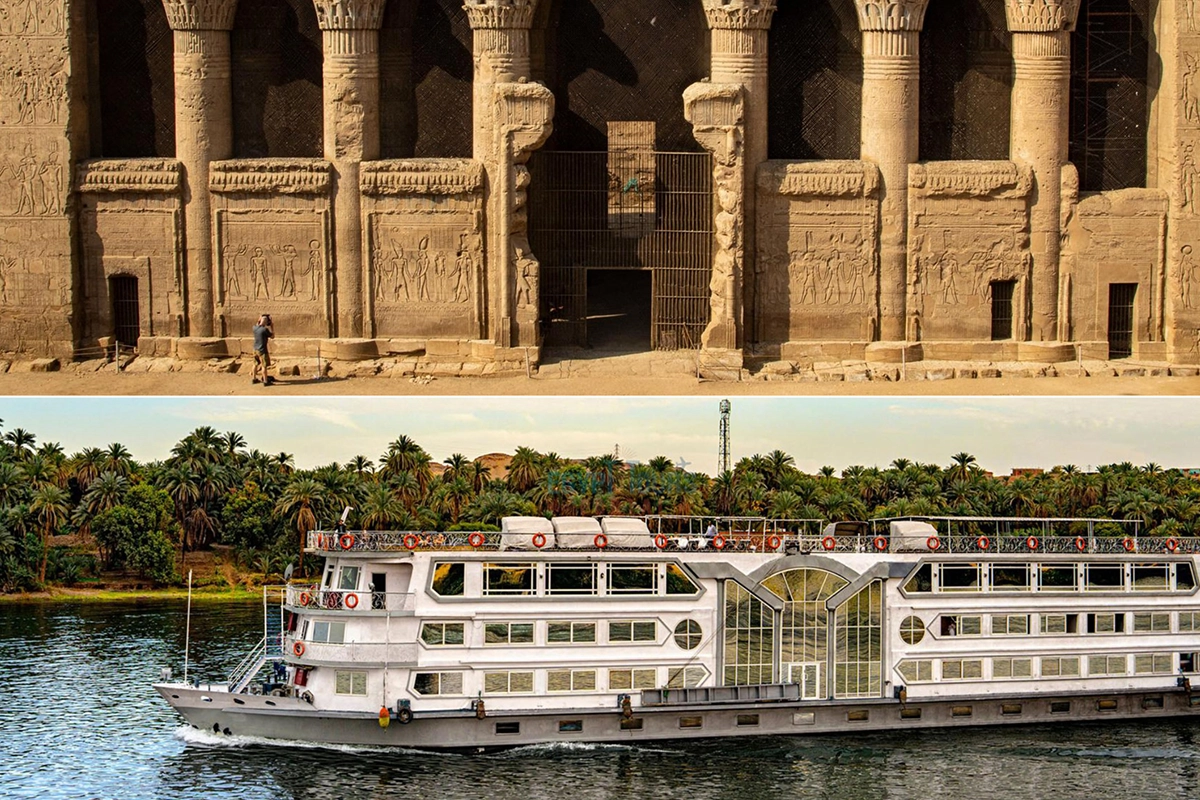
Yes, Esna Temple is open to visitors every day while restoration continues around it. Current 2026 listings give opening hours of about 7am to 4pm, with some sources listing later closing in summer, so check on the day, especially during Ramadan. Tickets for foreign adults are listed at around EGP 200, with reduced student prices, and photography with phones and cameras is allowed. A visit usually takes 45 minutes to an hour and a half.
Esna Temple to Luxor: Getting There
From Luxor, Esna is about an hour by car on the road along the west bank. Most people visit on a half-day private trip with a driver and guide, which can be combined with Edfu and Kom Ombo Temple on the way to Aswan. Esna also pairs well with the Valley of the Kings on a West Bank day. Our things to do in Luxor guide suggests how to fit it into a longer stay, and a tailor-made tour can add it to any itinerary.
Visiting on a Nile Cruise and the Esna Lock
Ships sailing between Luxor and Aswan pass through the Esna Lock beside the barrage first built here by the British in 1906. Boats often wait their turn, and small rowing boats come alongside with traders throwing tablecloths and galabeyas up to the deck in plastic bags. Bargain before you accept anything.
Many classic itineraries pass Esna without stopping, but some now include the temple as an excursion, and longer cruises and dahabiyas often moor in Esna. If the temple matters to you, ask before booking; our guide on how to book a Nile cruise lists the right questions. Browse our Nile cruises from Luxor, Luxor and Aswan Nile cruises and long Nile cruise itineraries, or read about the best stops on a Nile cruise.
The Walk Through Esna's Old Market
The walk from the river to the temple passes through the Qisariyya, Esna's historic covered market street, where textile shops and tailors still work. A heritage program restored parts of the old town, including the Ottoman-era caravanserai known as the Wekalet El-Gedawi. Vendors can be persistent, so a polite "la, shukran" (no, thank you) helps. For souvenir ideas, see our guide on what to buy in Egypt.
Tips for Your Visit
- Go in the morning, when the light inside the hall is soft and the town is cooler.
- Look up as soon as you descend the stairs; the ceiling is the highlight.
- Wear comfortable shoes, as the stairs into the pit are steep.
- Hire a guide who can read the scenes; most of Esna's meaning is in the texts.
- Visit between October and April for comfortable weather; our guide to the best time to cruise the Nile explains why.
Witness the Color and Greatness of Esna Temple
Esna Temple has gone from a forgotten, blackened hall to one of the great rewards of a Nile journey. Its zodiac, its Roman pharaohs and its hymns to the potter god are clearer now than at any time since the last priests left, and the restoration is still revealing new details.
Few places show so vividly how much color the ancient world once held. Whether you visit on a day trip from Luxor or as part of a cruise, give yourself time to stand under that ceiling. When you are ready, explore our Nile river cruises or contact us to add Esna to your journey.