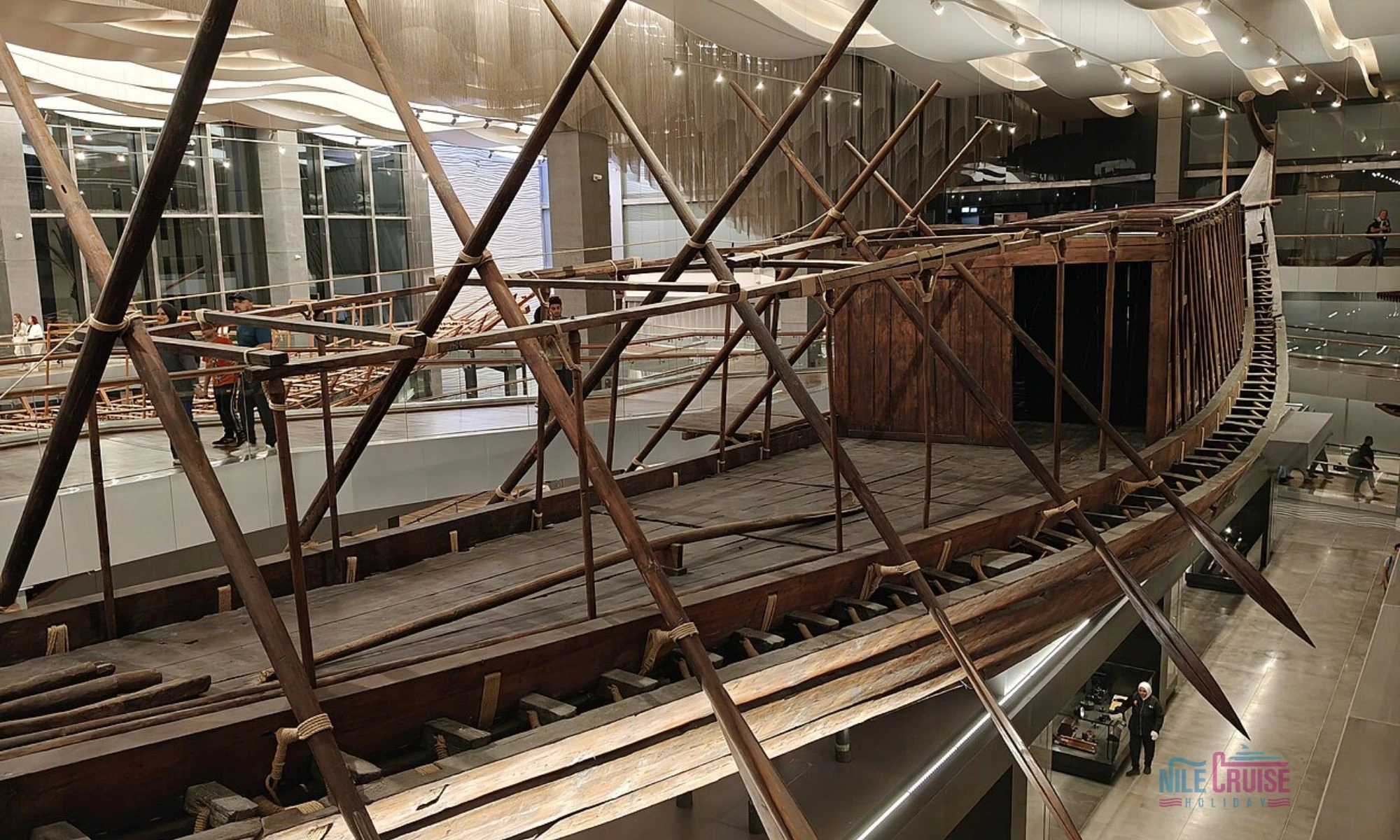

For more than four millennia, the Khufu Ship lay buried in pieces beside the Great Pyramid, one of the ancient world's most extraordinary wooden vessels. It was found dismantled in a sealed pit, its timbers stacked with care. Restorers spent years reassembling it into a full-size boat, and today the Grand Egyptian Museum displays it.
It is widely known as the Khufu Solar Boat, although its exact ancient function is still debated. The ship connects four stories at once: Old Kingdom shipbuilding, royal funerary belief, modern archaeological discovery, and one of Egypt's most remarkable conservation projects. This guide covers each of them and explains where the ship can be seen today.
What Is the Khufu Ship?

The Khufu ship is a full-size ancient Egyptian wooden vessel associated with the pharaoh Khufu, builder of the Great Pyramid at Giza. It dates to the Fourth Dynasty of the Old Kingdom, roughly 4,500 years ago, and Khufu's father Sneferu built the Bent Pyramid a generation earlier. The ship was found beside the Great Pyramid, part of the wider Giza pyramid complex, and was built mainly of cedar wood.
It is more than 42 meters long. Crucially, it was not found as a complete ship. It was discovered dismantled, as a carefully arranged set of separate components.
|
Fact |
Khufu Ship |
|
Period |
Fourth Dynasty, reign of Khufu |
|
Discovered |
1954 |
|
Found |
South of the Great Pyramid |
|
Material |
Mainly cedar wood |
|
Length |
Over 42 meters |
|
Current location |
Grand Egyptian Museum |
|
Purpose |
Debated |
How Was the Khufu Ship Discovered?

The 1954 Discovery Beside the Great Pyramid
In May 1954, during clearance work along the south side of the Great Pyramid, the Egyptian archaeologist Kamal el-Mallakh identified a sealed pit cut into the bedrock. Large limestone blocks covered it. When the first block was lifted, the smell of ancient cedar is said to have drifted up from below.
Inside lay the dismantled ship. Its timbers, oars, and fittings had been stacked in layers, with ropes and other materials alongside them. The ship itself was not found floating or assembled intact. It survived as carefully arranged wooden components, protected for thousands of years by the sealed pit.
Why Were Boats Buried Beside the Pyramid?
The boat pits were part of Khufu's funerary complex, the group of structures built around the pyramid to serve the king in death. Readers curious about the pyramid itself can see how the pyramids were built.
Boats held deep meaning in Egyptian royal burial. They could carry people and goods along the Nile in life, and they also appear in beliefs about travel in the afterlife. Burying full-size boats beside the pyramid may have served practical funeral rites, symbolic afterlife needs, or both. The exact reason is part of a wider debate covered below.
How Was the Khufu Ship Reconstructed?
Reassembly was an enormous challenge. The ship came out of the pit as 1,224 separate pieces, and there was no surviving ancient instruction manual. Restorers had to read construction clues from the wood itself: marks, notches, holes, and the shapes of individual planks.
The work was led by Ahmed Youssef Moustafa, chief restorer of Egypt's antiquities service. He studied traditional Egyptian boat-building and spent time with modern shipwrights along the Nile to understand how such a hull might fit together. The vessel was assembled, taken apart, and reassembled several times over years of study before the final reconstruction was complete.
Ancient Egyptian Shipbuilding Without Metal Nails
The Khufu ship was built using a shell-first approach, in which the hull planks were shaped and joined before internal frames were added. It has a flat bottom and no keel.
Its builders relied heavily on fitted timber joinery and rope lashings rather than modern metal fasteners. Wooden tenons slotted into mortises in neighboring planks, and ropes passed through holes in the timbers to lash planks and frames tightly together. Traditional wooden boats still sail the river today, such as on a felucca ride in Cairo, though they are built differently.
What Was the Khufu Ship Used For?

There is no single universally accepted answer. The vessel is widely known as the Khufu Solar Boat, but its exact purpose is still debated. It may have had a funerary role, a symbolic solar role, or both.
Funerary Boat Theory
One interpretation suggests the ship played a part in Khufu's funeral. It may have carried the king's body, or funerary equipment, along the river from Memphis, the royal capital, to Giza. Some researchers have pointed to signs of wear on the timbers as evidence that the ship was used on water at least once. Others question that reading.
If the funerary theory is right, the ship may have ended its working life at a harbor or valley temple near the plateau, similar in function to the later Valley Temple of Khafre, before being dismantled and buried.
Solar Boat Interpretation
Solar theology was central to Egyptian kingship. The sun god Ra was believed to travel across the sky by day and through the underworld by night in a boat. The king, after death, was associated with the sun god and could be thought of as joining that journey. A buried boat beside the pyramid fits naturally into this belief, which is why "solar boat" became the popular term.
The name "solar boat" is useful and widely recognized, but it is not proof of the vessel's exact historical function. A further theory suggests Khufu used it in life for journeys to important sites, before it was buried for his use in the afterlife.
The Second Khufu Ship
Two major boat pits lay south of the Great Pyramid, and the second held another dismantled vessel. Its pit was identified at the same time as the first, but the wood was fragile and the excavation did not begin until 2011.
The work has been carried out through Egyptian and Japanese cooperation, with Japanese archaeologists working alongside Egyptian conservators and funding from the Japan International Cooperation Agency. Around 1,650 wooden pieces have been recovered, studied and conserved, a figure often rounded to about 1,700. Many of the planks are in very weak condition. Reassembly began in public view at the Grand Egyptian Museum in December 2025 and is expected to take several years.
Why the Second Boat Matters
The second ship gives researchers something rare: a direct comparison. By studying both vessels, specialists can compare construction techniques, timber treatment, assembly methods and preservation. Similarities show which methods were standard in Khufu's time, and differences can reveal choices made by individual builders. The second boat is still undergoing conservation and reconstruction, so its story is very much in progress.
How the Khufu Ship Moved to the Grand Egyptian Museum

From the Old Solar Boat Museum to GEM
After reconstruction, the first ship was displayed in a purpose-built museum beside the Great Pyramid, which opened to the public in 1982. For decades, visitors saw it there, directly above the pit where it was found.
In August 2021, the ship was moved as a complete reconstructed vessel to the Grand Egyptian Museum, a short distance away. It now sits in a new display and conservation environment designed for its long-term protection. The old Solar Boat Museum beside the Great Pyramid is no longer where visitors see the first reconstructed Khufu ship.
Why Moving the Whole Ship Was So Difficult
The ship is more than 4,500 years old, made of organic material and over 42 meters long. Any twisting, vibration or sudden movement risked damaging the ancient timbers. Engineers moved it whole, inside a protective structure carried on a specially designed vehicle, with movement carefully controlled throughout the journey.
Where Can You See the Khufu Ship Today?

The first reconstructed Khufu ship is now displayed at the Grand Egyptian Museum in Giza. It sits in a dedicated boat museum within the GEM complex, where the second ship's conservation is also taking place. This modern display is separate from the original boat pits beside the Great Pyramid.
Can You Still See It at the Giza Pyramids?
Not in the old Solar Boat Museum beside the Great Pyramid. The archaeological context remains at the pyramid complex, where the boat pits were cut into the bedrock. The reconstructed ship itself moved to the GEM in 2021.
Combine the Great Pyramid and GEM
A visit to both gives the full story. The Great Pyramid shows the original archaeological context, and the GEM shows the preserved, reconstructed vessel. The pyramid shows where the vessel belonged, and the museum shows how it survived. Our list of things to do in Giza helps with wider planning, and most Cairo and Nile cruise tours include time at Giza.
Travelers combining Cairo, Giza and a Nile cruise can ask NCH to coordinate the Grand Egyptian Museum and Giza Plateau around a tailor-made itinerary.