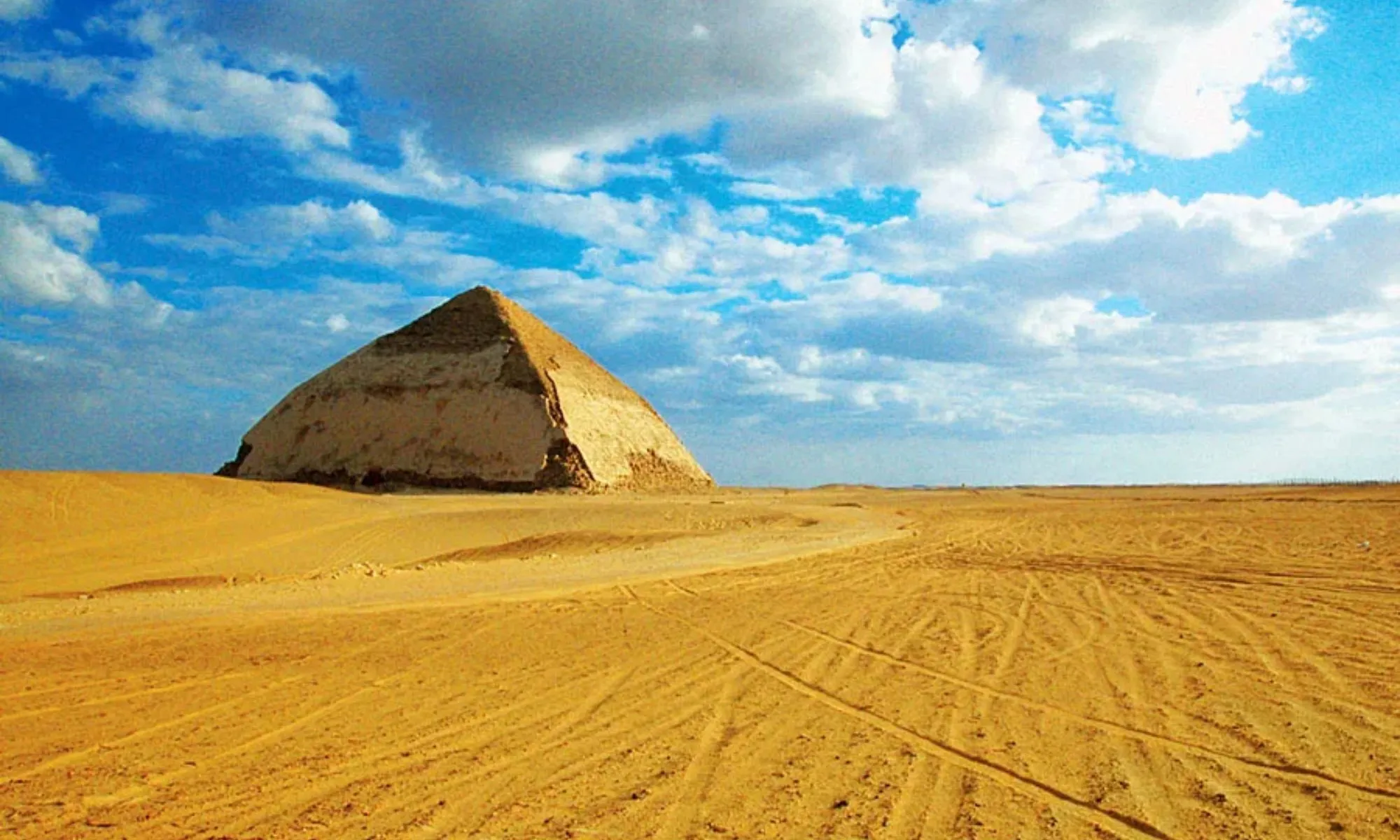
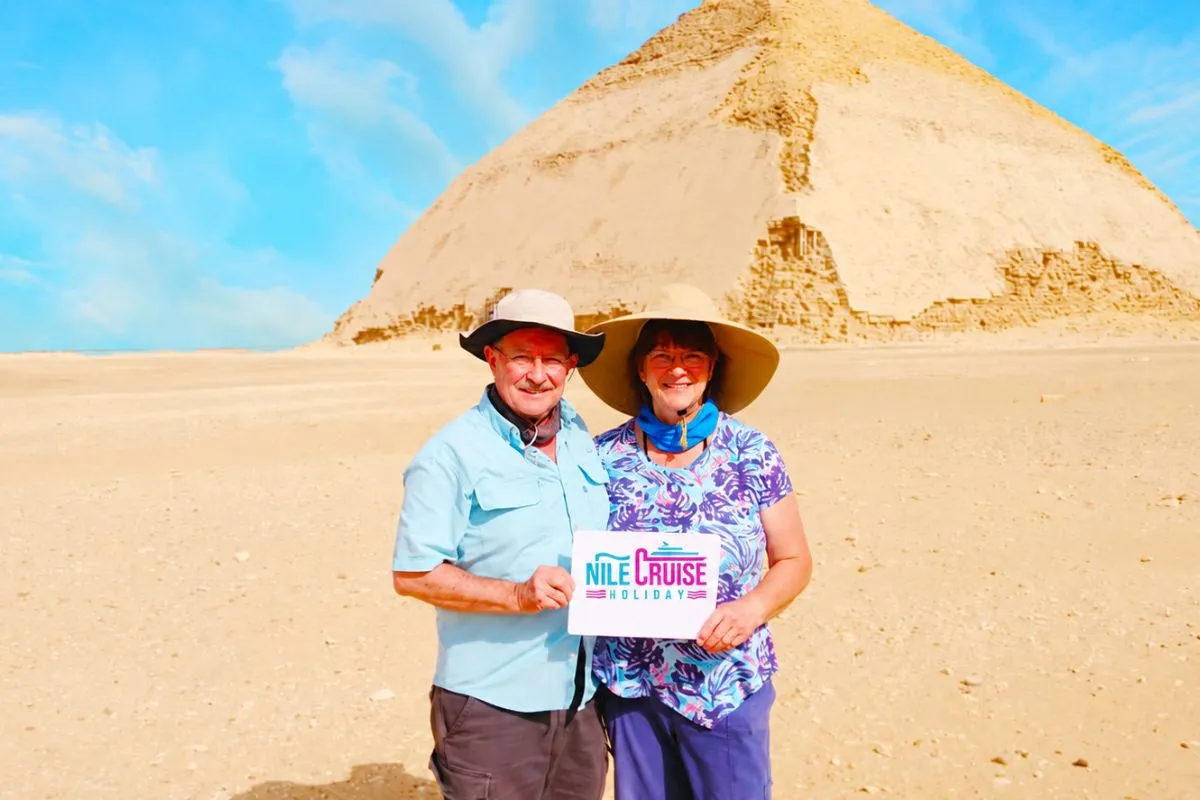
The road south from Cairo leaves the traffic behind faster than most visitors expect. Palm groves give way to open desert, and then a shape appears on the horizon that looks slightly wrong. Its lower half rises steeply. Its upper half leans back at a gentler angle, as if the builders changed their minds halfway up.
They did. The Bent Pyramid at Dahshur, about 40 kilometres south of central Cairo, is one of the clearest records of trial and error anywhere in the ancient world. Giza's famous pyramids did not appear fully formed. They came after decades of bold attempts, and at Dahshur, you can walk inside one of those attempts and feel its scale in your legs and lungs.
Most travelers know the things to do in Giza. Far fewer reach Dahshur, which is exactly why it rewards the effort. This guide covers why the pyramid bends, what the descent inside actually feels like, how it connects to the Red Pyramid next door, and how to fit it into private Cairo and Nile cruise tours.
Sneferu's Pyramid Experiment
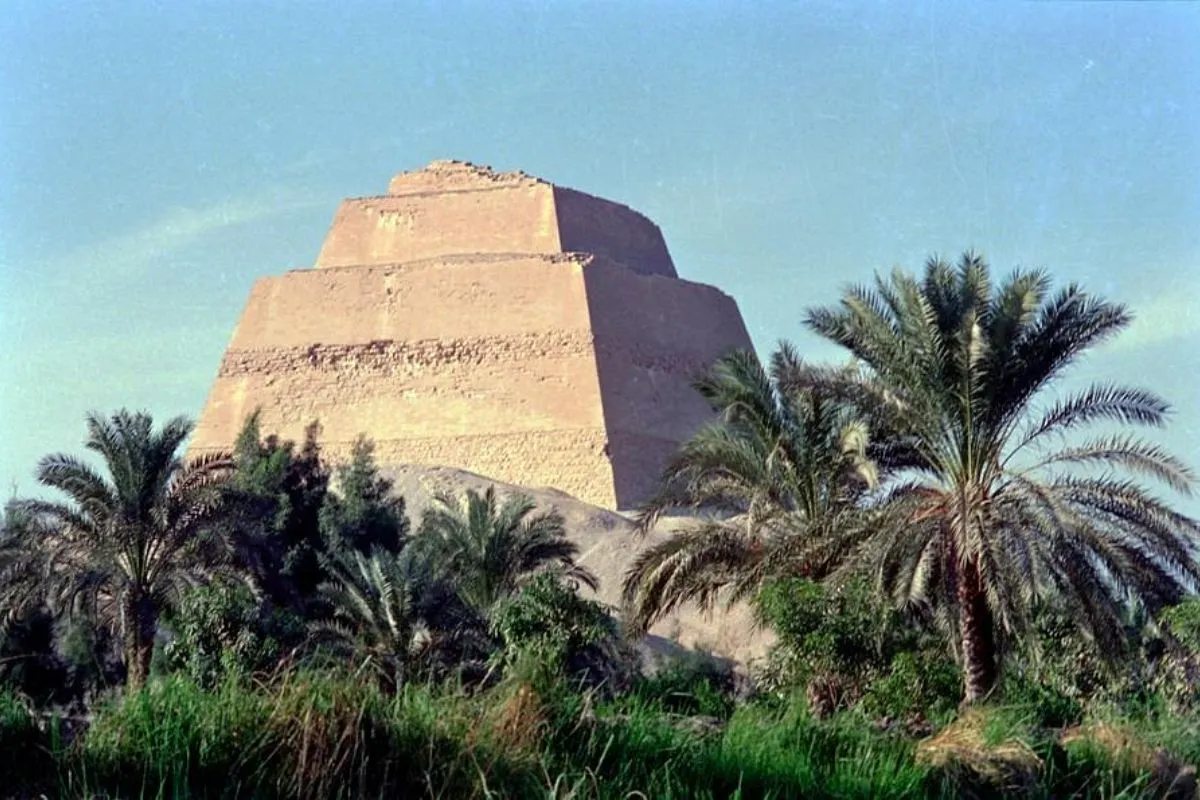
Sneferu, first king of the Fourth Dynasty, ruled around 2600 BC. His son Khufu would build the Great Pyramid of Giza, but the knowledge Khufu's engineers used was earned during his father's reign. Sneferu is credited with at least three major pyramids, more stone than any other pharaoh moved, and Dahshur was his proving ground.
From Saqqara to Dahshur
About a century earlier, the architect Imhotep stacked six stone platforms at Saqqara to create Djoser's Step Pyramid, the first monumental stone building in Egypt. It was a staircase to the sky, not a smooth geometric form. Sneferu's builders inherited that stepped tradition and set out to transform it.
Sneferu's Big Ambition
The goal at Dahshur was a true pyramid with flat, smooth sides meeting at a single point. That sounds simple today. In practice, it meant calculating loads, angles, and foundations on a scale no one had attempted. Among Egypt's top tourist attractions, few show the moment of invention as honestly as this one.
Why Is It Bent?
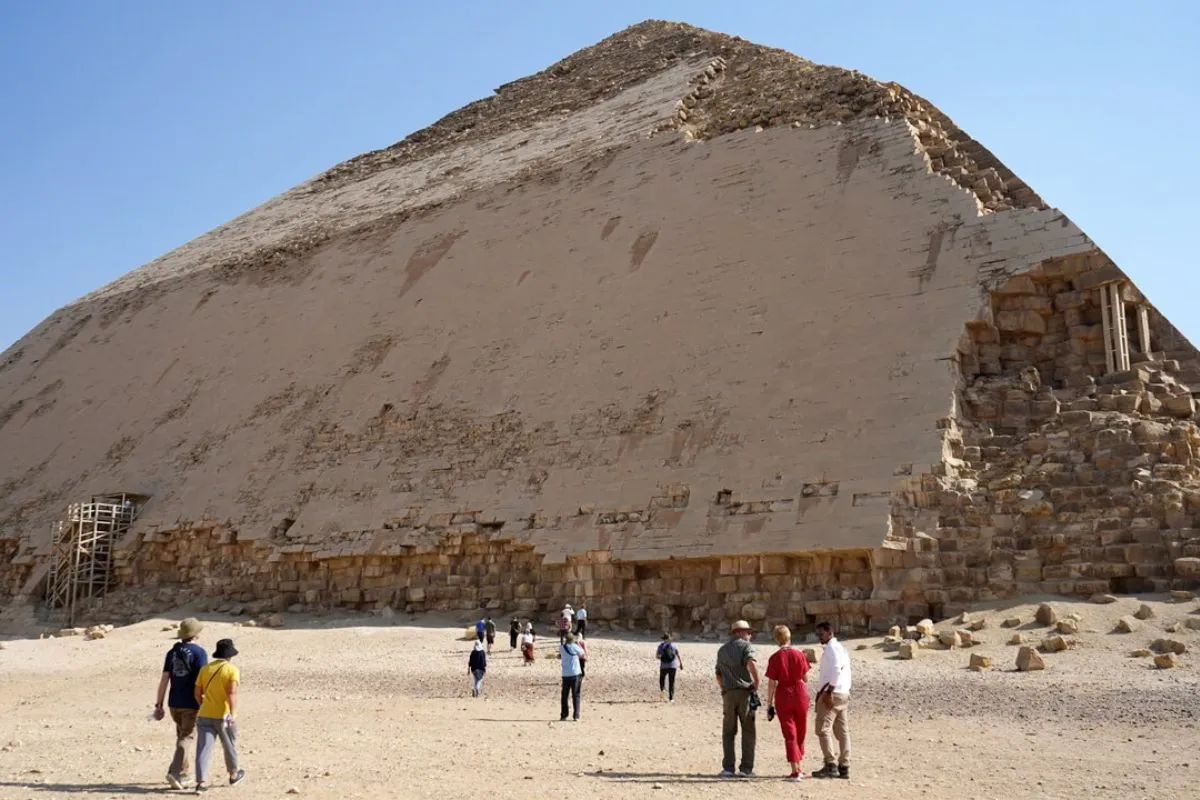
The answer is visible from the car park, which is part of the pleasure. The building tells its own story.
From 54° to 43°
The lower section of the Bent Pyramid rises at roughly 54 to 55 degrees. At around 49 metres, the angle drops to about 43 degrees for the remainder of the climb to its 101-metre summit. That change gives the monument its unmistakable silhouette.
Signs of Instability
Mainstream Egyptologists agree the builders reduced the slope because the structure was showing stress. The original steep angle placed enormous weight on the internal chambers, and the desert clay beneath the base was less stable than solid bedrock. Cracks appeared inside, and the builders added timber bracing and casing adjustments to hold things together. Lowering the angle cut the remaining mass and eased the pressure.
A Lesson in Stone
Calling it a failure misses the point. The Bent Pyramid still stands after 4,500 years, and it keeps more of its original polished limestone casing than any other pyramid in Egypt. When the afternoon sun hits that pale surface, you can see exactly how all pyramids were meant to look. It is a lesson recorded in stone, and every pyramid that followed learned from it.
Going Inside the Pyramid
The interior was closed to the public for decades and reopened in July 2019. Going in is the reason to come.
The Steep Descent
Entry is through a raised doorway on the north face. From there, a narrow passage about 79 metres long drops into the bedrock at a sharp angle. Wooden boards with cross slats give your feet purchase, and a handrail runs alongside. The ceiling sits low enough that most adults walk bent over, and the air grows warmer and stiller with every step. Conversation fades. All you hear is breathing and shoes on wood.
The Corbelled Chambers
At the bottom, the passage opens into a chamber that feels startling after the cramped descent. Its corbelled ceiling rises in inward stepping courses of stone, each layer projecting slightly over the one below, until the walls nearly meet far overhead. Torchlight catches the edges of each course. This technique let builders span a space without a single beam, and it is still holding after 45 centuries.
Ladders and Passages
The Bent Pyramid has two separate chamber systems, one reached from the north and one from a second entrance on the west face. Inside, a tall modern wooden ladder climbs from the lower chamber toward a passage connecting the two. Few pyramids feel this vertical. In the upper chamber, ancient wooden beams that the builders wedged between the walls are still in place, believed to be bracing against the very cracking that bent the pyramid.
Heat, Bats, and Tight Spaces
Expectations matter here. The passages are tight, the air is humid, and the climb back up is a real workout on the thighs. A faint ammonia smell from bats sometimes lingers in the lower areas. Water and light breathable clothing help, and our health guide for Egypt covers hydration in the heat.
The Red Pyramid

A short drive north, the payoff waits.
Sneferu Tries Again
Rather than gamble on the steep angle again, Sneferu's builders started the Red Pyramid at about 43 degrees from the base. The result was stable from the first course to the last. It rises around 104 metres, taking its name from the reddish limestone exposed after its white casing was removed in later centuries.
Egypt's First True Pyramid
The Red Pyramid is widely considered Egypt's first successful smooth-sided true pyramid. Every lesson from the Bent Pyramid fed into it, and within a generation that knowledge reached Giza, where Khufu raised the Great Pyramid and Khafre's builders later carved the Sphinx. Curious minds often ask how the Sphinx lost its nose, but fewer ask how the pyramids behind it became possible. Dahshur is the answer.
Going Inside the Red Pyramid
The entrance sits about 28 metres up the north face, reached by a stone stairway. A passage of roughly 60 metres slopes down into two connected corbelled antechambers, then a wooden stairway leads up into the tallest burial chamber. It is less vertical than the Bent Pyramid, but just as humbling. A visit here pairs well with the slower pace of a luxury Nile cruise later in your trip.
Visiting Dahshur
Why It Feels Different from Giza
At Giza, camel touts, tour buses, and crowded viewing points come with the territory. Dahshur is a different world. Some mornings, your group may be the only one at the Bent Pyramid. Wind moves across the sand, a guard nods from the shade, and the monument has your full attention.
How Much Time You Need
Two to three hours covers both pyramids comfortably, including both interiors and time to photograph the exteriors. Combined with Saqqara, Dahshur fills a relaxed full day, which is easy to build into a tailor-made Egypt itinerary. Cooler months make the descent far more pleasant, and our guide to the best time to cruise the Nile explains why.
Who Should Skip the Interior
Anyone with claustrophobia, knee or back problems, heart conditions, or asthma should think carefully before going down. The exteriors alone are worth the trip. Sturdy shoes are essential either way, and our packing list for a Nile cruise covers footwear that handles both pyramid passages and ship decks.
Explore Dahshur with NCH
Private Transport from Cairo
Dahshur is not served by easy public transport, and taxis rarely wait while you explore. Nile Cruise Holiday arranges a private, air-conditioned vehicle and driver from your Cairo hotel, as included in our 8 days Cairo and Nile cruise package. If you're weighing how private tours compare with group tours, Dahshur is where the difference shows most.
Follow the Pyramid Story
Without context, these sites are impressive piles of stone. With a licensed Egyptologist guide, they become chapters in one story: the Step Pyramid, the Bent Pyramid, the Red Pyramid, then Giza. Our guides time each stop around light and crowds, and our zero-commission policy means no unplanned detours to papyrus or perfume shops. That approach shapes all our Egypt tour packages with a Nile cruise.
Pair It with Saqqara
Saqqara sits on the road to Dahshur, so pairing them is effortless. Starting at Djoser's Step Pyramid and finishing inside Sneferu's chambers gives the clearest narrative of how pyramids evolved. The 10 days Cairo and Nile cruise package leaves room for that full archaeology day.
Continue to the Nile
A private Cairo archaeology day makes a fine opening chapter. From there, a short Cairo to Luxor flight guide covers the hop south to Nile cruises from Luxor, while a Cairo to Aswan flight suits northbound Luxor and Aswan Nile cruises. Travelers planning for August 2027 can even link Dahshur with a 2027 solar eclipse cruise near Luxor.
Plan Your Pyramid Journey
Walking inside Sneferu's experiment is a quiet privilege that Giza's crowds rarely offer. A private guided morning at Dahshur is the ideal opening to an Egypt trip, followed by a journey south aboard an ultra-luxury Nile cruise where the rest of ancient Egypt unfolds at river pace.