The Sekhmet Egyptian goddess is often remembered only as a war goddess. That picture is incomplete.
Her lioness power could destroy enemies and bring pestilence, but the same force could protect the king, repel disease, and support healing. This guide covers her roles, myth, symbols, and family, the statues made for Amenhotep III, and where to see them.
Who Was Sekhmet?
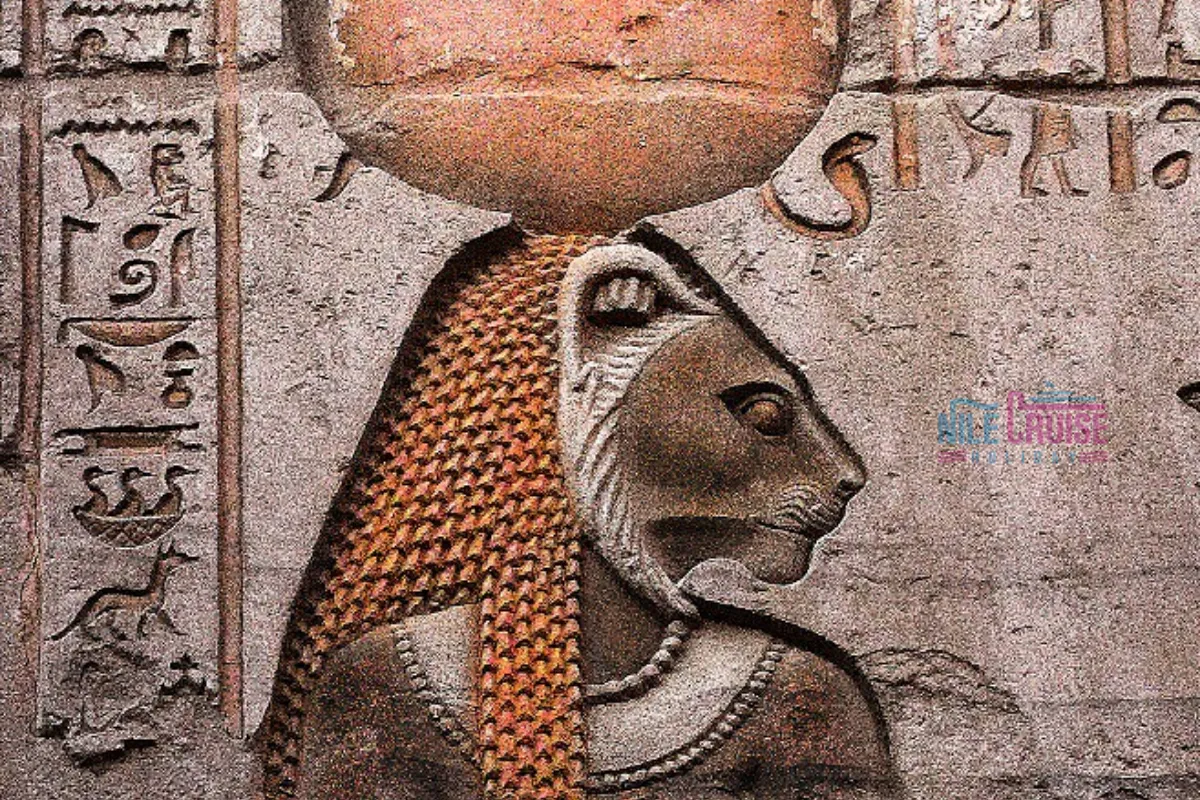
Sekhmet was a major lioness-headed Egyptian goddess whose name is usually understood as "the Powerful One." She embodied the sun's dangerous force and was tied to kingship, warfare, disease, and healing. In some traditions, she was a form of the Eye of Ra, the sun god's fierce protector.
Sekhmet represented destructive power under divine control. The same force that could punish enemies or send disease could also protect the king and repel danger.
Quick Facts About Sekhmet
| Question | Sekhmet |
|---|---|
| Main roles | War, pestilence, healing, protection |
| Form | Lioness-headed woman |
| Solar role | Eye of Ra |
| Major cult connection | Memphis |
| Consort | Ptah in Memphite tradition |
| Child | Nefertem in the Memphite Triad |
| Royal role | Protector of the king |
| Major statue patron | Amenhotep III |
What Was Sekhmet the Goddess Of?
War and Destruction
Texts compare a king's fury in battle to Sekhmet's. Her destructive power served divine and royal order. She turned against the enemies of the sun god and the king, rather than acting out of random violence.
Disease and Pestilence
Sekhmet could also be linked with pestilence and other dangerous, invisible forces. Her anger might be associated with outbreaks of disease. That did not make her the cause of every illness.
Healing and Protection
A goddess powerful enough to send disease could also restrain, repel, or cure it. Sekhmet could be associated with both causing and averting disease. Priests bearing her name could participate in healing practices, and a medical papyrus mentions priests of Sekhmet among those who examined patients.
Not every doctor was her priest, and not every priest of Sekhmet was a healer.
Sekhmet and the Eye of Ra

The Eye of Ra was the sun god's active, protective force, often imagined as a fierce goddess who went out to defeat his enemies. Sekhmet was one of several goddesses who could take this role.
The Destruction of Mankind
The best-known Sekhmet myth survives in the Book of the Heavenly Cow, inscribed in several New Kingdom royal tombs. As Ra grows old, humanity plots against him. He sends his Eye as a fierce goddess to punish them, and she begins to slaughter people.
Once her task is done, she cannot be stopped. Ra has beer dyed red with ochre poured over the fields so it looks like blood. The goddess drinks it, becomes drunk and returns calmed, and humanity survives. The story should not be read as a record of one exact festival ritual.
Sekhmet and Hathor
In the surviving text, the fierce goddess appears under Hathor's name, and Sekhmet's name is linked to her power. Different versions and traditions associate the destructive Eye of Ra with Sekhmet, Hathor, or closely overlapping forms of the solar goddess. They should not be collapsed into one permanent identity. Our guide to Hathor covers her side of the story.
Sekhmet Symbols and Family
What Did Sekhmet Look Like?
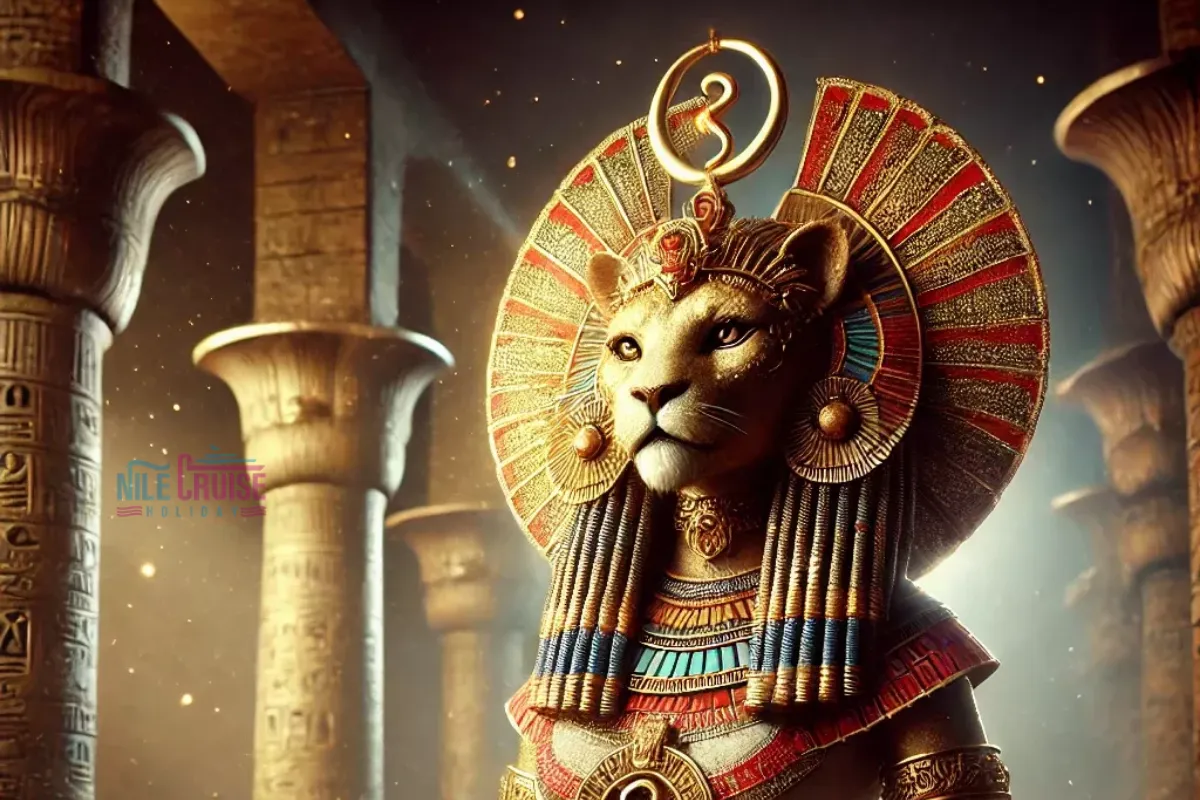
Sekhmet usually appears as a woman with a lioness head, wearing a close-fitting dress. A sun disk rests on her head, often with a uraeus, the rearing cobra, at its front. She may hold an ankh or a papyrus-shaped scepter.
Why a Lioness?
Lionesses were among the most feared predators Egyptians knew, and they defend their young fiercely. That combination of threat and protection matched Sekhmet's role. It also suited the scorching sun and a king's force in battle.
Sekhmet's Symbols
Her main symbols are the lioness, the sun disk, the uraeus and, in some images, the ankh. None of these, except her lioness form, identifies her on its own, since many Egyptian deities wore the sun disk and uraeus or carried the ankh. Our guide to Egyptian symbols and meanings explains them in more depth.
Ptah and Nefertem
At Memphis, Sekhmet was the consort of Ptah, the city's creator god, and Nefertem, a god linked with the lotus, was their child. This grouping belongs to the Memphite Triad and should not be treated as the only genealogy these gods ever had.
Sekhmet and Bastet
Sekhmet and Bastet were distinct feline goddesses whose solar and protective identities could overlap. Later and popular traditions often contrast Sekhmet's lioness ferocity with Bastet's more domestic feline form, but the two were not simply one goddess switching identities.
Amenhotep III's Sekhmet Statues
In the surviving record, the scale of Amenhotep III's Sekhmet statues is unmatched. He ruled in the fourteenth century BC. Hundreds of seated and standing granite figures survive.
Amenhotep III commissioned hundreds of Sekhmet statues, probably as part of an extensive ritual program involving royal wellbeing, protection, and the management of the goddess's dangerous power. Some Egyptologists interpret the group as a "litany in stone," in which each statue helped calm the goddess and keep her harmful side away from the king. This remains an interpretation rather than a documented purpose.
Many of the statues are thought to have stood first in Amenhotep III's mortuary temple on the West Bank, known today as Kom el-Heitan. According to the Grand Egyptian Museum, some were moved across the Nile to the Temple of Mut at Karnak around 300 years later. Large groups have been found at both sites, and scholars still debate whether every statue began at Kom el-Heitan. The popular idea that there was one Sekhmet statue for every day and night of the year is attractive but should not be presented as certain historical fact.
Where to See Sekhmet in Egypt
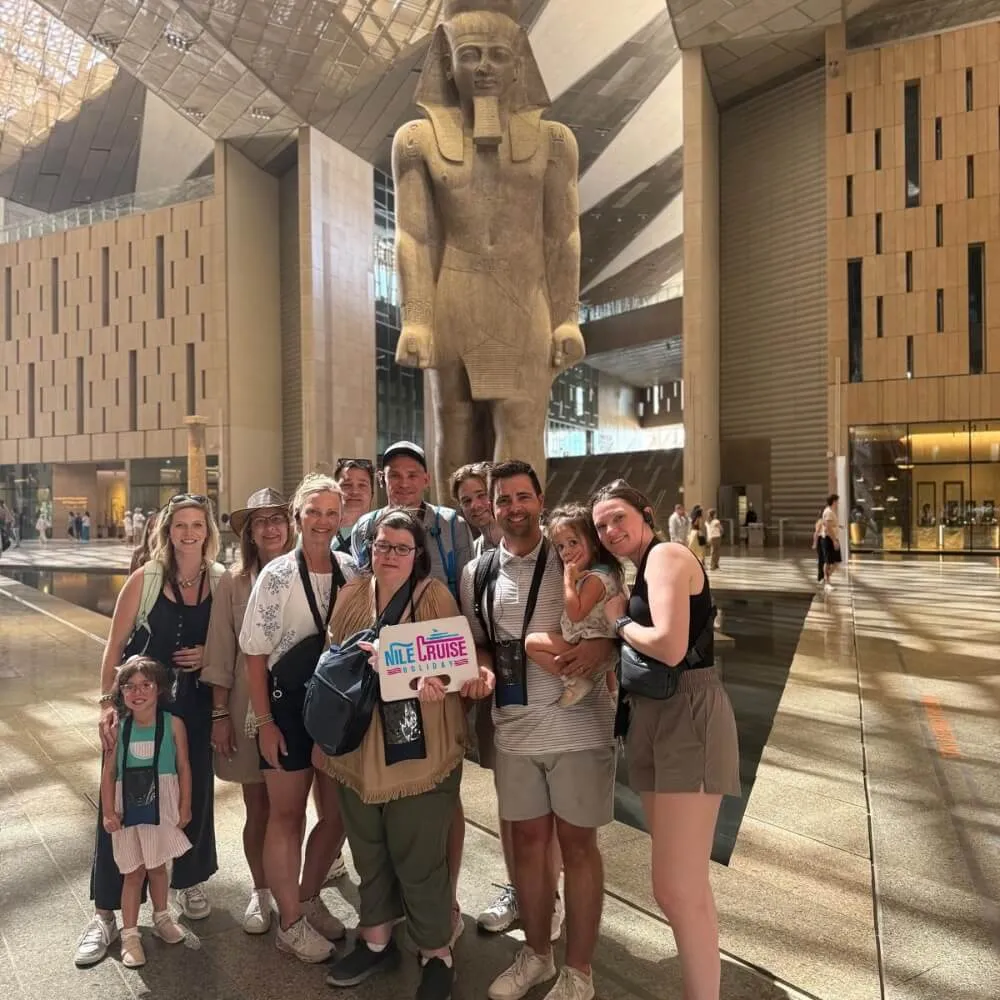
Grand Egyptian Museum
The Grand Egyptian Museum near Giza lists a seated granite statue of Sekhmet from Amenhotep III's reign (GEM 45251) in its Grand Stairs collection. Displays can change.
Karnak and the Mut Precinct
The Precinct of Mut lies just south of the main temple at Karnak. Many Sekhmet statues have been found there, and excavation teams have displayed a number of them within the precinct. Access to the Mut Precinct is more limited than to the main temple, so it should be confirmed in advance.
Amenhotep III's West Bank Temple
Little stands of Amenhotep III's mortuary temple beyond the Colossi of Memnon, the two great seated statues of the king at its entrance. Ongoing excavations behind them have recovered many Sekhmet statues. It is an archaeological landscape rather than a preserved temple.
Memphis
Memphis was the center of Sekhmet's family with Ptah and Nefertem. There is no intact Temple of Sekhmet to visit, but the site places her within the city's religious life.
Nile Cruise Holiday's Role
Nile Cruise Holiday can connect Sekhmet's story to the places where her cult and royal imagery survive, pairing Cairo's museum collections with Karnak and the West Bank archaeology of Amenhotep III within one coordinated journey. By handling itinerary sequencing, transfers, Nile cruise timing, and Egyptologist-guided visits, NCH helps travelers understand Sekhmet in context rather than as an isolated museum label. A Cairo and Nile cruise tour combines the Grand Egyptian Museum with Luxor.
Travelers interested in following Sekhmet's story can ask Nile Cruise Holiday to connect Cairo's museum collections with Karnak and the West Bank sites associated with Amenhotep III within a tailor-made Egypt trip.