Going inside the Great Pyramid does not reveal painted walls, golden treasure, or Khufu's mummy. The experience is architectural. Narrow passages, steep stone ramps, the tall Grand Gallery, and the granite King's Chamber are what visitors actually see.
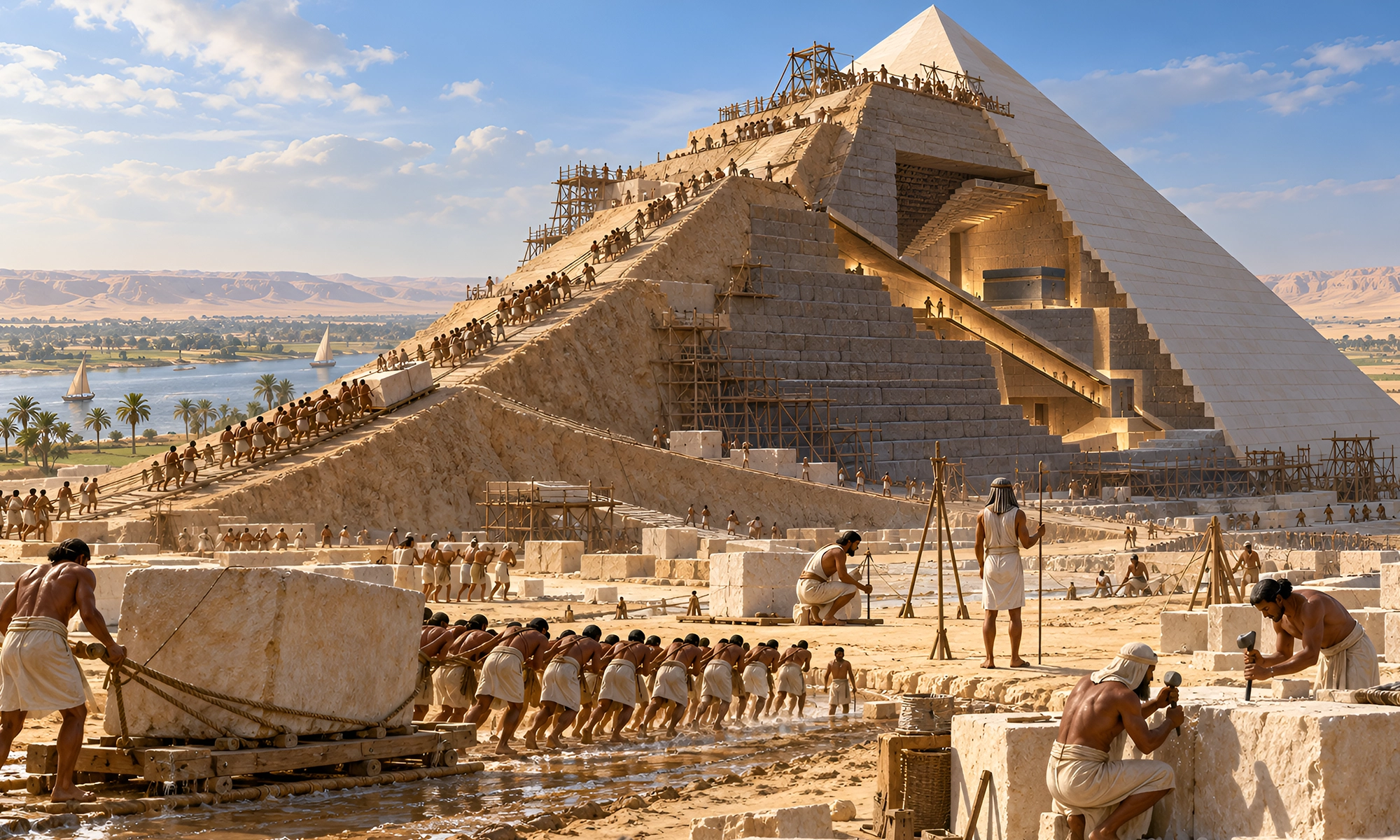
The Great Pyramid was built for Khufu, a king of the 4th Dynasty, around 4,500 years ago. Inside its mass of limestone lie three main chambers linked by a narrow internal route. Entry needs a separate interior ticket on top of plateau admission, and the reward is physical rather than decorative. Visitors climb through the monument itself.
This guide explains what is inside, how the route works, which chambers may or may not be open, what the climb feels like, and whether the interior ticket is worth it.
What Is Actually Inside the Great Pyramid?
The simplest answer comes from Egypt's Ministry of Tourism and Antiquities. The Great Pyramid has three chambers. One is cut into the bedrock beneath the pyramid, and two are built high within its masonry, a layout the Ministry notes is unique among pyramids. Its interior is a compact system inside an enormous structure.
The three principal chambers are the Subterranean Chamber, the chamber traditionally called the Queen's Chamber, and the King's Chamber. Linking them is a network of passages and spaces: the Descending Passage, the Ascending Passage, the Grand Gallery, narrow shafts running from the two upper chambers, and structural relieving spaces stacked above the King's Chamber.
| Feature | Great Pyramid Interior |
|---|---|
| Main chambers | 3 |
| Main visitor highlight | Grand Gallery |
| Upper chamber | King's Chamber |
| Sarcophagus | Granite, still inside |
| Wall decoration | None on the normal visitor route |
| Main experience | Architecture and confined passages |
| Built for | Khufu |
Are There Hieroglyphs Inside the Great Pyramid?
There are no decorative hieroglyphs or wall paintings on the normal visitor route. The passages and chambers that visitors see are bare stone.
That is not the same as saying there are no inscriptions anywhere. In the low relieving spaces above the King's Chamber, explored in the 1830s, the builders left painted work-gang marks and quarry notes, including names that refer to Khufu. These spaces are structural, not decorated rooms, and they are not part of the visitor route.
Why Is the Great Pyramid Interior So Plain?
Many travelers expect hieroglyphs, painted gods, treasure, and elaborate burial scenes. The Great Pyramid belongs to a very different tradition. It dates from the Old Kingdom, more than a thousand years before the richly painted royal tombs of the New Kingdom, and the funerary texts that later covered royal burial walls had not yet appeared there.
What survives inside is architecture: scale, precision and carefully built internal space. The Tomb of Seti I in the Valley of the Kings shows the opposite approach, with corridors covered in carved and painted funerary books. Seti I's tomb is about painted theology. Khufu's Great Pyramid is about mass, geometry, and internal space.
The contrast with the compact, painted burial chamber in the tomb of Tutankhamun is just as sharp. Going inside the Great Pyramid means experiencing architecture, not reading walls.
The Route Inside the Great Pyramid Step by Step
The interior is easiest to picture as a single line that splits. One passage runs down into the bedrock, while another climbs up through the masonry toward the two upper chambers.
Visitor Entrance and the Robbers' Tunnel
Visitors typically enter through a rough tunnel cut into the north face, a little below and to one side of the original entrance. It is not the ancient doorway. The tunnel is traditionally associated with the Abbasid caliph al-Ma'mun in the 9th century, though that attribution rests on later accounts rather than firm proof.
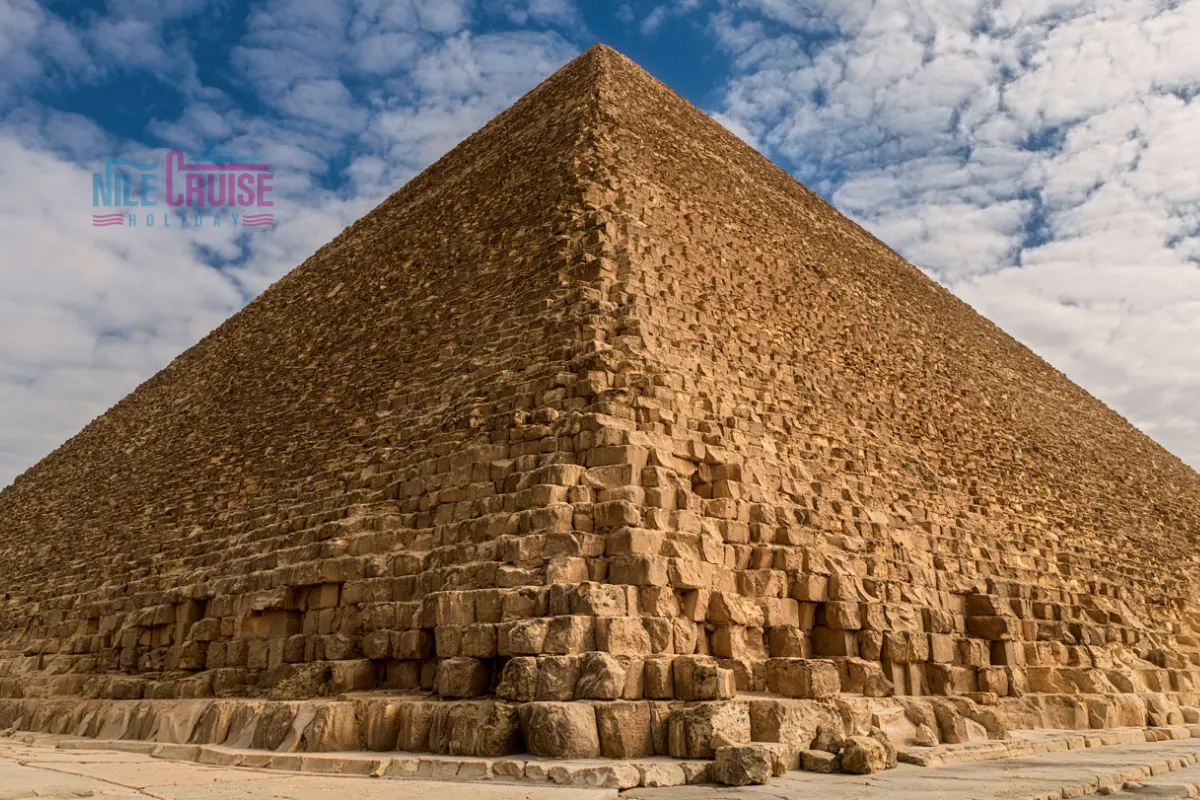
The original entrance sits higher on the same face, marked by large gabled limestone blocks that are easy to spot from outside. The forced tunnel meets the internal passages a short way inside.
Descending Passage
From the original entrance, the Descending Passage slopes steeply down through the masonry and into the bedrock, toward the chamber beneath the pyramid. It is part of the original internal plan. It is not necessarily part of the route every visitor follows today, and access to it should not be assumed.
Ascending Passage
Branching upward from the Descending Passage, the Ascending Passage is the main climb for most visitors. It is low, steep, and confined, and adults generally need to stoop for much of its length. Wooden boards with cross slats and handrails help with footing.
This is the most physically demanding part of the visit. It is also the transition that makes the next space so striking.
Grand Gallery
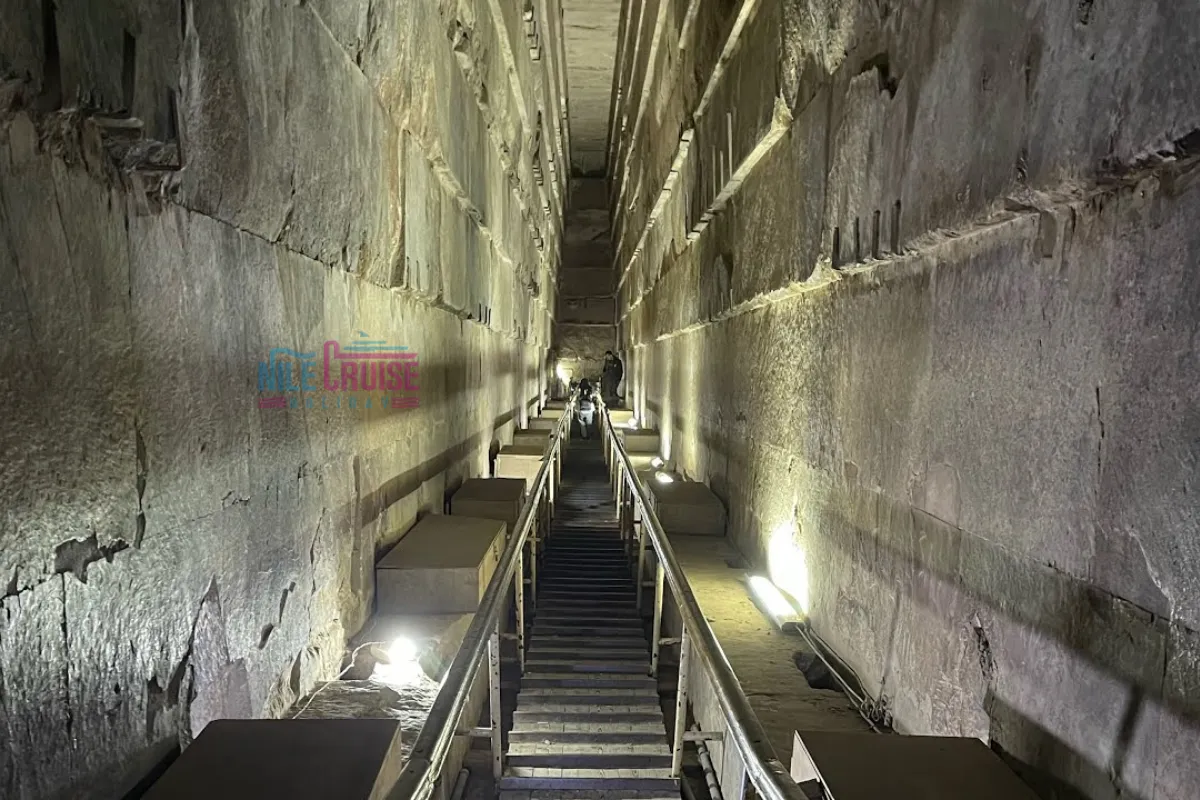
The Grand Gallery is one of the main architectural highlights of the interior. After the cramped Ascending Passage, the ceiling suddenly rises to more than 8 meters, and the passage continues upward for nearly 47 meters. Its walls step inward in overlapping courses of stone, a technique called corbelling, narrowing toward the roof.
The Ministry describes it as "a masterpiece of ancient engineering and architecture." Its exact architectural purpose is still debated, and no single explanation is proven. NCH's guide to how the pyramids were built covers the wider engineering questions.
For visitors, the main effect is the contrast in scale between the low passage below and the tall gallery above.
King's Chamber
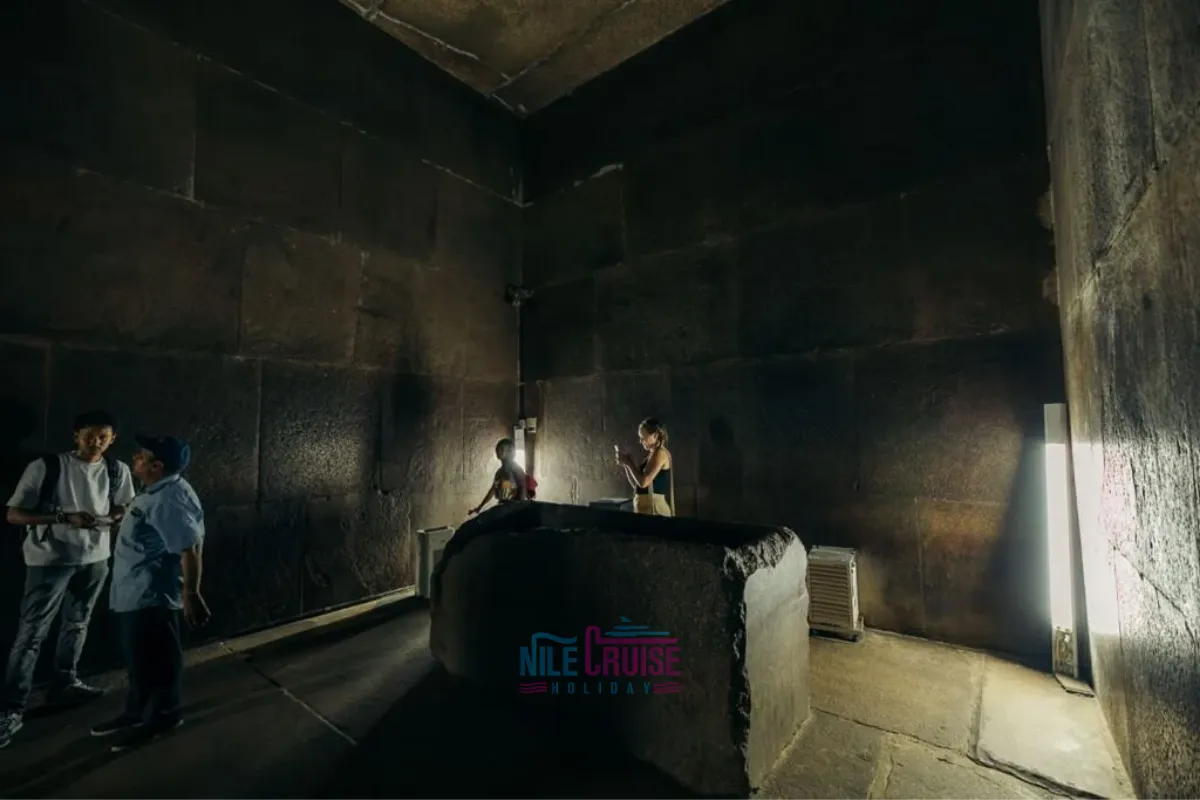
At the top of the Grand Gallery, a low passage and antechamber lead into the King's Chamber. The room is built largely from granite, with a flat ceiling of massive granite beams. It is quiet, plain, and larger than the passages suggest.
Against the west wall stands an empty, lidless granite sarcophagus. There is no painted decoration, no treasure, and no mummy. Khufu's granite sarcophagus remains in the chamber, but the king's body has never been securely identified inside the pyramid in modern times.
Above the ceiling sit five low relieving compartments, thought to help spread the weight of the masonry above. They are not open to visitors.
Queen's Chamber
A horizontal passage leads from the bottom of the Grand Gallery to the chamber traditionally called the Queen's Chamber. The name is a later convention. There is no evidence that it was built for a queen, and its original purpose is still debated. The room has a pointed, gabled ceiling and a niche in its east wall, and two narrow shafts run from its walls into the masonry.
Access to the Queen's Chamber is not guaranteed on every visit.
Subterranean Chamber
At the bottom of the Descending Passage lies the Subterranean Chamber, cut into the bedrock below the pyramid. It was left unfinished, with a rough floor and walls, and it remains part of the monument's internal architectural system. It is not always open to visitors.
Can You Go Inside the Great Pyramid Today?
Yes, when it is open. Interior entry requires a separate ticket from general Giza Plateau access. Availability, chamber access, and daily ticket numbers can change, so confirm current rules shortly before your visit.
As of late 2026, published sources show a discrepancy in the Great Pyramid interior ticket price, so travelers should confirm the current official e-ticket price shortly before visiting. NCH's guide to things to do in Giza covers the wider plateau visit.
Is the Queen's Chamber Open?
Access can vary, so don't assume every chamber will be open on the day of your visit. Which chambers are open is decided by the site authorities.
Is the Subterranean Chamber Open?
The same applies. The Subterranean Chamber is not part of the standard route and should not be expected as part of a normal interior visit.
Photography
Photography rules can change, so follow current site signage and staff instructions on the day.
Recent Discoveries Visitors Cannot Enter
Research inside the Great Pyramid is still adding to the picture without excavation. The ScanPyramids project uses non-destructive methods, especially muon imaging, which measures cosmic-ray particles passing through stone to detect empty spaces.
In 2017, the team reported a large void above the Grand Gallery, often called the Big Void. In 2023, further work confirmed a corridor about 9 meters long behind the chevron blocks on the north face, and an endoscope camera showed its vaulted interior. The function of both features is still uncertain, and neither is open to visitors. They are best understood as internal spaces of uncertain function, not new rooms to visit.
What Does Going Inside the Great Pyramid Actually Feel Like?
The climb is physical. Passages are narrow, ceilings are low in parts, and the ascent is steep. Adults generally need to stoop for long stretches, and short pauses on the way up are common.
The passages are enclosed stone on all sides. Heat and humidity can feel noticeable, especially in busy periods, and airflow is limited. Visitors move up and down the same passages, so passing people coming the other way can make the route feel tighter than it looks on a plan.
The Grand Gallery provides a clear change, with far more headroom than the passage below. The King's Chamber at the top is a plain granite room where visitors can stand upright and take in the space.
Who Is It a Strong Fit For?
- Archaeology enthusiasts
- Engineering-minded travelers
- Visitors curious about the physical interior
- People comfortable with confined spaces
- Travelers who want the experience of entering Khufu's monument
Who May Prefer to Skip It?
- Travelers with strong claustrophobia
- Visitors with significant mobility limitations
- People expecting wall paintings or treasure
- Anyone with a very rushed Giza day
Visitors with mobility, breathing, or confined-space concerns should consider whether the climb suits them and follow current site guidance.
Is Going Inside the Great Pyramid Worth It?
The answer depends on what the visit needs to deliver.
Worth It If
- Entering the monument is personally important
- Ancient engineering is a real interest
- The Grand Gallery is high on the list
- Tight spaces are not a problem
- This may be the only Giza visit
Travelers keen on pyramid interiors can also compare a visit to the Bent Pyramid at Dahshur, a different site with its own passages and atmosphere.
Verdict
The Great Pyramid interior is worth paying for when the experience of moving through the monument itself matters to you. It is not a ticket to buy for painted decoration, treasure, or a richly furnished burial chamber.
How to Fit the Great Pyramid Interior into a Giza Day
The interior visit takes time and is best planned around everything else on the plateau. Arrival time, queues, current ticket access, the guide's schedule, Cairo traffic, and the rest of the day all shape when it fits best.
Most Giza days also include the Great Sphinx, the other pyramids, and the panoramic viewpoints across the plateau, all covered in NCH's guide to the Giza Pyramids Complex.
The Grand Egyptian Museum sits close by and deserves its own block of time. Some travelers see the museum first for context, while others prefer the pyramids early. No single sequence suits everyone.
How Nile Cruise Holiday Fits In
Nile Cruise Holiday can build the Giza day around the experiences travelers actually want, allowing enough time for the Great Pyramid interior without sacrificing the Sphinx, plateau viewpoints, or the Grand Egyptian Museum. Depending on the itinerary booked, that day can include private transport and an Egyptologist guide, along with Cairo hotel timing and interior-ticket planning.
NCH coordinates the route, guide, and timing. The Ministry controls pyramid access, ticket availability, and site rules.
For travelers continuing south, Cairo and Nile cruise tours pair Giza with the temples of Luxor and Aswan.
Travelers who want the Great Pyramid interior to fit smoothly into a wider Giza and Cairo itinerary can ask Nile Cruise Holiday to plan a tailor-made Egypt trip, coordinating the timing around the Sphinx, plateau viewpoints, Grand Egyptian Museum, and onward Nile travel.