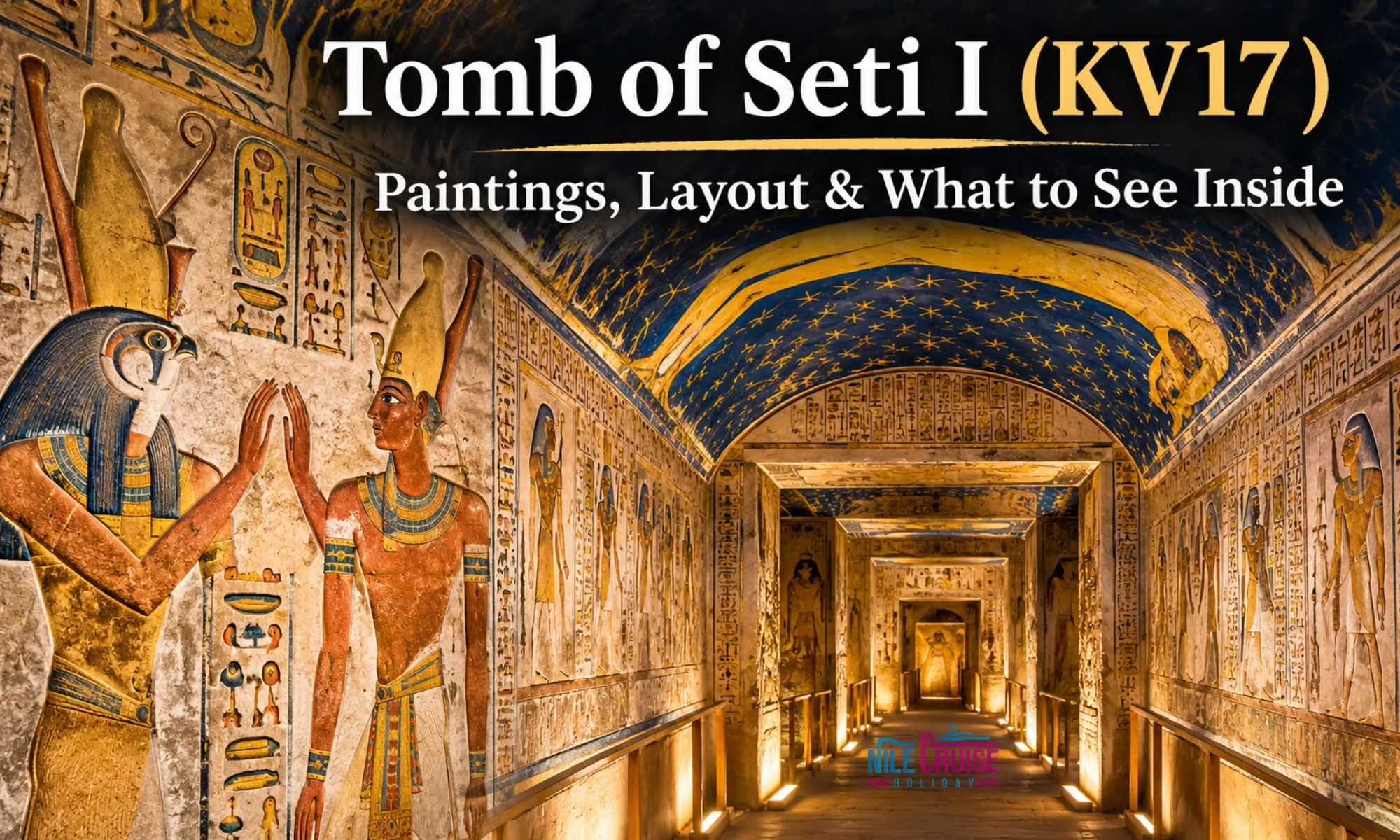

The Tomb of Seti I is easy to admire and harder to understand. Its painted gods, carved texts, astronomical ceiling, and long descending corridors were not created as separate decorations. Together, they formed a ritual journey through the Egyptian afterlife, laid out in stone for one king.
The tomb belongs to Seti I of the 19th Dynasty and sits in the Valley of the Kings on Luxor's West Bank as KV17. The descent leads from bright desert light into corridors where almost every surface carries color, carved figures, and hieroglyphs.
Knowing the layout changes the visit. A corridor becomes a chapter, and a turn in the plan becomes part of the story. Visitors comparing tickets and extra-entry tombs can use NCH's dedicated guide to Valley of the Kings tickets and tombs.
Why Is the Tomb of Seti I So Important?

Seti I was the second ruler of the 19th Dynasty, who reigned from about 1294 to 1279 BC. His reign is remembered for refined art, and KV17 shows that quality more clearly than anything else in the Valley of the Kings.
He was also the father of Ramesses II, whose story is told in NCH's guide to Ramses II and Nefertari.
KV17 is one of the longest and deepest tombs in the Valley. According to the Egyptian Ministry of Tourism and Antiquities, it was also the first tomb in the Valley to be completely decorated. The Theban Mapping Project describes most of it as painted raised relief, carved first and then colored.
| Fact | KV17 |
|---|---|
| Pharaoh | Seti I |
| Dynasty | 19th Dynasty |
| Location | Valley of the Kings |
| Tomb number | KV17 |
| Famous for | Extensive painted and carved decoration |
| Architectural plan | Jogged axis |
| Major feature | Vaulted astronomical burial chamber ceiling |
| Modern discovery | Giovanni Battista Belzoni, 1817 |
How Is the Tomb of Seti I Laid Out?

The Seti I tomb layout is a long descent with a change of direction partway down. The Theban Mapping Project's plan of KV17 records seven corridors and ten chambers.
Entrance and Descending Corridors
Sloping corridors and stairways open the tomb, each one leading further from daylight. Even these first passages are decorated.
The tomb of Tutankhamun is compact by comparison. KV17 keeps descending, past a well chamber with a deep shaft, to the first pillared hall.
First Pillared Hall and the Jogged Axis
KV17 does not simply continue in one straight line. Archaeologists describe its plan as a "jogged axis". The first corridors descend along one alignment. At the first pillared hall, the route shifts, and later corridors continue toward the burial complex on a different line.
The shift was deliberate, a recognized plan for royal tombs of this period. For visitors, it marks the move into the deeper section leading to the burial chamber.
The Off-Axis Chamber
Off the first pillared hall, a doorway continues along the original alignment into a separate two-pillared room. The Ministry notes that this room may have been intended to make intruders believe they had reached the real burial chamber, while the true route descended elsewhere.
That reading comes from the plan, not an inscription. The room matters for another reason too. Egyptian artists usually laid out scenes in red preliminary outlines, corrected them in black, and only then carved and painted. Here, the Theban Mapping Project records the Amduat scenes as outline drawings that were never carved, giving a rare look at an earlier stage of the work.
Burial Chamber Complex
Lower corridors lead through an antechamber to the burial chamber, the most elaborate space in KV17. Pillars stand in its front section, a vaulted rear section carries astronomical figures, and five side rooms open from it.
Passage Below the Burial Chamber
At the rear of the burial chamber, a passage is entered through the floor and descends still deeper into the rock. The Theban Mapping Project notes that it began as a divided stairway and that Seti I's sarcophagus was found above its entrance.
This deep descending passage has attracted dramatic labels, but the excavation evidence is more modest. An Egyptian team cleared it between 2007 and 2010 and, as announced by the antiquities authorities in June 2010, found it ran about 174 meters and was never completed. Instead of finished decoration, the workers left preliminary sketches and an architect's note in hieratic script with instructions to widen the passage.
The Ministry interprets the passage as having ritual significance, linking the tomb with the regenerative powers of the underworld. That remains an interpretation. What is clear is that the work stopped before completion, reportedly because the king died first, and the passage should not be assumed to be part of a standard visit.
What Do the Paintings and Hieroglyphs in KV17 Mean?
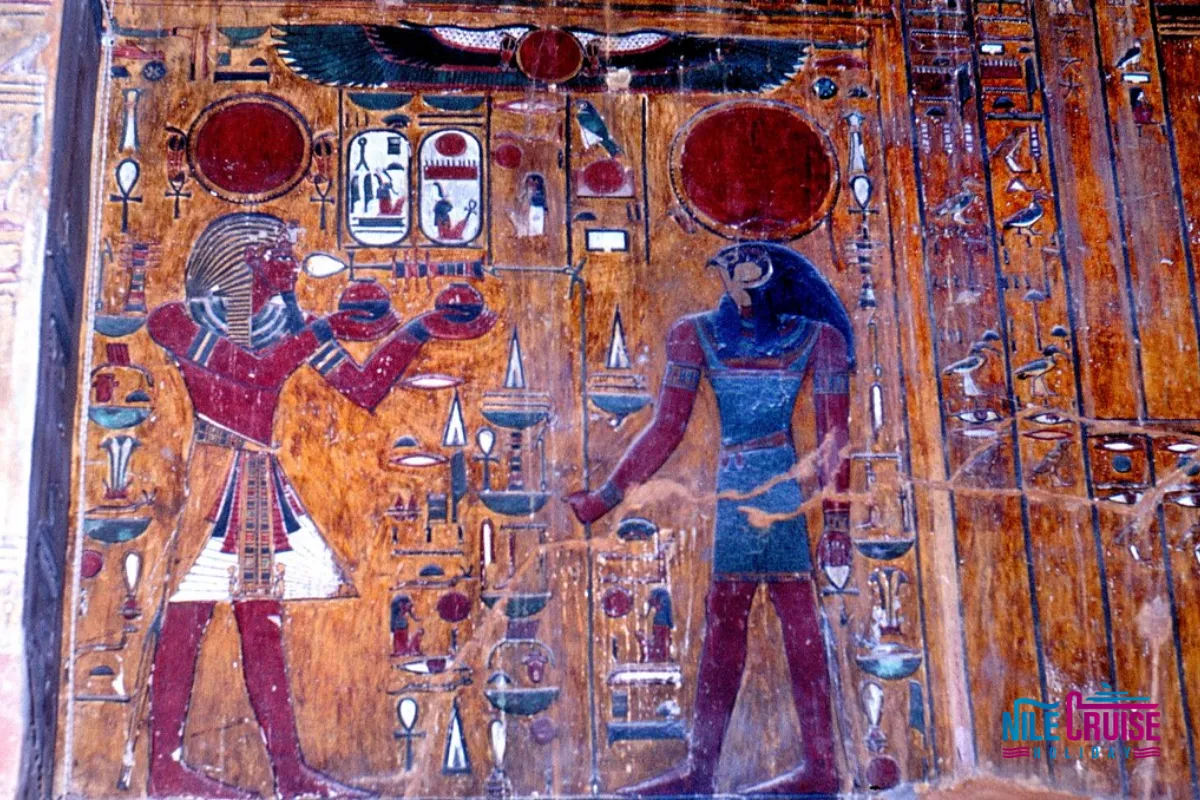
The Seti I tomb paintings are only half the story. Most scenes were carved in raised relief and then painted, so light across a wall picks out faces and hieroglyphs in three dimensions.
The Ministry lists four main funerary texts in KV17: the Litany of Re, the Amduat, the Book of Gates and the Book of the Divine Cow. The Theban Mapping Project also records the Opening of the Mouth ritual in the lower corridors and passages from the Book of the Dead.
Litany of Re
Near the entrance, the Litany of Re invokes the sun god in his many forms. Its theme is solar transformation and regeneration, the daily renewal of the sun, with the king identified with that renewal.
Amduat
The Amduat, whose name means "what is in the underworld", follows the sun god through the twelve hours of the night. Each hour is a region of the underworld, filled with boats, gods, enemies and the dead. At the end of the twelfth hour, the sun is reborn at dawn.
If the sun could travel through darkness and emerge renewed, a king who joined that journey could do the same.
Book of Gates
The Book of Gates describes the same nightly journey in a different way. Here, the hours of the night are separated by gates, each guarded by deities and serpents. The sun god's boat must pass each gate to continue.
In KV17, it covers walls in the first pillared hall and the burial chamber. For the king, passing every gate meant reaching the morning.
Book of the Divine Cow
Found in a side room off the burial chamber, this text tells of human rebellion against the aging sun god and his withdrawal into the sky, carried by a celestial cow. Its concern is cosmic order and the separation of gods and people.
Seti I and the Gods
Throughout the tomb, Seti I stands before deities such as Osiris, Anubis, and Hathor, offering to them and being welcomed. Figures connected with the story of Isis and Osiris appear often, including winged figures of Isis and Nephthys at the tops of the burial chamber walls.
The images were not simply illustrations. Together with the texts, they were intended to help ensure the king's successful transition and regeneration in the afterlife.
The Burial Chamber and Astronomical Ceiling
The Ministry identifies KV17 as the first Valley tomb with a vaulted burial-chamber ceiling. Instead of a flat lid, the ceiling arches overhead like a sky.
The Seti I astronomical ceiling carries figures that the Ministry describes as simulating the night sky. The walls describe the sun's passage through darkness, while the ceiling brings images of the night sky into the king's burial space.
This is one of the places where visitors should slow down and look upward rather than focusing only on the walls.
Seti I's Sarcophagus and Belzoni's Discovery
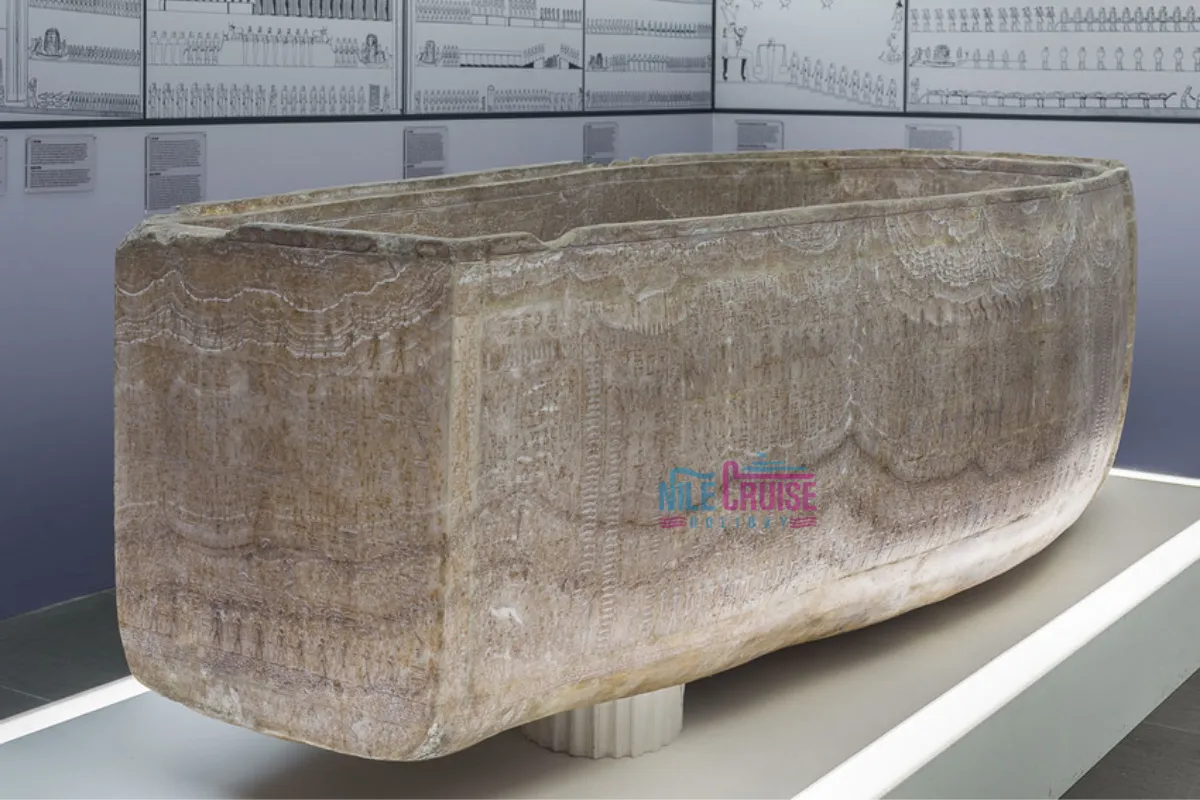
What Happened to Seti I's Sarcophagus?
Giovanni Battista Belzoni found the king's sarcophagus in the burial chamber. It is carved from calcite, often called Egyptian alabaster.
According to Sir John Soane's Museum, its surfaces carry scenes from the Book of Gates, once filled with Egyptian blue. The sky goddess Nut is carved on the interior floor. The lid was broken by ancient grave robbers.
It was shipped to London, and after the British Museum declined it, the architect Sir John Soane bought it in 1824. It remains in his former house, now the museum.
The tomb, sarcophagus, and body went separate ways. Seti I's mummy was recovered in 1881 from the Deir el-Bahari royal cache and is now at the National Museum of Egyptian Civilization in Cairo. How royal bodies were prepared is covered in NCH's guide to Egyptian mummification.
Belzoni and the Tomb's Modern History
According to Sir John Soane's Museum, Belzoni found the opening and entered the tomb on October 18, 1817, hence the nickname "Belzoni's Tomb". The broken lid shows that ancient grave robbers had reached the burial long before him.
In 1821, painted reconstructions of several rooms went on show at the Egyptian Hall in Piccadilly, London, drawing crowds and spreading interest in ancient Egypt well beyond scholars.
Fame came at a cost. The Theban Mapping Project records that flooding soon after the tomb was opened, nineteenth-century copying with wet paper "squeezes", and the removal of some decorated sections all damaged the walls. Consolidation work began in the early 1900s, and the tomb's condition still requires conservation.
What Should You Look for Inside the Tomb of Seti I?
A few cues turn a walk through color into an understanding of the whole design.
- The ceiling overhead. The astronomical vault in the burial chamber is the most distinctive surface in the tomb.
- The pillars. Close up, the carved edges of faces, wigs, and jewelry stand out beneath the paint.
- The texts in sequence. The Litany of Re near the entrance gives way to the Amduat and the Book of Gates deeper in, so the walk mirrors the sun's journey.
- The change in axis. The turn at the first pillared hall marks the descent toward the burial chamber, part of the ritual route.
- Degrees of finish. Where accessible, red and black outlines beside finished relief show draftsmen, sculptors and painters working in stages. Not every such area is open.
- The depth. KV17 is an architectural experience as much as an art one, built around a long, steady descent.
- Interpretation. An Egyptologist guide can connect figures, texts, gods, and architecture, so the walls read as one program rather than isolated pretty pictures.
Visiting KV17 Today
As of November 2026, KV17 requires separate admission from the general Valley of the Kings ticket. Prices and access can change with conservation needs, so current Ministry information is the best reference. The Valley of the Kings ticket guide covers pricing, standard and extra-ticket tombs, and how KV17 fits alongside other choices.
How Nile Cruise Holiday Fits In
The order of West Bank stops matters, and NCH's guide to Luxor East Bank vs West Bank explains how the two sides of the city are usually sequenced.
Nile Cruise Holiday can build the West Bank day around the tombs travelers most want to understand, allowing enough time for KV17 rather than treating the Valley of the Kings as a rushed checklist. Depending on the itinerary booked, that day can include private transfers and an Egyptologist guide to lead the interpretation.
Nile cruises from Luxor can include a West Bank day timed around the ship's schedule. NCH coordinates timing, while ticketing and tomb access remain with the antiquities authorities.
Travelers especially interested in Seti I, royal tomb art, or ancient Egyptian afterlife texts can ask Nile Cruise Holiday to build a tailor-made Egypt trip around KV17, combining Egyptologist interpretation with the timing and transfers needed to experience the Valley without rushing.


