The lights are low in the Royal Mummies Hall. Behind glass, a face 3,200 years old lies still, its hair faintly auburn, its hands crossed over the chest. This is Ramses II, the most famous pharaoh of all, and you are standing a few feet away.
For the ancient Egyptians, that preservation was everything. They believed survival after death depended on the body staying whole, so the soul could recognise it and return. Over three thousand years, Egyptian mummification grew into one of the most sophisticated practices of the ancient world.
This guide covers both sides of the story: how the mummification process actually worked, step by step, and where to see ancient Egyptian mummies today, from Cairo's Royal Mummies Hall to the Valley of the Kings, on Cairo and Nile cruise tours.
Why Egyptians Made Mummies
The Body and the Afterlife
Egyptians believed each person had several spiritual parts, including the ka, a life force, and the ba, often shown as a bird with a human head. The ba could leave the tomb by day but needed a recognisable body to return to at night. Without it, the afterlife was at risk. The myth of Osiris, the first mummy, gave this belief its shape, and the story of Isis and Osiris explains how.
Anubis and Embalming
Anubis, the jackal-headed god, was the guardian of embalming and cemeteries. Priests overseeing the work may have worn jackal masks, and his image watches over countless tomb walls and coffins.
From Desert Burial to Mummies
The earliest Egyptians buried their dead in shallow pits in the hot, dry sand, which naturally dried and preserved the bodies. One such body, known as Gebelein Man, survives from around 3400 BC. When elite burials moved into coffins and stone tombs, bodies no longer touched the sand and began to decay. Artificial mummification was the solution.
The 70-Day Journey

According to the Greek historian Herodotus and the evidence of the mummies themselves, the full mummification process for a wealthy person took about 70 days. These are the main steps of mummification.
Washing the Body
The body was carried to a purification tent near the river and washed with palm wine and Nile water. The smell of spice and water would have hung in the air.
Much of this work took place in a dedicated embalming workshop known as the "wabet", or "pure place," where specialist embalmers used tools such as bronze probes, blades, and cleaning implements to prepare the body.
Removing the Organs
An embalmer made a cut in the left side of the abdomen and removed the lungs, liver, stomach and intestines, the organs most likely to decay first. The heart was left inside. Egyptians considered it the seat of thought and memory, needed for judgement in the afterlife.
Removing the Brain
In many mummies, the brain was removed through the nose with a long hook, breaking through the thin bone behind the nostrils. Embalmers saw no special value in it and discarded it.
Drying with Natron
The body was then packed and covered with natron, a natural salt found at Wadi el-Natrun and other sites. Over about 40 days, natron drew out moisture and stopped decay, leaving the body dark, light and leathery.
Oils and Resins
Embalmers rubbed the dried skin with oils, beeswax and plant resins to keep it supple and fragrant. The body cavity was often stuffed with linen, sawdust or resin to restore its shape.
Wrapping the Mummy
Hundreds of square metres of linen were wound around the body in careful layers. Amulets were placed between the wrappings, including a heart scarab over the chest. Priests recited spells as they worked, and a mask was set over the face. The finished mummy was placed in its coffin on about day 70.
The Canopic Jars
What Went Inside
The four removed organs were dried, wrapped, and stored in four canopic jars, buried with the mummy.
The Four Protectors
Each jar was guarded by one of the Four Sons of Horus. Imsety, with a human head, protected the liver. Hapy, a baboon, protected the lungs. Duamutef, a jackal, guarded the stomach, and Qebehsenuef, a falcon, guarded the intestines.
What Changed Over Time
By the Third Intermediate Period, around 1000 BC, embalmers often wrapped the organs and returned them to the body. Canopic jars were sometimes still buried, but as solid symbolic objects with nothing inside.
What Mummies Reveal
Disease and Injury
CT scans let researchers study mummies without unwrapping them. They have revealed arthritis, dental abscesses, hardened arteries, and healed fractures, showing that even kings lived with pain. The mummy of Ramses II, for example, shows severe arthritis and poor circulation in old age.
Age and Identity
Bone density and growth plates help estimate age at death, while DNA testing has clarified some royal family links, including Tutankhamun's parentage.
How Pharaohs Died
The mummy of Seqenenre Taa II carries brutal head wounds. A 2021 CT study suggested he was killed in battle against the Hyksos, possibly executed after capture, around 1555 BC.
Where to See Them Today
The Royal Mummies Hall
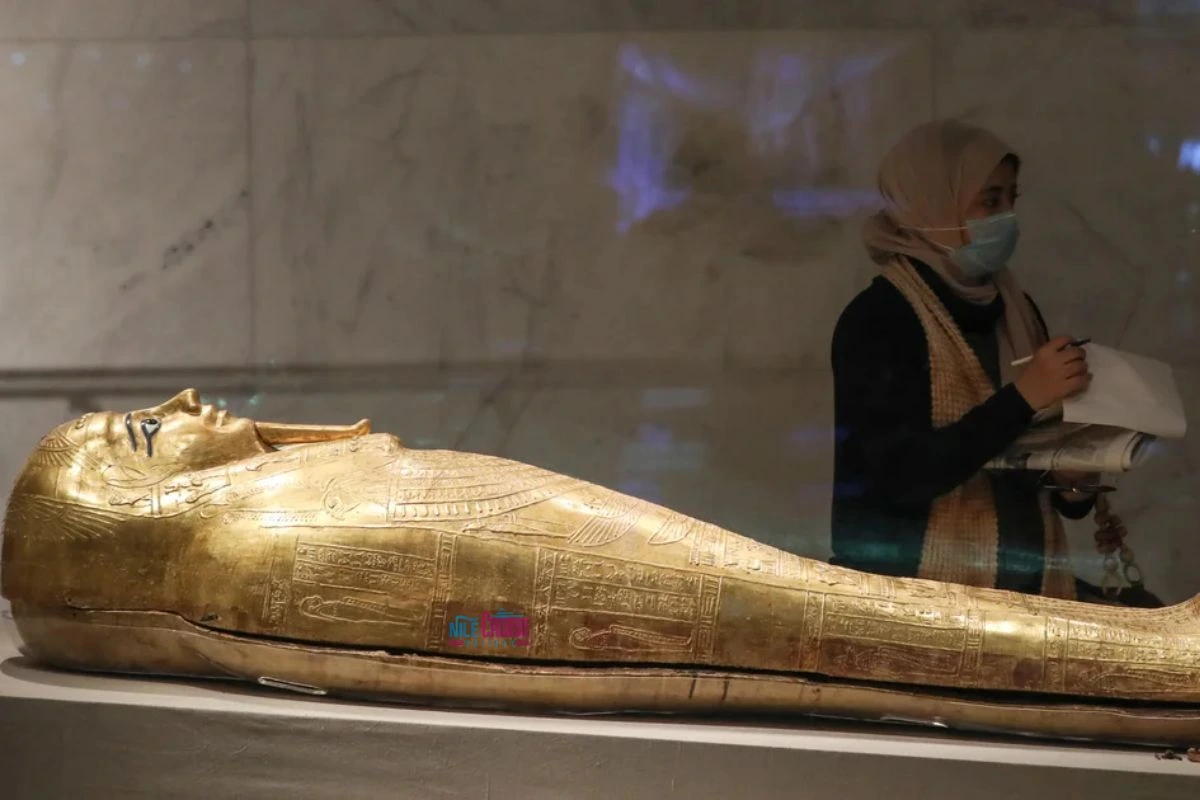
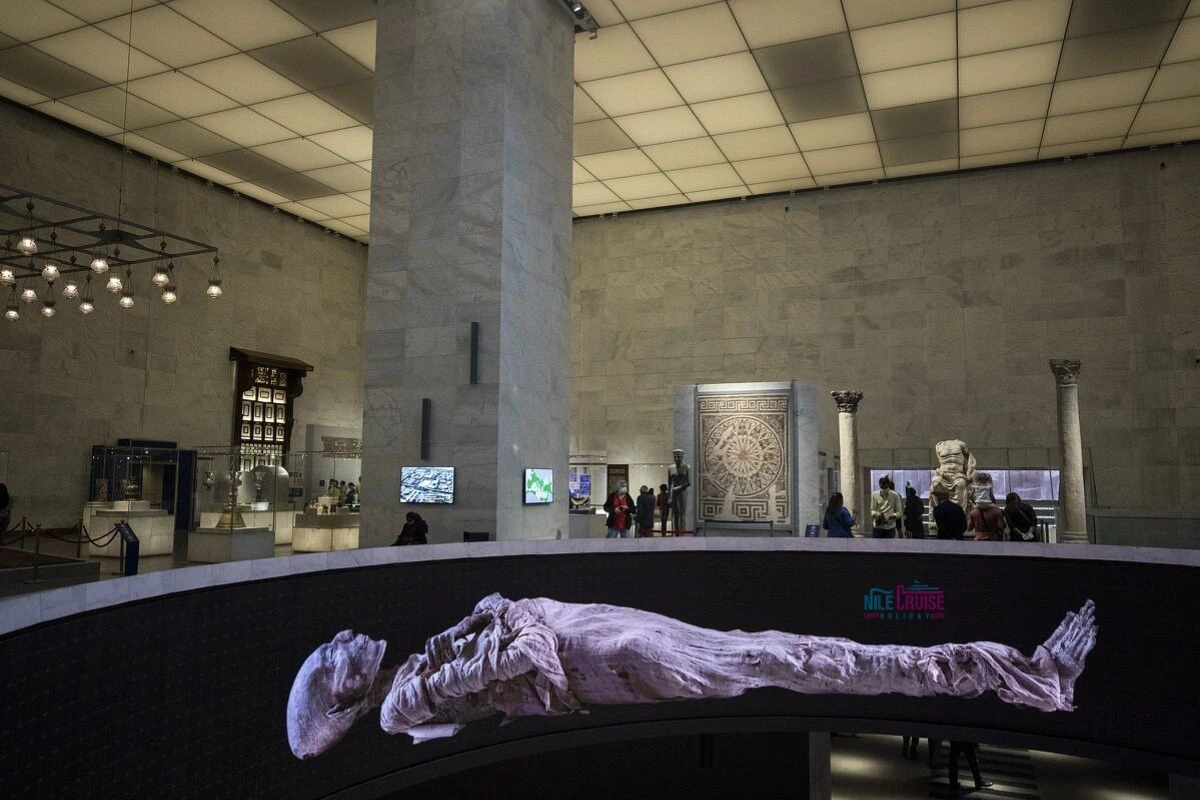
The finest answer to where to see mummies in Egypt is the National Museum of Egyptian Civilization (NMEC) in Fustat, Old Cairo. In April 2021, 22 royal mummies travelled there from Tahrir in the televised Pharaohs' Golden Parade. Today the Royal Mummies Hall displays 20 of them in dim, climate-controlled galleries designed to feel like the Valley of the Kings. Each king and queen lies in a sealed, climate-controlled case beside their coffin and a short biography. Seqenenre Taa II is here too, his wounds still clearly visible. The low lighting and quiet keep the atmosphere hushed and respectful.
The hall also uses modern imaging and interactive displays to show what lies beneath the wrappings, connecting the preserved bodies with the CT-scan research that has revealed their age, injuries, and health.
Ramses II and Hatshepsut
Two names draw most visitors. Ramses II, who ruled for 66 years, lies here, as does Hatshepsut, the female pharaoh identified in 2007. Our guides to who Hatshepsut was and Ramses II and Nefertari give helpful background before your visit.
Not at the GEM
Many travelers assume the Grand Egyptian Museum holds the royal mummies. It does not. The GEM showcases Tutankhamun's treasures, while the royal mummies remain at NMEC.
Mummies in Luxor
Luxor completes the story, and it is the base for travelers heading to the August 2027 solar eclipse cruise too.
Luxor Museum
Since 2004, the Luxor Museum has displayed two royal mummies: Ahmose I, who drove the Hyksos from Egypt, and a mummy identified as Ramesses I, returned from a North American museum in 2003.
Tutankhamun in KV62
Tutankhamun's mummy never left the Valley of the Kings. It rests in a climate-controlled case inside his tomb, KV62, where visitors can see his face. Our guide to the tomb of Tutankhamun explains the visit, and the curse of King Tut covers the legend.
The Mummification Museum
On the Luxor Corniche, the small Mummification Museum displays embalming tools, canopic jars, and mummified animals. It is an easy addition to any list of things to do in Luxor.
Cairo to Luxor and Following the Mummies
Start at NMEC
Meeting the kings in Cairo first gives the rest of the trip real faces. Our 8 days Cairo and Nile cruise package begins in the capital.
Continue to Luxor
A short flight, covered in our Cairo to Luxor flight guide, brings you to the Valley of the Kings and the start of Nile cruises from Luxor.
See Their Temples
Hatshepsut's terraced temple, Ramses II's Ramesseum and the tombs of the pharaohs you met in Cairo all wait across Luxor's East and West Banks, and Luxor and Aswan Nile cruises link them in one journey.
Experience the Mummies with NCH

Private NMEC Visits
Nile Cruise Holiday arranges private NMEC visits with seasoned Egyptologists, included in programs such as our 10 days Cairo and Nile cruise package.
Beat the Crowds
Pre-arranged tickets and carefully timed visits mean quieter galleries and no queue at the door. This approach shapes all our Egypt tour packages with a Nile cruise, with no shopping stops on the way.
Cairo to the Nile
Private drivers, flights, and transfers connect Cairo seamlessly with your luxury Nile cruise.
Your Egyptologist Matters
A good guide turns a row of glass cases into a family history of kings. That context explains how private tours compare with group tours, and it brings the story alive for children on our Nile cruises for families.
Meet the Pharaohs in Person
Standing before the face of Ramses II is a moment few travelers forget. Our team can build NMEC, the Valley of the Kings, and a Nile cruise into one seamless, tailor-made Egypt journey.