From the air, Egypt looks like a green ribbon laid across a brown desert. That narrow strip of farmland, following the river for hundreds of kilometers before opening into the Delta, explains why the phrase Gift of the Nile has lasted so long.
The phrase is often reduced to water and fertile soil. The Nile also concentrated settlement, moved people and goods, shaped religious ideas and organized the year, and the remark by Herodotus behind it is narrower than the modern slogan.
What Does Gift of the Nile Mean?

Gift of the Nile describes how Egypt's settlement, agriculture, and prosperity depended heavily on the river, which supplied water, renewed the floodplain, and connected communities through an otherwise arid landscape.
Rain falls only occasionally across most of Egypt, and deserts surround much of the inhabited land. Most people lived in the Nile Valley and the Delta, where the river made reliable farming possible.
The Nile was the central environmental foundation of Egyptian settlement and agriculture, but geography, resources, trade, and political organization also helped shape the civilization that developed along it. The deserts also supplied stone, gold, and routes to the oases.
Who Said Gift of the Nile?
The phrase is linked with Herodotus, a Greek historian of the fifth century BC who visited Egypt and described it in Book II of his Histories. He was not Egyptian, and he wrote some two thousand years after the pyramids of Giza were built.
The familiar phrase "Egypt is the Gift of the Nile" is a conventional modern rendering of his observation. His wording is closer to describing part of Egypt as "the gift of the river," especially land formed by river sediment.
What Herodotus Actually Meant
Context matters. Herodotus was writing about the Egypt that Greek ships reached, meaning the Delta and the land near it. He argued that this land had been built up by the river's deposits, calling it an addition the Egyptians had gained and a gift of the river. As evidence, he noted that sailors a day out from the coast still brought up mud when they took soundings.
He presents the point partly as something he learned from Egyptian informants, and some scholars think the idea may go back to the earlier Greek writer Hecataeus of Miletus. The phrase became famous because Herodotus recorded it. Later readers turned his geological remark into a shorthand for Egypt's broader dependence on the Nile.
How the Nile Made Egypt Fertile
Before modern dams, the Nile rose each summer, fed mainly by monsoon rains over the Ethiopian Highlands. The inundation spread water across the floodplain, soaked the soil, and left behind a layer of fresh alluvial sediment. The result was a dark, fertile strip beside the desert.
The amount of water mattered. A low flood could mean insufficient irrigation and poor harvests, while an exceptionally high flood could damage fields, dikes, and settlements. The inundation was beneficial only within limits.
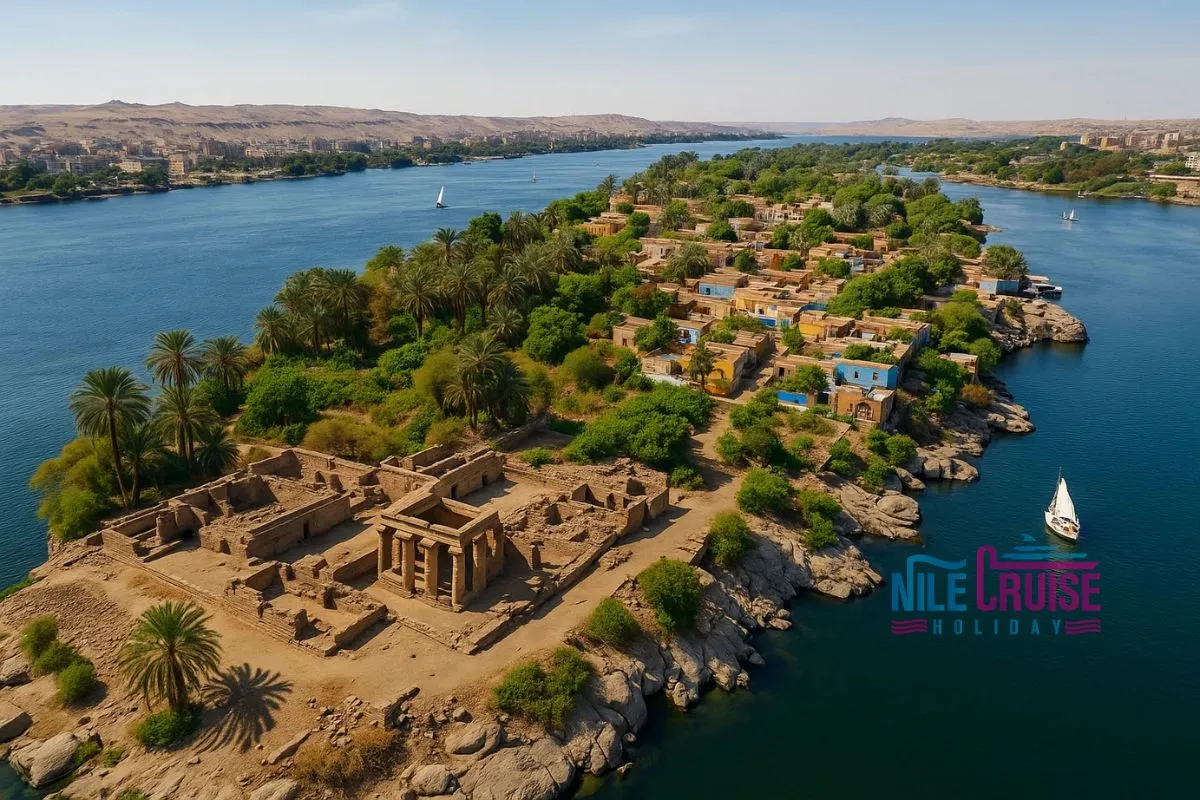
Egyptians did not simply wait for the river to do the work. Communities built and repaired embankments, cut canals, and held water in basins so it reached more land and drained at the right time. On Elephantine Island in Aswan, a Nilometer recorded water levels that helped officials judge the likely harvest.
How the Nile Fed Egypt
The Nile did not produce food by itself. It created the environmental conditions that allowed farmers to cultivate the floodplain.
On that land they grew emmer wheat and barley for bread and beer, flax for linen, vegetables and fruit, and fodder that helped support livestock. Our guide to ancient Egyptian food covers what people actually ate.
In good years, the floodplain produced a surplus. Grain could be stored, collected as dues, and redistributed to temple staff, officials, craftsmen, and workers. That surplus supported the administration and the monuments.
The Nile as Egypt's Highway
The Nile was not just a source of water. It was Egypt's principal internal transport corridor.
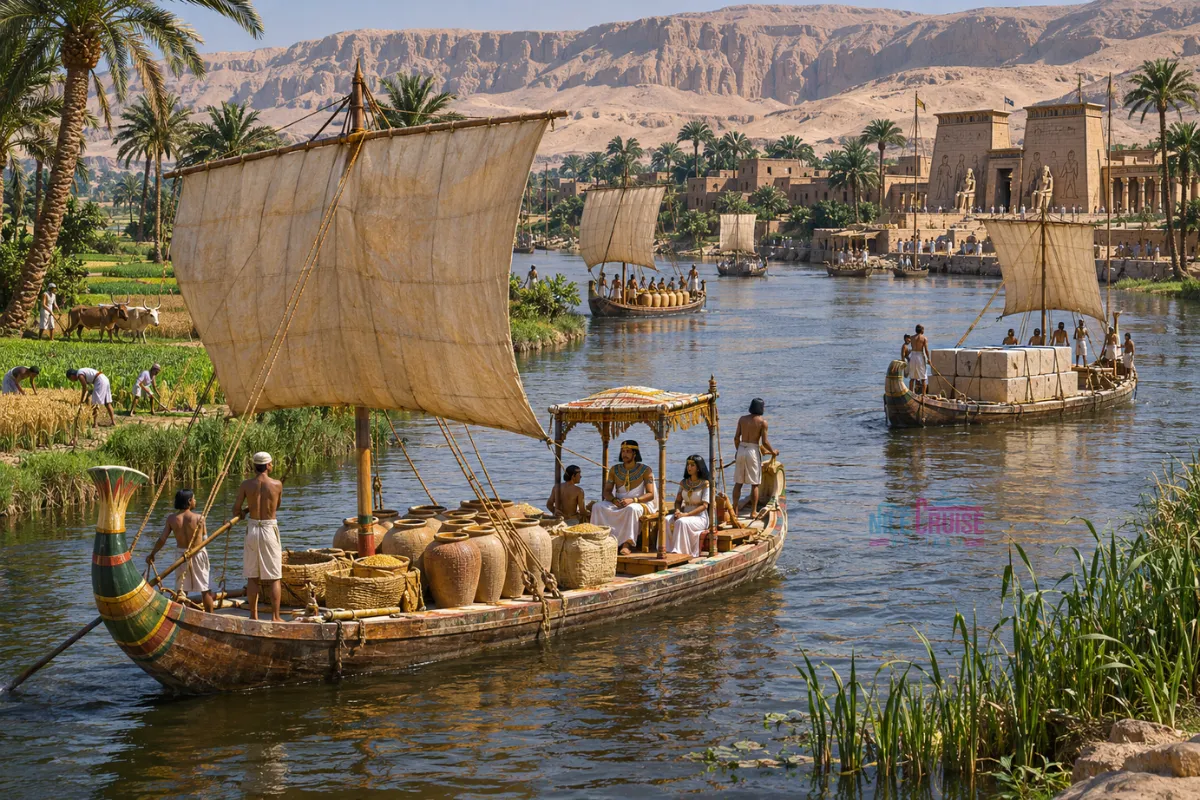
The river flows north toward the Mediterranean, while the prevailing wind in Egypt usually blows from the north. Boats could drift downstream with the current and raise a sail to travel upstream against it. That combination made two-way river travel practical for most of the year.
Boats carried officials and messengers, grain, animals, temple supplies and building stone. Granite from Aswan, for example, reached temples and tombs far downstream by water. The river linked Upper Egypt in the south with Lower Egypt in the north, and connected major towns, temples and royal centers into one network. That network made it easier to govern a country stretched along a single valley.
The Nile in Egyptian Belief
The yearly return of the flood made renewal a natural theme in Egyptian thought. Land that lay dry revived after the water receded, echoing ideas of fertility and rebirth.
The best-known figure linked with this is Hapy. Hapy personified the inundation and abundance associated with the Nile rather than simply functioning as a modern-style "god of the river." Hymns and offerings to Hapy sought a good flood. Other deities and rituals could also be connected with water, fertility, and particular places along the river, such as Khnum at Aswan.
The river cycle also helped structure the year. Egyptians divided it into three seasons, Akhet (inundation), Peret (growth), and Shemu (harvest). Our ancient Egyptian calendar guide explains how that system worked and why it did not always match the real flood.
Is Egypt Still the Gift of the Nile?
Partly. Most of Egypt's population and agriculture remain concentrated in the Nile Valley and Delta. The Nile still shapes where people live and farm, but the river experienced major changes through modern dams, irrigation systems, and water management. Since the Aswan High Dam was completed in 1970, water has been stored in Lake Nasser and released under control, and the natural downstream flood no longer arrives as it did in antiquity. Farming now relies on year-round irrigation rather than basin flooding.
The continuity lies in the landscape and settlement pattern rather than in the hydrology.
Seeing the Gift of the Nile Today
A Nile journey between Luxor and Aswan makes the phrase visible. Green farmland hugs the river while desert begins only a short distance away, and major temples and historic settlements repeatedly appear along the same narrow corridor, from Luxor to Edfu, Kom Ombo and Aswan.
Nile Cruise Holiday helps travelers connect geography with history by sequencing river sailing, temple visits, and Egyptologist-guided sightseeing so the Nile is understood as the system that supported the settlements and monuments along its banks. Rather than treating each temple as an isolated attraction, NCH can organize the journey as one continuous river story.
Depending on the itinerary booked, NCH coordinates cruise timing, Luxor sightseeing, Elephantine visits, and transfers, and the Nile cruise itineraries range from short sailings to longer routes.
A Cairo and Nile cruise tour adds Cairo and Giza at the start or end.
Travelers who want to understand why the Nile shaped Egyptian civilization can ask Nile Cruise Holiday to organize a tailor-made Egypt trip between Cairo, Luxor, and Aswan that connects river geography, temple sites, and Egyptologist-guided interpretation within one coherent itinerary.