Long before Egypt built the pyramids of Giza, one royal official helped transform a rectangular tomb into the first pyramid ever attempted. His name was Imhotep. Around 4,600 years ago, during the Third Dynasty, he served King Djoser at Saqqara, where six stone steps still rise above the desert edge west of the Nile.
That monument, the Step Pyramid, is the strongest reason Imhotep is remembered. Yet his name lived on for another reason too. Centuries after his death, Egyptians honored him as a sage, a patron of scribes and eventually a god of healing.
Imhotep's importance comes from two very different stories: the historical royal official associated with Djoser's Step Pyramid, and the extraordinary later reputation that transformed him into a symbol of wisdom and healing. This guide keeps those two stories apart.
Who Was Imhotep?
Imhotep was a real person who lived in ancient Egypt during the Third Dynasty of the Old Kingdom. He served King Djoser as one of his highest officials and is closely associated with the royal building program at Saqqara, above all the Step Pyramid complex.
He was not a king. Even so, he became one of the most famous non-royal figures in Egyptian history, remembered long after most officials of his era were forgotten.
|
Fact |
Imhotep |
|
Period |
Third Dynasty |
|
King Served |
Djoser |
|
Best Known For |
Step Pyramid complex at Saqqara |
|
Main Role |
High royal official and architect |
|
Main Site |
Saqqara |
|
Later Reputation |
Wisdom, writing and healing |
|
Later Status |
Deified |
|
Tomb |
Not securely identified |
The historical Imhotep and the divine Imhotep known from later Egyptian religion are separated by centuries of developing tradition. Nothing reliable records his birth or death years, his birthplace or his appearance.
Imhotep and Djoser's Step Pyramid
From Mastaba to Pyramid
Before Djoser, Egyptian kings and elite officials were buried beneath mastabas. These were flat-topped, rectangular tombs with sloping sides, usually built of mudbrick.
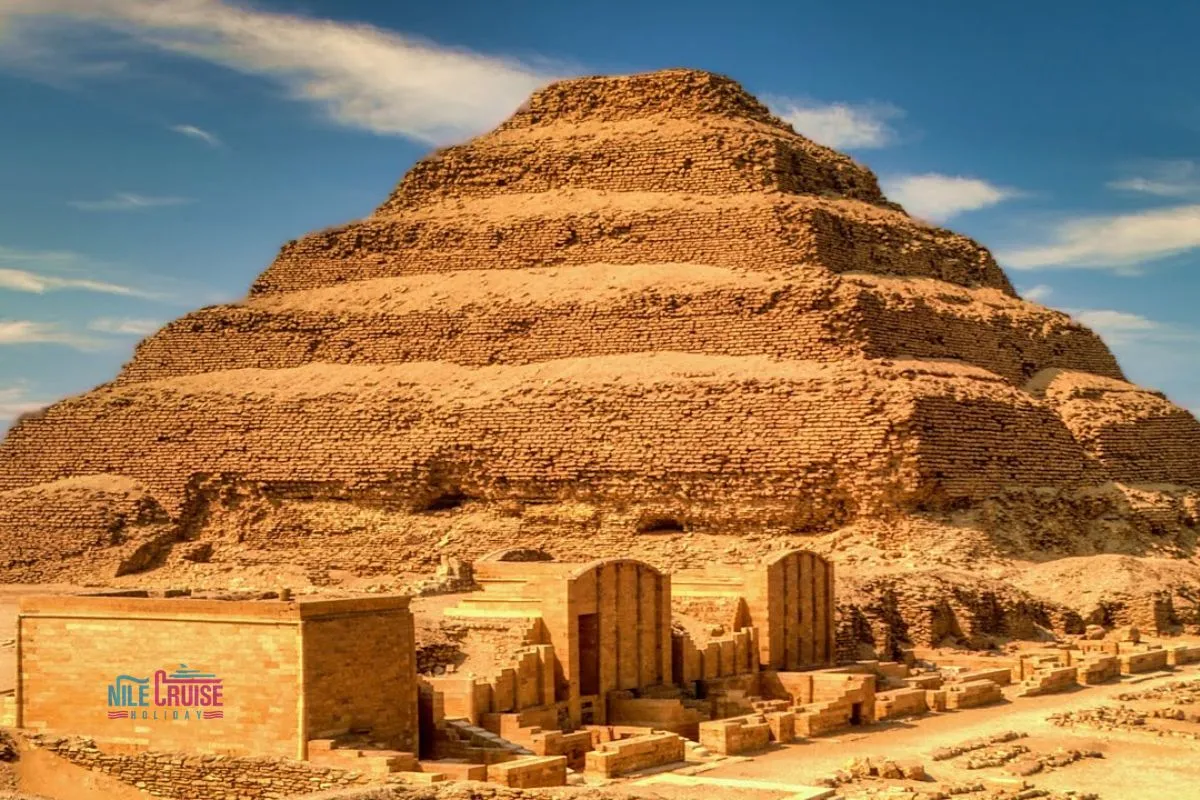
Djoser's monument began in that tradition. Its first stage was a large square mastaba built of stone. Then the plan changed. The structure was enlarged, and then enlarged again, until mastaba-like layers stacked one on top of another produced a four-step pyramid. A further expansion created the final six-step form, roughly 60 meters high.
Imhotep is credited with the design or oversight of the complex, while the monument itself shows that the project evolved through several construction phases. Archaeologists reconstruct those phases from the masonry itself. The question of how the blocks were actually quarried and moved belongs to a separate story, explained in our guide to how the pyramids were built.
Why the Step Pyramid Changed Egyptian Architecture
The Step Pyramid is the first pyramid in Egypt and one of the earliest monumental buildings made largely of cut stone. Earlier builders had used stone, but never at this scale.
The pyramid was also only one part of a much larger whole. A long enclosure wall of paneled limestone surrounded courtyards, shrines, ceremonial buildings and false structures. Many of them reproduced in stone the forms once built of reed, wood and mudbrick.
That combination of pyramid, enclosure and ritual buildings set a precedent for royal burials. Later builders refined the idea, reaching true smooth-sided pyramids at sites such as the Bent Pyramid at Dahshur. Khufu's Great Pyramid at Giza did not appear from nowhere. The architectural path toward Giza begins at Saqqara.
Was Imhotep Really the Architect?
Modern scholars generally associate Imhotep with the Step Pyramid for two reasons. One comes from his own lifetime: his name appears in a royal setting at the complex. The other comes from much later tradition. By the Ptolemaic Period, the Egyptian priest-historian Manetho credited him with pioneering building in dressed stone under Djoser.
Neither source tells us which decisions were his or how the work was divided. No architectural drawings by him survive. Calling him the architect of the Step Pyramid reflects strong association rather than a signed blueprint, and he was not the first Egyptian to build with stone. A graffito at the unfinished step pyramid of Djoser's successor Sekhemkhet suggests he may have continued working after Djoser's reign.
The Inscription That Preserved His Name
The key piece of contemporary evidence is the base of a statue of Djoser, found at the Step Pyramid complex. Alongside the king's name, it carries Imhotep's own name and titles. They are commonly translated as chancellor of the king of Lower Egypt, first after the king, administrator of the great palace, high priest of Heliopolis, and builder or sculptor.
It is highly unusual for a non-royal official to appear so prominently on a royal statue. Djoser's famous seated statue, from a different part of the complex, is displayed at the Egyptian Museum in Cairo.
The inscription proves the man existed. It does not prove every achievement later Egyptians attributed to him.
What Else Did Imhotep Do?
The surviving titles point to a career at the heart of the royal court rather than a single specialty. As chancellor and palace administrator, he held administrative responsibility close to the king. A builder's title links him to construction oversight. The Heliopolis priesthood connects him with one of Egypt's most important religious centers.
Most stories about his wisdom, writings, and cures come from sources written many centuries later, so a complete career biography cannot be built from contemporary evidence.
Was Imhotep Really a Doctor?
His later reputation as a healer is well established, but direct evidence that he practiced medicine during Djoser's reign is much less certain. Nothing from his own lifetime describes him treating patients or writing medical texts.
The healing reputation grew slowly. Later Egyptians revered him as a sage and a patron of learning, and by the Late Period he was increasingly worshipped as a healer. Clear references to his healing powers are known from around the Thirtieth Dynasty, roughly two thousand years after he lived. The Greeks then identified him with Asklepios, their own god of medicine.
Modern summaries sometimes call Imhotep the "father of medicine," but that label reflects his later reputation more than direct contemporary evidence. Surviving medical papyri, including the famous Edwin Smith Papyrus, cannot be shown to be his work.
How Did Imhotep Become a God?
Imhotep's deification happened gradually, centuries after his lifetime, and nothing suggests Djoser's contemporaries worshipped him. Few non-royal Egyptians ever reached divine status.
It began with reputation. Later generations remembered him as a wise man, and scribes are thought to have honored him as a patron of their craft. Over time, that respect turned into religious devotion. By the Late Period, he was regarded as a son of Ptah, the creator god of Memphis, Egypt's ancient capital just south of Saqqara.
A healing cult grew around him in the Memphis region and beyond, and later worshippers associated him with cures and protection. In the Greco-Roman period, Greek speakers called him Imouthes and linked him with Asklepios.
Why Later Statues Show Him Holding a Papyrus
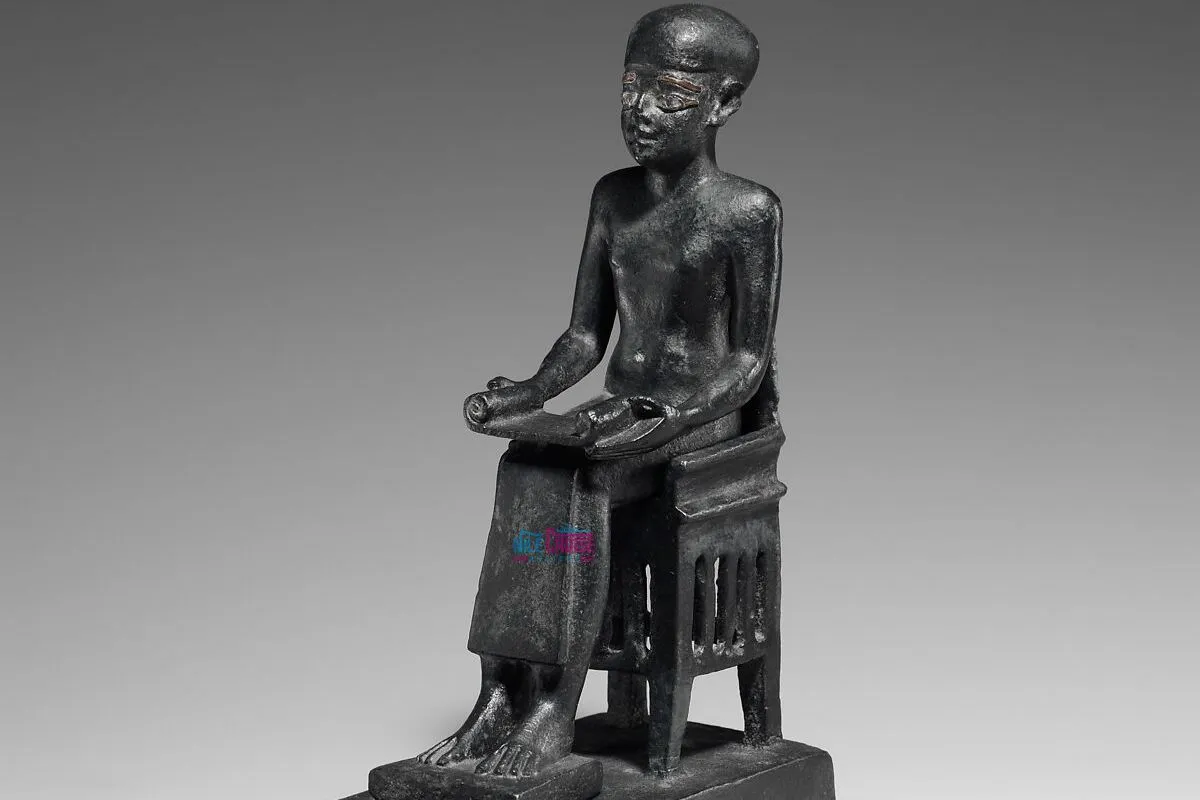
Most images of Imhotep come from these later centuries, especially small bronze figures. They usually show him seated, wearing a close-fitting cap or with a shaven head, with a papyrus scroll unrolled across his lap.
The papyrus signals learning, wisdom, and scribal culture, the qualities later Egyptians most admired in him. These statues do not show what the historical Imhotep looked like. They show how later Egyptians understood him.
Where Can You See Imhotep's Legacy in Egypt?

Step Pyramid of Djoser at Saqqara
The Step Pyramid complex is the most important surviving monument associated with Imhotep, and the best place to understand his architectural legacy. At the paneled enclosure wall, visitors can see the stepped silhouette that marks the turning point.
Saqqara is often paired with a day on the Giza plateau, so the first pyramid and the Great Pyramid can be seen in sequence. Many Cairo and Nile cruise tours include Saqqara on the Cairo days.
Imhotep Museum
The Imhotep Museum stands at the entrance to Saqqara. It is dedicated to Imhotep and to archaeological discoveries from the site, and helps explain both the Step Pyramid complex and the history of excavation there. The museum was renovated and reopened in 2023.
Travelers combining Saqqara with Upper Egypt often see it as part of an Egypt tour package with a Nile cruise.
Has Imhotep's Tomb Been Found?
No securely identified tomb of Imhotep is universally accepted. Researchers have searched for it for more than a century, and Saqqara is the area most often associated with the search, since he served the king buried there. Several proposed locations have been put forward, but none has been proven.
Travelers who want to understand Imhotep in context can ask NCH to combine Saqqara, the Step Pyramid, and Cairo's wider ancient sites with a private Egyptologist as part of a tailor-made Egypt itinerary.