

The smell arrives before the stalls do. Open sacks of cumin and coriander line the street, next to heaps of deep red hibiscus flowers and baskets stacked in towers. Bolts of patterned cloth hang from doorways. As the light softens in the evening, local families shop for dinner beside travelers browsing for gifts, and the narrow street fills with conversation.
Aswan market is commonly known as Aswan Souk or by its street name, Sharia el-Souk. It sits in central Aswan and serves both residents and visitors. It is best experienced slowly. The best way to enjoy it is not to chase the lowest price. It is to know what is genuinely worth buying, what is negotiable, and when the souk is at its best.
What Is Aswan Market?
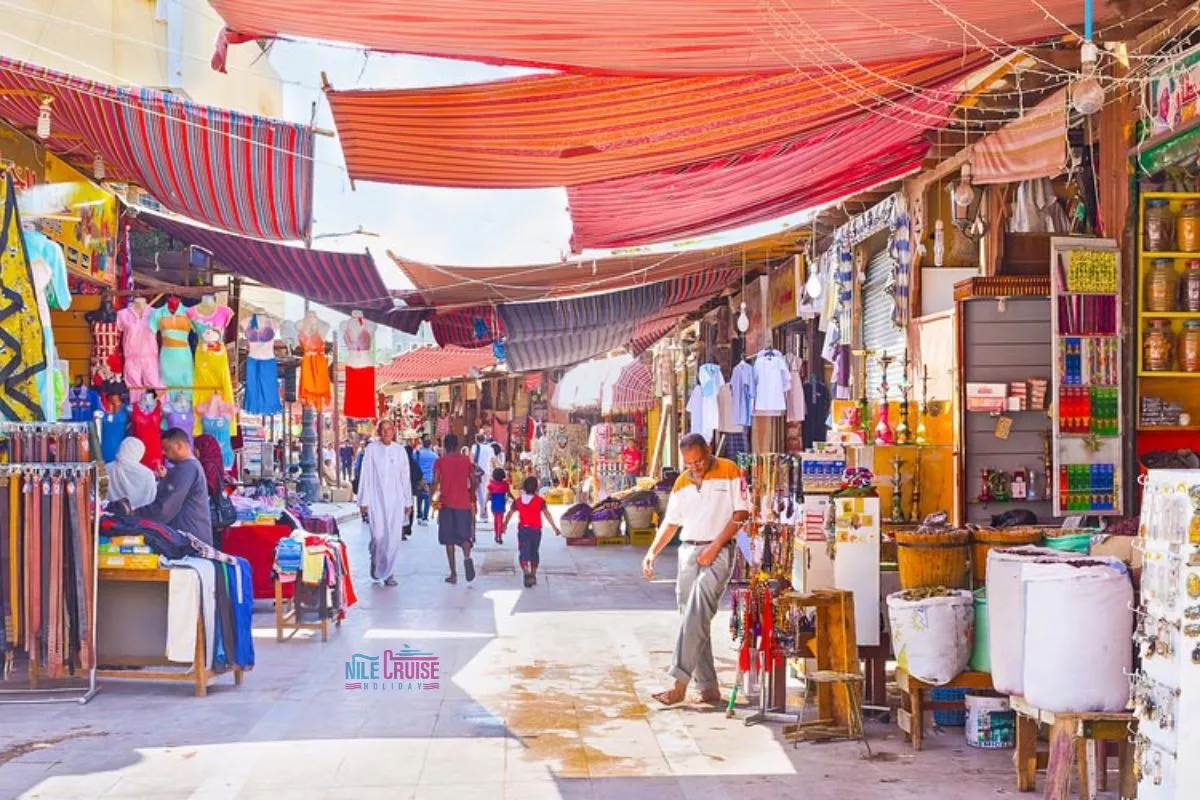
Sharia el-Souk runs through central Aswan, a short walk inland from the Nile and roughly parallel to the river. Its northern end lies close to the railway station and city-center area, so it is easy to reach from most central hotels and from the Corniche.
The Aswan old market is a working local market, not a purpose-built tourist bazaar. Stalls selling spices, fruit, household goods and clothing for local shoppers sit beside shops aimed at visitors, with baskets, scarves and souvenirs. Not every stall sells local or handmade goods, and the tourist-oriented shops can carry the same stock found across Egypt. Knowing the difference is what makes a visit rewarding.
Is Aswan Market the Same as the Nubian Market?
No. Aswan Souk is the downtown city market. The craft stalls of the Nubian Village form part of a separate village visit across the river, usually reached by boat.
Products can overlap, especially baskets, beadwork, and spices, but the setting and context are different. Anyone weighing whether the village is worth visiting will find that experience covered separately.
Best Time to Visit Aswan Market
Morning for Easier Browsing
Mornings are cooler and calmer than the middle of the day. With fewer people in the street, it is easier to compare stalls, ask questions, and look at items closely. This suits travelers who dislike crowds and anyone with practical buying in mind, such as spices to take home. Some shops may still be setting up early in the day.
Late Afternoon and Evening for Atmosphere
For a first visit, late afternoon and evening are usually the best choice. Temperatures ease, more local shoppers arrive, and the market lights come on. The street feels more social.
An evening visit also combines easily with dinner in central Aswan. Many travelers finish their walk with a meal of traditional Egyptian food nearby.
Best Season
October to April is generally the most comfortable time for walking the souk. In the hotter months, visits need better heat planning, and the middle of the day is best avoided where possible. Individual shop hours vary throughout the year, so there is no single opening or closing time for the whole market.
What to Buy at Aswan Market

|
Best Buy |
Why It Suits Aswan |
What to Check |
|
Dried hibiscus (karkade) |
The classic Aswan purchase |
Whole flowers, deep color, no dust |
|
Spices |
The souk's strongest draw |
Strong smell, busy stall, clean storage |
|
Palm-leaf baskets |
Common Nubian-style craft |
Tight, even weave and where it was made |
|
Beadwork and textiles |
Colorful local-style designs |
Finishing, stitching, handmade or factory |
|
Dates |
Easy edible gift from the south |
Taste first; ask for sealed packaging |
|
Higher-value items |
Possible, but buy with care |
Material, receipt, compare sellers |
Hibiscus and Spices
The Aswan spice market is the souk's strongest draw. Dried hibiscus, known locally as karkade, is the classic Aswan purchase, brewed into a deep red drink served hot or cold. Cumin, coriander, cardamom, turmeric, dried herbs, and spice mixes are all widely sold.
Quality cues are simple. Good spices smell strong as soon as a sack is opened. Stalls with visible turnover, where locals are buying too, tend to have fresher stock. Clean storage matters, and whole, intact hibiscus flowers are better than dusty, broken fragments. Asking for spices to be packed securely for travel avoids spills in a suitcase. Not every product is locally grown, so it is fair to ask where something comes from.
Products sold as "saffron" deserve a closer look. A brightly colored spice is not automatically genuine saffron, and some stalls sell safflower or other alternatives. Asking exactly what is being sold, and buying at a price that matches the answer, avoids disappointment.
Nubian Baskets, Beadwork and Textiles
Palm-leaf basketry, beadwork, woven or patterned textiles and small decorative items are among the most appealing Nubian crafts in Aswan. Handmade and factory-made goods can both appear in tourist markets, and not every colorful item is made by Nubian artisans.
Looking at the finishing helps. Handmade baskets usually show slight irregularities in the weave, and beadwork with tight, even stitching lasts longer. The simplest step is to ask where an item was made and by whom.
Dates, Incense and Perfume Oils
Dried dates from southern Egypt are a good edible gift, and stalls usually let shoppers taste before buying. Incense and perfume oils are also common, and compact enough for luggage. Fragrance is personal, so smelling a few options at different stalls before choosing is sensible.
Jewelry and Higher-Value Purchases
Higher-value purchases need more care in any market. It makes sense to ask about material and purity, compare established sellers, and ask for a receipt or documentation. For broader authenticity checks and high-value souvenir advice, our guide on What to Buy in Egypt covers the details.
How to Bargain at Aswan Market
Ask Before You Bargain
Bargaining works best after a little homework. The smart order is a close look at the item first, then a question about what it is made from and, where relevant, where it was made. After that comes a comparison of similar items at two or three stalls, and finally a decision about what the item is worth to you. Bargaining makes sense only once you know you actually want something.
Make a Counteroffer Without Turning It Into a Fight
Bargaining is normal at many independent stalls, and the opening price is often flexible. A smile and a calm tone go a long way. Counteroffers work best when they move gradually, without insulting the item or the seller. Walking away politely is perfectly normal, and sometimes the seller calls a better price as you leave.
There is no single correct percentage. The sensible approach is to start below what you are genuinely willing to pay, then move gradually toward your own limit.
When Not to Bargain
Bargaining is not appropriate everywhere. Fixed-price shops, supermarkets, pharmacies, formal retailers, and items with clearly marked fixed prices are not places to negotiate. Recognizing the context is part of shopping respectfully in Aswan.
Cash, Cards and Shopping Without Overpaying
Egyptian pounds are usually the easiest currency at the Aswan local market, and small notes make paying for small purchases much simpler. Cards may not be accepted at small stalls. Some sellers accept foreign currency, but the conversion may not be favorable. It is worth counting change carefully and asking for documentation for anything expensive. Our guide to money in Egypt explains cash and cards in more detail.
Compare Before You Buy
Browsing first pays off. Noting where good items appear, comparing quality as well as price, and returning later if necessary all help. The first stall does not need to be the final stall.
Avoid Commission Shopping
Some recommended shopping stops may involve commercial relationships between sellers and those bringing visitors. A recommendation does not automatically mean poor quality, but travelers should feel free to compare independently and ask questions before buying. Broader context sits in our guide to common Egypt scams. NCH keeps a zero-commission shopping policy, so its guides focus on the sites rather than steering guests toward shops.
How to Fit Aswan Market into Your Nile Cruise Stay

Aswan Market works best as an evening city experience, not as a rushed shopping stop between temples. It fits naturally into the late afternoon after a sightseeing day, after cruise check-in if the schedule allows, or before dinner in central Aswan. Many ships moor within reach of the city center. The wider list of things to do in Aswan shows what else fits around it.
Some travelers pair a sunset felucca ride with a walk through the souk afterward, when the market is at its liveliest.
Travelers arriving or departing on cruises that start in Aswan can fit the market around their actual schedule, often on the first evening.
NCH plans Aswan stays so that the market fits in calmly, with private drivers and local Egyptologists arranged around the cruise schedule. Travelers who would like more time in the city can ask for a tailor-made Aswan stay.


