For half of each year, the water rose, and the sanctuary of Isis slipped beneath it. Columns that had stood for more than two thousand years sank to their capitals. Painted walls dissolved in the dark. Then the water drained away, and the stone came back up, stained and weaker than before.
Philae is a temple that drowned twice. The first time was slow and seasonal. The second threat was permanent, and it would have erased the island. What saved it was one of the boldest engineering projects of the twentieth century: a steel wall built in the middle of the Nile, a temple cut into roughly 40,000 numbered blocks, and a granite island blasted into a new shape so the stones could rise again.
This was also the last great stronghold of the goddess from the story of Isis and Osiris. The last known hieroglyphic inscription in Egypt was carved here in 394 AD. Losing Philae would have meant losing the final chapter of a writing system that had lasted for millennia. This is the story of how Philae Temple was moved and why the Philae Temple relocation remains one of the greatest rescues in archaeology.
Why Philae Had to Move
The First Aswan Dam
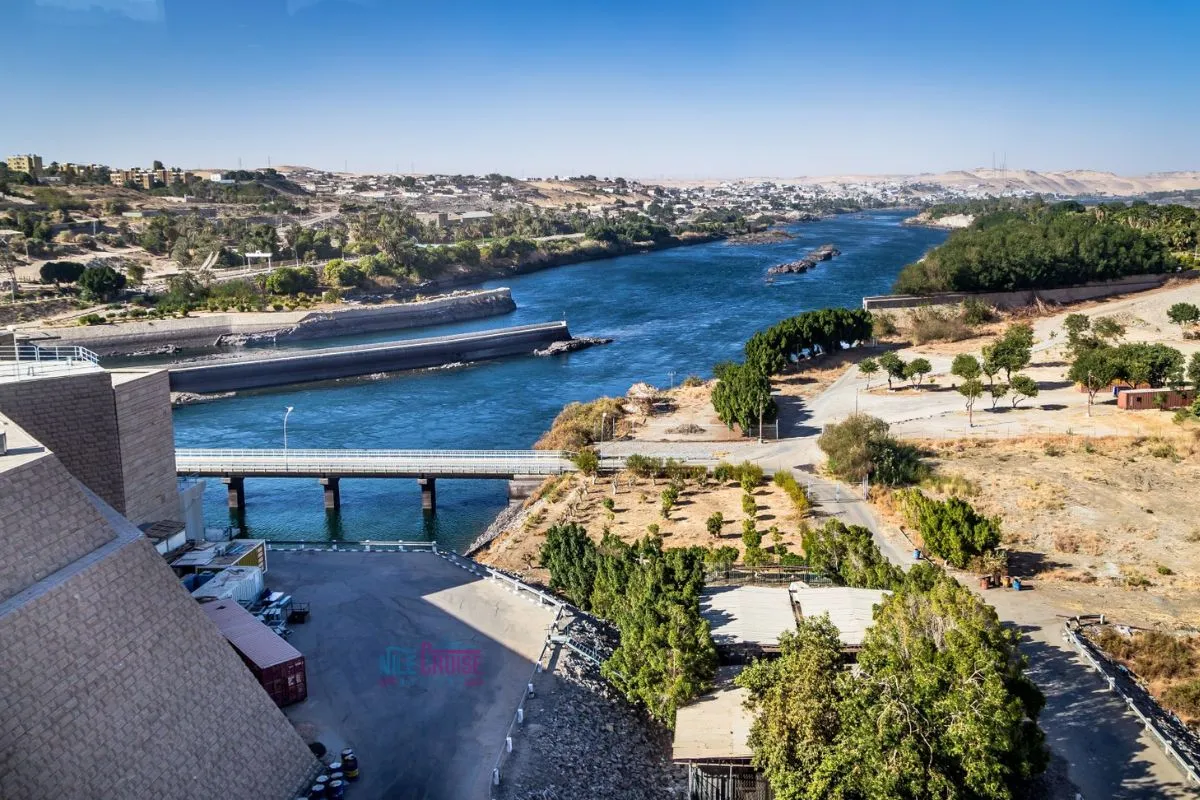
The trouble began in 1902. British engineers completed the Aswan Low Dam just downstream of Philae, built to control the Nile flood and store water for Egypt's cotton fields. It worked. It also turned Philae into a seasonal island.
Each winter, when the reservoir filled, the water crept up the temple walls. The dam was raised twice, between 1907 and 1912 and again between 1929 and 1934, and each raising pushed the waterline higher. Through most of the year Philae sat partly or fully submerged. Only between roughly July and October, when the sluices opened, did the island emerge into the light.
At the time, the trade seemed acceptable to the authorities. Agriculture fed a growing population, and a temple could not compete with harvests. Some engineers at least tried to shore up the foundations so the buildings would not collapse outright. Nobody yet imagined that a much bigger dam would follow.
The High Dam Threat
That bigger dam arrived with Gamal Abdel Nasser. The Aswan High Dam was built between 1960 and 1970, a few kilometers upstream, and it changed everything. Philae now lay trapped between two dams.
The new reservoir behind the High Dam became Lake Nasser, flooding hundreds of kilometers of Nubia and displacing tens of thousands of people, whose story still echoes in every Nubian village around Aswan. For Philae, the danger was different but just as final. Water between the two dams would no longer rise and fall with the seasons. It would stay at a fluctuating level all year, lapping and churning against the stone daily. That constant rise and fall would grind the sandstone away within decades.
The Drowned Temple
Boats Through the Temple
Strangely, the drowning made Philae famous. Victorian and Edwardian travelers arrived in Aswan expecting a ruined temple on a rock. What they found was a building half swallowed by a calm green lake.
So they hired rowing boats and floated straight into it. Passengers glided between the columns of the great colonnade, reaching up to touch carved capitals that had once stood high above their heads. Guides steered past the tops of doorways. Photographers set up tripods on the shore and captured scenes that looked like something from a dream: palm-crowned stone rising out of still water, a small boat drifting through a flooded courtyard.
Writers such as Amelia Edwards, who had sailed to Philae in 1873 and 1874 before the dam, had already made the island a romantic legend. The flooded version only deepened its appeal. For a few decades, a boat ride through a drowned temple was one of the most coveted experiences on any Egyptian journey.
Beauty Became Danger
The romance hid real damage. Every season the sandstone soaked up water, then dried in the fierce Aswan sun. Salts crystallized inside the stone and pushed it apart from within. Mud settled into the carvings.
The most painful loss was color. Early visitors described ceilings and reliefs still bright with ancient pigment. Decades of flooding washed most of that paint away. What visitors see today is beautiful, but it is a paler temple than the one Amelia Edwards described.
UNESCO Calls the World
The 1960 Appeal
On 8 March 1960, UNESCO Director-General Vittorino Veronese issued an appeal that had never been made before. He asked the whole world to help save the monuments of Nubia from the rising waters of the High Dam.
The timing was remarkable. The Cold War was at its height, and the dam itself was a political flashpoint. After the United States and Britain withdrew their funding offer in 1956, the Soviet Union stepped in to help finance and build it. Yet the appeal reached across those lines. Around fifty countries eventually contributed money, archaeologists, engineers or equipment. For a few years, rival governments worked on the same patch of desert for the same cause.
Bigger Than Philae
Philae was only one part of the campaign. In total, 22 monuments were saved across Nubia. The most famous was Abu Simbel, cut into blocks and lifted 65 meters up the cliff between 1964 and 1968. That is why the Abu Simbel Sun Festival still works today, with the sunlight reaching the inner sanctuary twice a year.
Others, such as Kalabsha, Wadi es-Sebua and Amada, were moved to new sites along the shore of Lake Nasser. Several of them are now reached only on Lake Nasser cruises such as the 5-day Lake Nasser itinerary. Anyone weighing a Lake Nasser cruise vs Nile cruise is really choosing which rescued temples to see.
Philae came last, and it was the hardest of all. Abu Simbel stood on dry land above the water. Philae was already underwater, which meant engineers first had to give it back to the air.
Taking Philae Apart
Building the Cofferdam
Engineers first studied a plan to ring Philae with smaller dams and keep the water at its old level. It proved too expensive. The only answer was a complete Philae Temple relocation, and in 1974 the contract went to the Italian firms Condotte and Mazzi Estero, with the Egyptian High Dam Company preparing the site.
The first task was to empty a lake. Around Philae, workers drove two parallel rows of steel sheet piles into the riverbed, forming a double wall around the island. The gap between the walls was then packed with about 1 million cubic meters of sand. Pumps worked day and night to remove water seeping through. Slowly, the temple emerged, coated in mud and silt, standing in a dry pit with the reservoir pressing against the steel on every side.
The scale was financial as well as physical. When the Philae contract was signed in June 1971, the rescue was estimated at US$13 million; inflation pushed the forecast close to US$15 million by early 1972, and later estimates put the final salvage program above US$16 million.
Recording Every Stone
Before a single block could move, every surface had to be recorded. Teams cleaned the walls of their mud and used photogrammetry, a technique that builds precise measurements from overlapping photographs. It allowed engineers to capture the exact size, shape and position of each block, even where carvings ran across joints.
That record became the master plan for the reconstruction. Without it, rebuilding the temple faithfully would have been close to impossible.
The 40,000-Piece Puzzle
Dismantling ran from 1974 to 1977. The buildings were cut into about 40,000 units, each one given a number and logged. Some were small pieces of carved wall. Others were massive sections of column and architrave weighing up to 25 tons.
Cranes lifted each block onto barges and trucks, and the pieces were stored and catalogued in order. A single misplaced number could mean a wall that did not fit, so the bookkeeping mattered as much as the lifting.
Not every monument lay safely inside the cofferdam. Parts of the Roman northern end remained underwater, so British and Egyptian naval divers had to locate blocks of the Gate of Diocletian and the Temple of Augustus beneath the Nile mud and raise them for reconstruction on Agilkia.
Resurrection on Agilkia

Building a New Philae
The new home was Agilkia, an island of granite about 500 meters away and safely above the waterline. It looked nothing like Philae. So the engineers changed its shape.
Crews blasted away rock with explosives and reshaped the island until its contours matched Philae's original outline. The aim was more than a safe platform. The temples needed to sit in the same relationship to each other, and to the river, as they had for two thousand years. The new site stands roughly 12 meters higher than the old one, well clear of the reservoir.
Stone by Stone
Reconstruction ran from 1977 to 1980. Guided by the photogrammetric plans, the work crews set each numbered block back in place, rebuilding the Temple of Isis, the Kiosk of Trajan, the Gate of Hadrian and the long colonnades piece by piece. Foundations were laid in modern concrete so the buildings would never shift again.
The complex was officially reopened in March 1980. Meanwhile, the cofferdam was taken down, and the waters closed over the old island of Philae for good. Today, its granite summit lies just beneath the surface, while the temple it once carried stands a short distance away.
See the Rescue Story Today
Look for the Evidence
The rescue left its fingerprints on the stone. Visitors who look closely can find fine reconstruction joints running through reliefs, where a carved figure was cut and later fitted back together. On some lower walls, a faint tide line still marks where the flood water once sat.
The setting itself is evidence too. From the water, Agilkia reads as a natural island, but its shape is the work of explosives and surveying. A sunset felucca ride in Aswan gives a quiet view of the dams, the islands and the scale of what changed.
Philae also makes a fascinating comparison with other temples saved in different ways. The recent restoration at Esna Temple revealed lost color through careful cleaning. Both appear on lists of the best temples to see on a Nile River cruise for good reason.
Visit Philae Temple with NCH

Knowing the story transforms the visit, and that is where a guide matters most. Nile Cruise Holiday pairs travelers with private Egyptologists who point out the joints, the tide lines and the inscriptions that survived the floods, turning a temple tour into the story of its rescue. Private drivers and coordinated boat transfers keep the visit smooth, and the zero-commission shopping policy means no detours to bazaars.
For tickets, boat crossings and timings, the Philae Temple travel guide covers everything practical. Philae fits easily into Nile cruises from Aswan, Luxor and Aswan Nile cruises. It is worth checking which direction to sail before choosing, and pairing the visit with other things to do in Aswan, along with a long lunch of traditional Egyptian food.
Travelers wanting the full Nubian story can join the 8-day Cairo, Nile cruise and Abu Simbel package, which links Philae with the other great rescue. A luxury Nile cruise adds comfort between temples, and a solar eclipse cruise in August 2027 pairs ancient stone with a rare sky. For anything else, NCH's tailor-made itineraries shape the journey around the temples that matter most to each traveler.