
Queen Tiye was not born a princess, yet she became one of the most visible women at the height of Egypt's 18th Dynasty. As the Great Royal Wife of Amenhotep III, she appears beside the king in statues, on official commemorative objects, and in the tombs of court officials. She was the mother of Akhenaten and, on the most widely accepted reading of the evidence, a grandmother of Tutankhamun.
What makes Tiye unusual is not a later legend. It is the record itself. Her name appears on royal scarabs alongside the king's. A foreign ruler wrote to her directly. After her husband died, she remained a respected figure at her son's court. Few royal wives left such a clear trail across two reigns.
Who Was Queen Tiye?

Tiye lived during the New Kingdom, in the 18th Dynasty, the line of kings that also produced Hatshepsut, Thutmose III and Tutankhamun. She married Amenhotep III early in his long reign, which is usually dated to roughly 1390 to 1352 BC, although exact dates vary between chronologies. Her own birth and death dates are not recorded.
| Fact | Queen Tiye |
|---|---|
| Dynasty | 18th Dynasty |
| Period | New Kingdom, around the 14th century BC (approximate) |
| Parents | Yuya and Tjuyu |
| Husband | Amenhotep III |
| Position | Great Royal Wife |
| Son | Akhenaten (Amenhotep IV) |
| Grandson | Tutankhamun |
Her children with Amenhotep III included Akhenaten, an elder son named Thutmose who died before he could become king, and several daughters, among them Sitamun, Isis, Henuttaneb and Nebetah. A daughter named Beketaten, seen later at Amarna, is often thought to be hers as well.
Was Queen Tiye Born Royal?
No. Her father, Yuya, held priestly and military titles, including a role linked to the king's chariotry, and was a priest of the god Min at Akhmim in Middle Egypt. Her mother, Tjuyu, held religious titles connected to Min and Amun. They were a highly placed provincial family, but not royal.
Remarkably, this was not hidden. A series of large scarabs issued to announce the marriage names Tiye as Great Royal Wife and lists her parents by name. Yuya and Tjuyu were later given a tomb in the Valley of the Kings, KV46, discovered nearly intact in 1905, an honor rarely granted to non-royals. A man named Anen, a senior priest of Amun, is identified on his own monument as Tiye's brother.
How Did Queen Tiye Become So Powerful Beside Amenhotep III?
Tiye's importance is visible in the royal record rather than merely inferred from later stories. Her surviving representations and commemorative records show an unusually prominent position for a royal wife.
Her Name Beside the King's
Amenhotep III issued sets of large commemorative scarabs, small carved objects with inscriptions on the base, to announce events such as lion hunts, his marriage, and new building works. On several of these series, Tiye's name follows the king's in a standard formula, often with her name written in a cartouche. That pairing placed her inside official royal messaging, sent across Egypt and beyond.
The so-called lake scarab is a striking example. Dated to the king's 11th regnal year, it records that a large artificial lake was dug for the Great Royal Wife Tiye in her town, and that the king sailed on it in a royal barge to celebrate. A public work named for a queen in this way is rare.
Shown at the King's Scale
Royal women were often shown much smaller than the king. Tiye was frequently shown at a similar scale. A colossal limestone group from western Thebes, now in the Egyptian Museum in Cairo, shows her seated beside Amenhotep III at nearly the same size, with small figures of their daughters in front.
She also appears in the tombs of officials, including the Theban tomb of Kheruef, where she accompanies the king during his jubilee celebrations. In Nubia, a temple at Sedeinga was dedicated to Tiye, who was honored there in the form of a goddess, a further sign of her elevated status.
None of this makes her a ruler. Amenhotep III remained king. The evidence shows a queen placed unusually close to the center of royal display, which is precisely why she stands out.
Queen Tiye and Egypt's Foreign Diplomacy

During the Late Bronze Age, Egypt was one of several major powers, alongside Mitanni, Babylon, Hatti, and others. Their rulers exchanged letters, gifts, and marriage alliances, and many of these letters survive as clay tablets written in Akkadian cuneiform. Found at Amarna, they are known today as the Amarna Letters.
Among them is correspondence from Tushratta, king of Mitanni, a kingdom in northern Mesopotamia and Syria. Tushratta had close ties with Amenhotep III, and one of his daughters married into the Egyptian court. After Amenhotep III died, Tushratta wrote directly to Tiye. In other letters to her son, he repeatedly refers to her as the person who knew what had been said and agreed.
The correspondence shows that foreign rulers regarded her as someone with direct knowledge of previous diplomatic commitments. It does not show that she controlled Egyptian foreign policy, but it does show recognition that few royal wives received in writing.
Why Did King Tushratta Write to Queen Tiye?
Tushratta wanted the friendship between Mitanni and Egypt to continue under the new king, and he was unhappy about gifts. According to his letters, Amenhotep III had promised statues of solid gold, but the items later sent were gold-plated rather than solid.
He appealed to Tiye because she knew what had been agreed during Amenhotep III's reign. In his letters to Akhenaten, Tushratta suggests that the young king ask his mother, since she had witnessed the earlier exchanges. In writing to Tiye herself, he asked her to help keep good relations alive. The letters show her standing as a living link between two reigns.
Queen Tiye, Akhenaten and the Amarna Period
Tiye remained important after Amenhotep III's death. Her son came to the throne as Amenhotep IV, later changed his name to Akhenaten and founded a new capital at Amarna in Middle Egypt.
Evidence links Tiye to that later court. In the tomb of Huya, her steward, at Amarna, wall scenes show the Queen Mother visiting the city and dining with Akhenaten, Nefertiti and their family. Objects bearing her name have also been found in the Amarna period context, and her status as Queen Mother gave her a recognized place in royal life.
Nefertiti was her daughter-in-law. Some scholars have suggested a family link through the official Ay, who may have been related to Tiye, but this remains a hypothesis. The wider story of the couple is covered in our guide to Akhenaten and Nefertiti.
For travelers deeply interested in Tiye and the late 18th Dynasty, Tell el-Amarna helps complete the family story. It lies well north of the usual Luxor and Aswan route, so it is not part of a standard Nile cruise.
What Did Queen Tiye Look Like?

Ancient Portraits
Several surviving portraits are commonly identified as Tiye. The best known is a small head of yew wood from Gurob, now in Berlin. It shows a mature woman with a firm mouth and heavy-lidded eyes, and its headdress was altered in antiquity. A small green stone head from Serabit el-Khadim in Sinai carries her name in a cartouche on the crown.
Egyptian royal portraits mixed likeness with symbolism and convention, so none is a photograph. Still, some representations of Tiye appear to show an older royal woman rather than an eternally youthful ideal, which makes them unusually personal. Not every proposed portrait of Tiye is securely identified, and scholars still debate some attributions.
Queen Tiye Facial Reconstructions
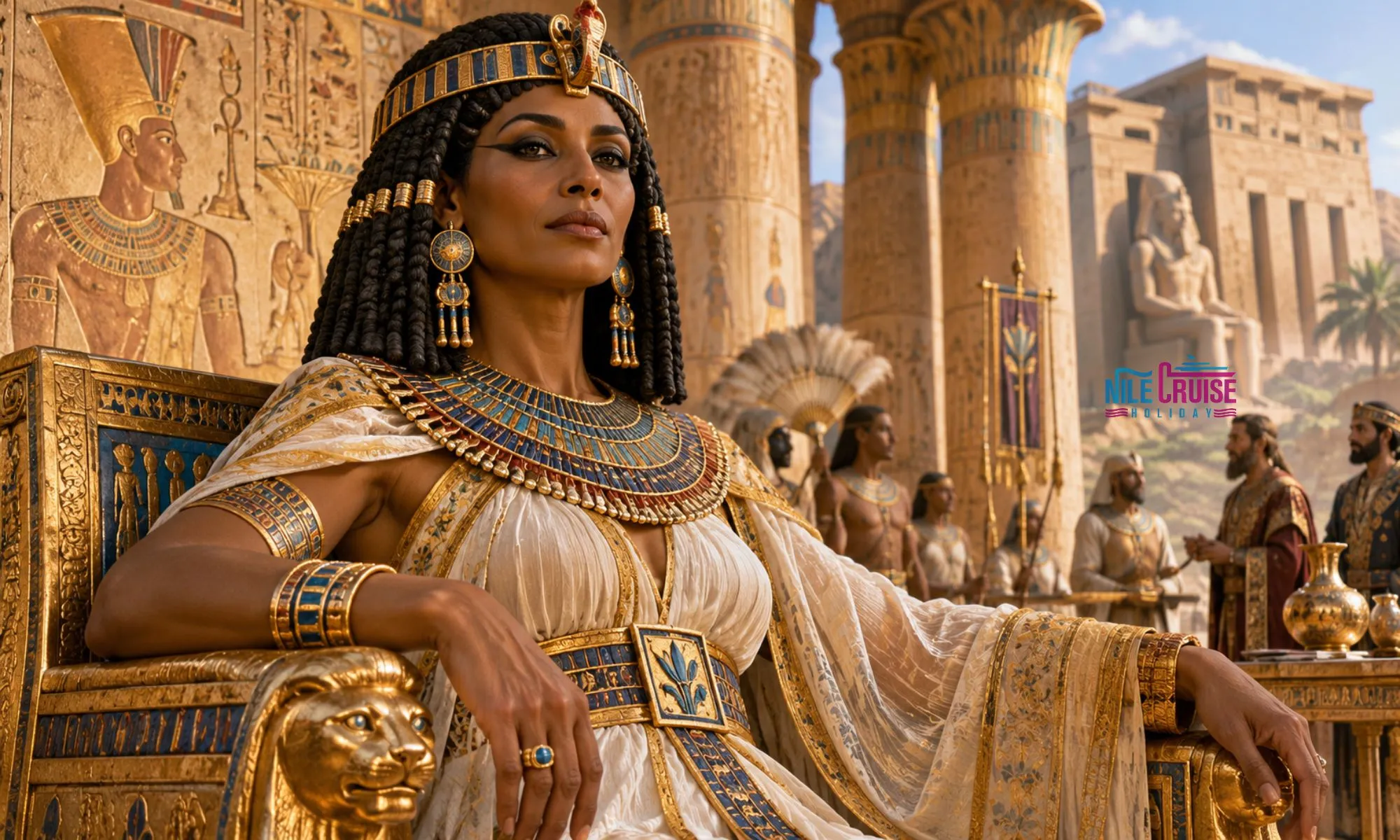
Modern facial reconstructions of Tiye are interpretations. They depend on the preserved mummy, scans, anatomical assumptions about soft tissue, and many artistic choices, such as skin tone, hair, and expression. Two skilled artists working from the same skull can produce noticeably different faces. A reconstruction is an approximation, not a portrait.
What Was Queen Tiye's Ethnicity?
Ancient Egyptian identity does not map neatly onto modern racial categories. Portraits, the appearance of a mummy, and facial reconstructions cannot establish modern ethnicity. Early Egyptologists sometimes speculated that her father Yuya was of foreign origin, partly because of unusual spellings of his name, but this is unproven. What is known is that her family came from Akhmim and held offices in Egypt. The DNA studies published so far focus on family relationships, not on assigning Tiye to a modern racial group.
Queen Tiye's Mummy, Death and Burial
Was Queen Tiye's Mummy Found?
Probably, yes. In 1898, a group of royal mummies was found cached in the tomb of Amenhotep II in the Valley of the Kings, KV35. One unlabeled woman became known as the "Elder Lady."
In the 1970s, a lock of hair found in a small inscribed coffin in Tutankhamun's tomb, labeled with Tiye's name, was compared with the Elder Lady's hair and judged a match. In 2010, a DNA study led by Egyptian researchers reported that the Elder Lady was the daughter of Yuya and Tjuyu and the mother of the man in tomb KV55. On that basis, she is now widely identified as Tiye. Some scientists have questioned aspects of ancient DNA methods, so the identification is best described as strongly supported rather than beyond debate. The mummy was moved in 2021 to the National Museum of Egyptian Civilization in Cairo.
Where Was Queen Tiye Buried?
Her original burial place is uncertain. Fragments of funerary figures bearing her name have been found in the tomb of Amenhotep III in the Western Valley at Thebes, which suggests she was buried there, perhaps after an earlier burial elsewhere.
Tomb KV55 in the Valley of the Kings contained parts of a gilded funerary shrine made for Tiye by Akhenaten. KV55 is archaeologically complex, however, and its contents include material linked to several Amarna royals. It was not simply Tiye's tomb. Her body eventually ended up in the KV35 cache, where priests later gathered many royal mummies for protection.
How Did Queen Tiye Die?
The cause of Queen Tiye's death remains unknown. Neither written sources nor the mummy provide a firm answer. She is last securely attested around the early to middle years of Akhenaten's reign.
How Old Was Queen Tiye When She Died?
Estimates based on examination of the mummy usually place her age at death at roughly 40 to 50 years. That is an estimate from the remains, not a recorded age.
Queen Tiye's Legacy and Where Travelers Can Encounter Her Story

Tiye's legacy is a family that shaped the end of the 18th Dynasty, and a set of monuments that still show her beside the king.
Luxor
Ancient Thebes, modern Luxor, holds much of Amenhotep III's building program. On the West Bank, the Colossi of Memnon once guarded his vast mortuary temple, and smaller figures of Tiye and the king's mother stand beside his legs. The great statue group of Tiye and Amenhotep III now in Cairo was found nearby in western Thebes, near Medinet Habu.
On the East Bank, much of Luxor Temple was built under Amenhotep III. Not every monument there is connected to Tiye, but walking through his colonnades gives a strong sense of the court she lived in. Many of these sites are already part of a Luxor and Aswan Nile cruise.
Amarna
Amarna helps visitors understand the reign of Tiye's son and her place at his court. It requires different logistics from the standard Luxor to Aswan route, usually a separate overland trip or a longer itinerary. Our guide to the long Nile cruise explains when Middle Egypt can fit into a river journey.
How Nile Cruise Holiday Fits In
Nile Cruise Holiday can connect Tiye's story to the wider 18th-Dynasty landscape by coordinating expert-guided sightseeing, cruise timing, and deeper historical stops where the route allows. That means private Egyptologist guides in Luxor, sequencing the West Bank and East Bank sites, managing hotel and cruise handoffs and transfers, and planning Tell el-Amarna or other Middle Egypt additions on suitable itineraries.
Travelers especially interested in Queen Tiye, Amenhotep III, and Akhenaten can ask Nile Cruise Holiday to shape a tailor-made Egypt trip around the 18th Dynasty, combining Luxor's royal landscape with deeper Middle Egypt stops where the route allows.