

Ancient Egyptian artifacts are some of the most recognisable objects on Earth: the golden mask of Tutankhamun, the Narmer Palette, the colossal statues of Ramesses II, and thousands of amulets, coffins and painted papyri made to last for eternity. Most of them are still in Egypt, displayed in museums from Giza to Aswan, and a Nile Cruise journey lets you see the treasures and the temples and tombs they came from on the same trip. Few experiences match standing before an object made for a pharaoh 3,300 years ago and seeing the gold still shine.
This guide explains which ancient Egyptian artifacts to see and where to find them. It covers the main types of artifacts, the highlights of the Grand Egyptian Museum and the Egyptian Museum in Tahrir, the royal mummies, the museums of Luxor and Aswan, the famous pieces held abroad, and practical tips for fitting museum visits into a Nile cruise holiday.
What Makes Ancient Egyptian Artifacts So Special
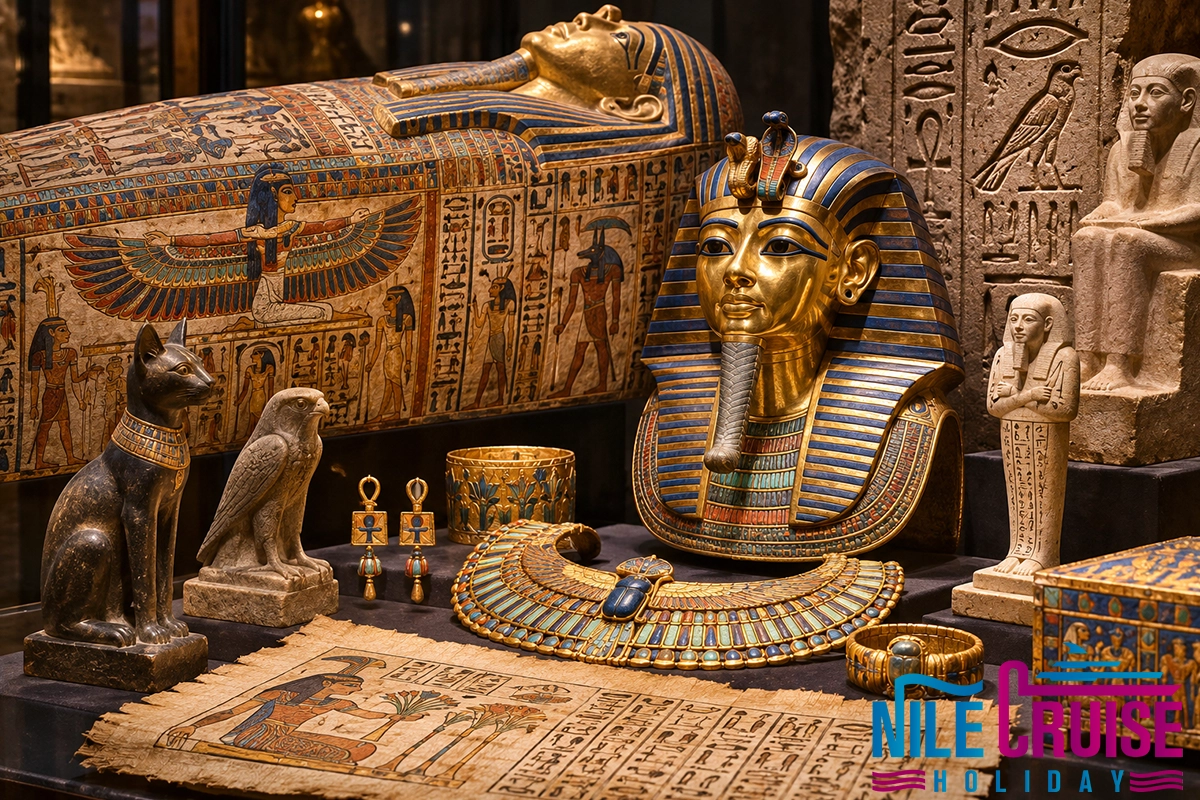
Egypt's dry climate and its belief in eternal life preserved an extraordinary range of objects, from royal treasure to a worker's sick note.
Statues and Royal Portraits
Statues were made to house the spirit of the person they showed, which is why so many survive in tombs and temples. They range from the tiny ivory figure of Khufu, just 7.5 centimetres high, to the 11 metre colossus of Ramesses II.
Jewelry and Amulets
Egyptians wore jewelry in life and in death. Pieces were made of gold, silver, faience, glass and semi-precious stones such as carnelian and lapis lazuli. Protective amulets, including the scarab, the ankh and the Eye of Horus, were placed within mummy wrappings.
Funerary Objects
The richest artifacts were made for burial. Canopic jars held the liver, lungs, stomach and intestines, each protected by one of the Four Sons of Horus, while the heart was usually left in the body. Shabtis, small figurines meant to work for the dead in the afterlife, were buried in large numbers, and coffins, masks and the Book of the Dead papyri guided the soul through the underworld.
Writing and Everyday Life
Papyri, inscribed stelae and ostraca, flakes of limestone or pottery used as notepads, preserve letters, wages and even school exercises. Many of the best ostraca come from the village of the royal tomb builders at Deir el-Medina in Luxor.
The Grand Egyptian Museum: Tutankhamun and the Giant Statues
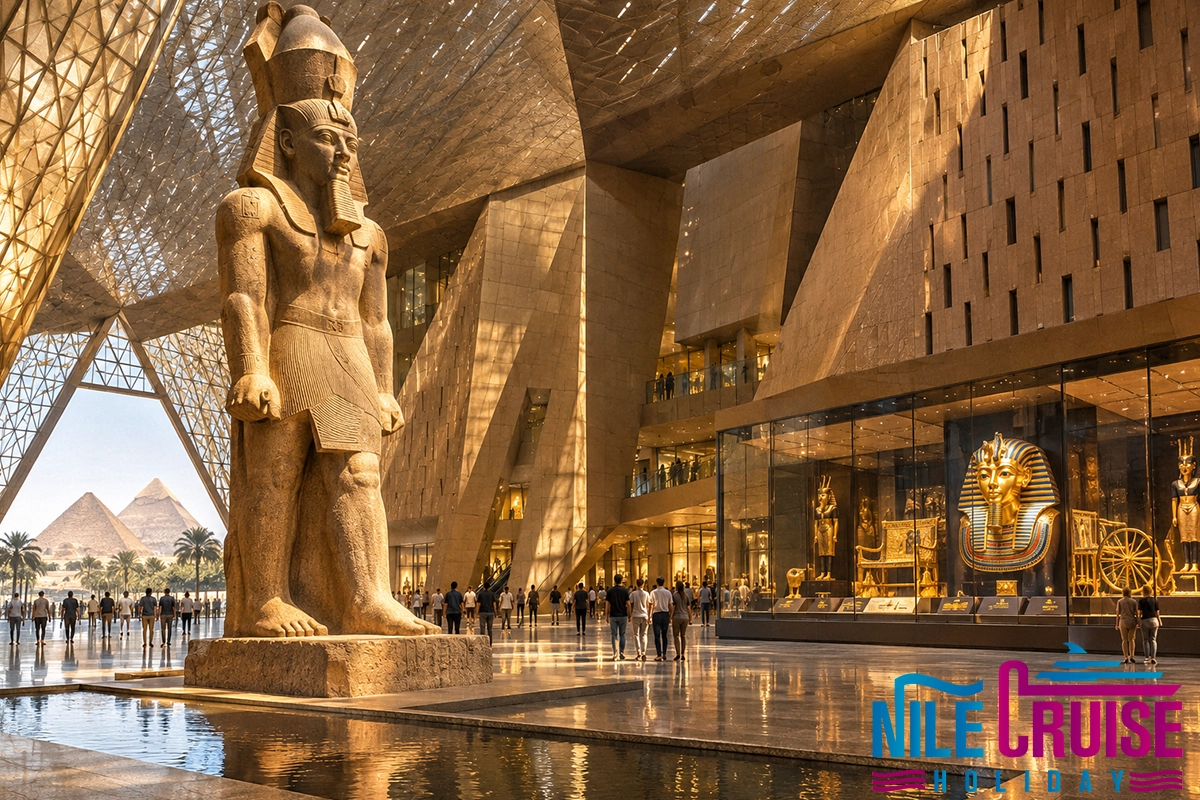
The Grand Egyptian Museum, beside the Giza Pyramids, fully opened in November 2025. With more than 100,000 artifacts and 12 main galleries, it is the largest museum in the world devoted to a single civilisation.
The Complete Tutankhamun Collection
For the first time since Howard Carter opened tomb KV62 in 1922, the boy king's entire burial, about 5,400 objects, is displayed together. The star is the golden mask, about 54 centimetres tall and weighing over 10 kilograms, inlaid with lapis lazuli, quartz and coloured glass. Around it you will find his gilded shrines, chariots, thrones, jewelry, sandals and the canopic chest. Our guide to the tomb of Tutankhamun tells the story of where these objects were found.
The Ramesses II Colossus and the Grand Staircase
In the atrium stands the granite colossus of Ramesses II, about 11 metres tall and roughly 3,200 years old, which once stood in front of Cairo's main railway station. Beyond it, the Grand Staircase is lined with around 60 royal statues and sarcophagi, including kings Thutmose III, Senusret I and Amenhotep III, and a colossal statue of Queen Hatshepsut.
The Khufu Solar Boat
The museum also displays the Khufu boat, a 42 metre cedar vessel about 4,600 years old, found dismantled in a pit beside the Great Pyramid in 1954. It is one of the oldest and best-preserved ships in the world.
The Hanging Obelisk
Outside the entrance, an obelisk of Ramesses II from Tanis is raised on supports so you can walk beneath it and see the king's cartouche carved on its base.
Visiting the Grand Egyptian Museum
The museum is open daily from about 8:30am to 6pm. Foreign adult tickets were reported to rise to about EGP 1,830 from November 2026, so check the official site before booking, especially for Friday and Saturday visits, which can sell out. Phone photography is allowed, but professional cameras are not. Allow at least half a day, and see our guide to things to do in Giza to plan the rest of the area.
The Egyptian Museum in Tahrir: Classic Masterpieces

Opened in 1902, the Egyptian Museum in Cairo still holds over 120,000 objects, even after Tutankhamun's treasures moved to Giza. Its crowded halls and old wooden cases are part of its charm.
The Narmer Palette
This carved slate palette from Hierakonpolis, dated to about 3100 BC, shows King Narmer wearing the white crown of Upper Egypt on one side and the red crown of Lower Egypt on the other. It is often called the first historical document of a united Egypt.
The Old Kingdom Masterpieces
Look for the ivory Khufu statuette, found by Flinders Petrie at Abydos in 1903 and the only certain three-dimensional portrait of the builder of the Great Pyramid. Nearby are the painted limestone statues of Rahotep and Nofret with their lifelike inlaid eyes, the Menkaure triads, and the seated statue of Djoser from the Saqqara Step Pyramid complex.
The Treasures of Tanis
Upstairs, the gold mask and silver coffin of King Psusennes I, found intact at Tanis in 1940, rival Tutankhamun's treasures but receive a fraction of the attention.
Yuya and Thuya
The tomb of Yuya and Thuya, the parents of Queen Tiye and great-grandparents of Tutankhamun, was found almost intact in 1905. Their gilded masks, coffins and furniture are on display, along with a 19 metre Book of the Dead papyrus.
Royal Mummies and Cairo's Other Great Museums
The National Museum of Egyptian Civilization
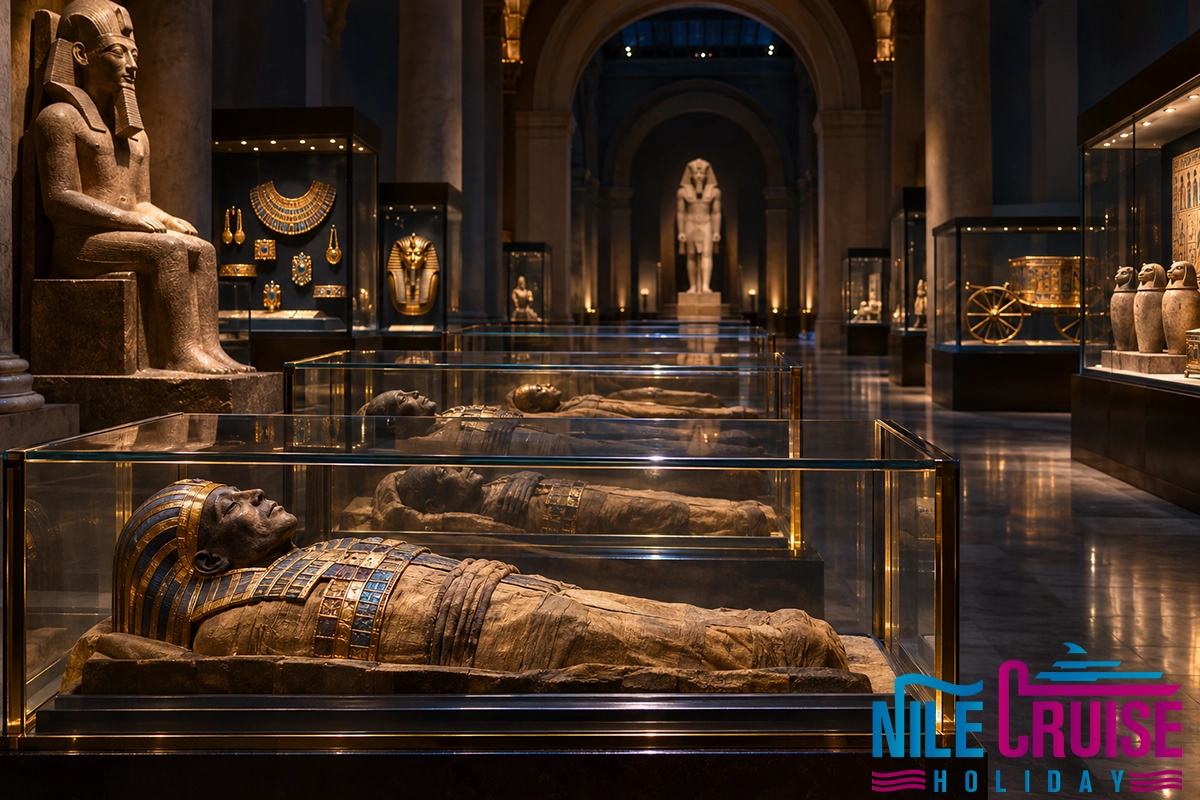
On 3 April 2021, 22 royal mummies, including Ramesses II, Seti I and Hatshepsut, travelled through Cairo in the Pharaohs' Golden Parade to the National Museum of Egyptian Civilization (NMEC) in Fustat. Their dimly lit Royal Mummies Hall is one of the most moving rooms in Egypt, and the museum's main gallery traces Egyptian history from prehistory to the present.
The Coptic Museum and Museum of Islamic Art
To see Egypt beyond the pharaohs, the Coptic Museum in Old Cairo, beside the Hanging Church, holds textiles, icons and manuscripts from Egypt's Christian era. The Museum of Islamic Art in central Cairo holds one of the world's great collections of Islamic metalwork, ceramics and manuscripts.
Museums Along the Nile: Luxor and Aswan

The cities of a Nile cruise have their own museums, and their collections were found in the temples and tombs you will visit.
The Luxor Museum
The Luxor Museum, opened in 1975 on the Corniche, is small but beautifully displayed. Highlights include a statue of Amenhotep III with the crocodile god Sobek, a wall of 283 painted blocks from a lost Karnak temple of Akhenaten, statues from the Luxor Temple cache found in 1989, and the mummies of Ahmose I and a king believed to be Ramesses I. Its evening opening makes it easy to visit after a day of sightseeing.
The Mummification Museum
Also on the Corniche, the Mummification Museum explains how mummies were made, with embalming tools, canopic jars, mummified animals and the mummy of a priest named Masaharta.
The Nubian Museum in Aswan
The Nubian Museum in Aswan holds objects rescued from the land flooded by Lake Nasser, from prehistoric tools to statues of the Kushite pharaohs. It won the Aga Khan Award for Architecture in 2001 and is an ideal visit before a Lake Nasser cruise.
Treasures Still in Place
Some of the greatest works never left their sites. The painted tombs of the Valley of the Kings, the reliefs of Karnak Temple and the vivid ceilings of Dendera Temple and Abydos Temple are museums in their own right.
Famous Artifacts Abroad and Planning Your Museum Visits

Egyptian Treasures in Foreign Museums
Several famous pieces left Egypt in the 19th and early 20th centuries. The Rosetta Stone, inscribed in 196 BC under Ptolemy V in hieroglyphs, Demotic and Greek, has been in the British Museum since 1802. The painted bust of Nefertiti, found at Amarna in 1912, is in Berlin's Neues Museum, and the Dendera Zodiac ceiling is in the Louvre, with a copy still in place at Dendera. Egypt has formally requested the return of some of these objects.
How to Fit Museums Into a Nile Cruise
The easiest plan is to spend two or three days in Cairo before or after your cruise, with one day for Giza and the Grand Egyptian Museum and another for Tahrir and NMEC. Our Cairo and Nile cruise tours and Nile cruises from Cairo combine both. In Luxor and Aswan, the museums fit into free afternoons and evenings, and our guides to things to do in Luxor and things to do in Aswan suggest when.
Practical Tips
- Book Grand Egyptian Museum tickets online in advance, as payment on site is by card only.
- Hire an Egyptologist guide for the big museums to focus on the highlights.
- Visit on weekdays and early in the day to avoid crowds.
- Check photography rules, since some halls, such as the royal mummies, do not allow photos.
Cast Your Eyes on Some Marvelous Ancient Egyptian Artifacts
Egypt's museums hold the physical memory of one of the world's longest civilisations, from the Narmer Palette to the gold of Tanis and the complete treasure of Tutankhamun. Start with the Grand Egyptian Museum and the Egyptian Museum in Cairo, add the royal mummies of NMEC, then follow the Nile to the Luxor, Mummification and Nubian museums, where the artifacts sit close to the temples that made them.
Seen this way, every golden mask and painted coffin becomes part of a single, timeless story. To build museums into your journey, browse our Egypt tour packages with a Nile cruise or ask our team for a tailor-made trip.


