

Egypt stargazing is one of the country's quiet wonders. With dry desert air, very little rain and vast areas with almost no artificial light, Egypt offers some of the clearest night skies in the region, from the sun deck of a Nile cruise to a camp among the chalk towers of the White Desert. The ancient Egyptians built their calendar, their temples and their beliefs about the afterlife around these same stars, and on a clear night you can still see the sky much as they did.
This guide helps you choose the stargazing experience that fits your trip. It explains why Egypt's skies are so good, the best months and moon phases, and what you can see. It then compares stargazing on the Nile, in the Western Desert, in Sinai and on the Red Sea, and at Egypt's ancient sites, with practical tips and a simple table to match each option to your travel style.
Why Egypt Is Great for Stargazing

Dry Air and Dark Deserts
More than 90 percent of Egypt is desert, and outside the Nile Valley and the coastal cities the population is tiny. Rain is rare in most of the country, the air is dry and clear, and light pollution drops quickly once you leave the towns. The Western Desert and the mountains of South Sinai are the darkest areas.
The Best Time of Year
The most comfortable stargazing season is October to March, when nights are cool, skies are usually clear and outdoor activities are pleasant. Desert nights can fall below 10°C in winter, so warm layers are essential. Summer nights are warmer and still clear, but the heat makes long desert trips harder. Our guide to the best time to cruise the Nile and our tips for Egypt in December or January explain the seasons.
Moon Phases and Meteor Showers
Plan around the moon. The week either side of the new moon gives the darkest skies, while a full moon washes out all but the brightest stars. If your dates are flexible, aim for a meteor shower such as the Perseids, which peak around 12 to 13 August, or the Geminids, around 13 to 14 December.
What You Can See
On a clear, moonless night away from towns, the Milky Way stretches across the sky. In winter, look for Orion and Sirius, the brightest star in the night sky. Because Egypt lies so far south, you can also see Canopus, the second-brightest star, low above the southern horizon, a star that never rises for most of Europe. Planets such as Jupiter, Saturn and Venus stand out clearly.
Stargazing on the Nile

The river is the easiest way to combine stargazing with sightseeing, and it needs no extra trip.
The Sun Deck of a Nile Cruise
On a Luxor and Aswan Nile cruise, the sun deck becomes an open-air observatory after dinner. Skies are brightest when ships moor in Luxor or Aswan, but they darken when the ship docks at quieter riverbanks near Edfu or Kom Ombo. Our guide to nightlife onboard a Nile cruise describes evenings on deck, and our luxury Nile cruises often keep the deck bar open late.
A Dahabiya Under the Stars
Dahabiyas, traditional sailing boats with only a few cabins, often moor at small islands or empty riverbanks far from town lights, which makes them one of the best ways to stargaze on the Nile. Some even offer dinners or bedding on deck. Our dahabiya Nile cruise guide and comparison of dahabiya vs Nile cruise explain the difference.
Lake Nasser Cruises
The darkest skies on any cruise belong to Lake Nasser Nile cruises, which sail between Aswan and Abu Simbel through almost uninhabited desert. With no towns along the shore, the Milky Way can appear in full above the water.
A Felucca at Dusk
A sunset sail on a felucca does not last long enough for deep-sky viewing, but it is a beautiful way to watch the first stars and planets appear over the river. Browse our felucca tours in Luxor, Aswan and Cairo.
Desert Stargazing in the Western Desert
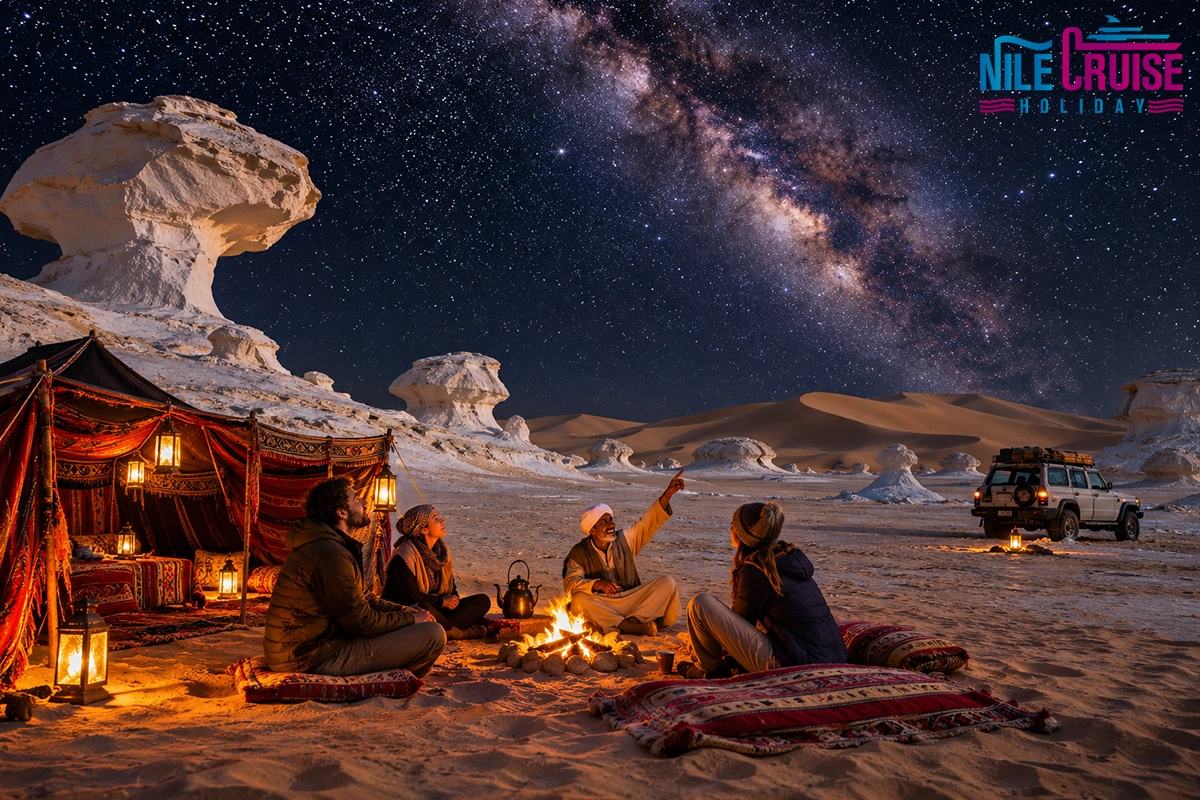
For truly dark skies and a sense of adventure, the Western Desert is unbeatable.
The White Desert
The White Desert National Park, near Farafra Oasis, is Egypt's most famous stargazing spot. Overnight camping trips, usually two or three days from Cairo, let you sleep beside wind-carved chalk formations under one of the darkest skies in the country. Bedouin guides set up camp, cook dinner over a fire and point out the constellations.
Siwa Oasis
Deep in the Western Desert near the Libyan border, Siwa Oasis combines dark skies with salt lakes, hot springs, palm groves and Berber culture. Desert camps outside the town offer the best views, especially among the dunes of the Great Sand Sea.
Fayoum
For a shorter trip, the Fayoum depression is about 1.5 hours from Cairo. Desert camps near Wadi el-Rayan and the Magic Lake give much darker skies than the capital, and you can return to Cairo the next day.
Stargazing in Sinai and on the Red Sea

St Catherine and Mount Sinai
The mountains around St Catherine in South Sinai rise above 1,500 metres, giving thin, clear air and very dark skies. Many travelers stargaze from the trail while hiking Mount Sinai overnight to watch the sunrise from its 2,285 metre summit.
Marsa Alam and Wadi El Gemal
In the south of the Red Sea coast, Marsa Alam is far quieter than Hurghada. The Wadi El Gemal National Park, about 7,450 square kilometres of desert and coastline, offers night excursions with telescopes, while beach resorts here enjoy very little light pollution.
Hurghada and El Gouna Desert Safaris
From Hurghada and El Gouna, evening desert safaris head into the Eastern Desert by jeep or quad bike, often combining a Bedouin dinner, a camel ride and a telescope session. Our guides to the Hurghada desert safari and things to do in Hurghada cover the options, and our guide to a Nile cruise and Red Sea trip shows how to combine both.
Stars and Ancient Egypt
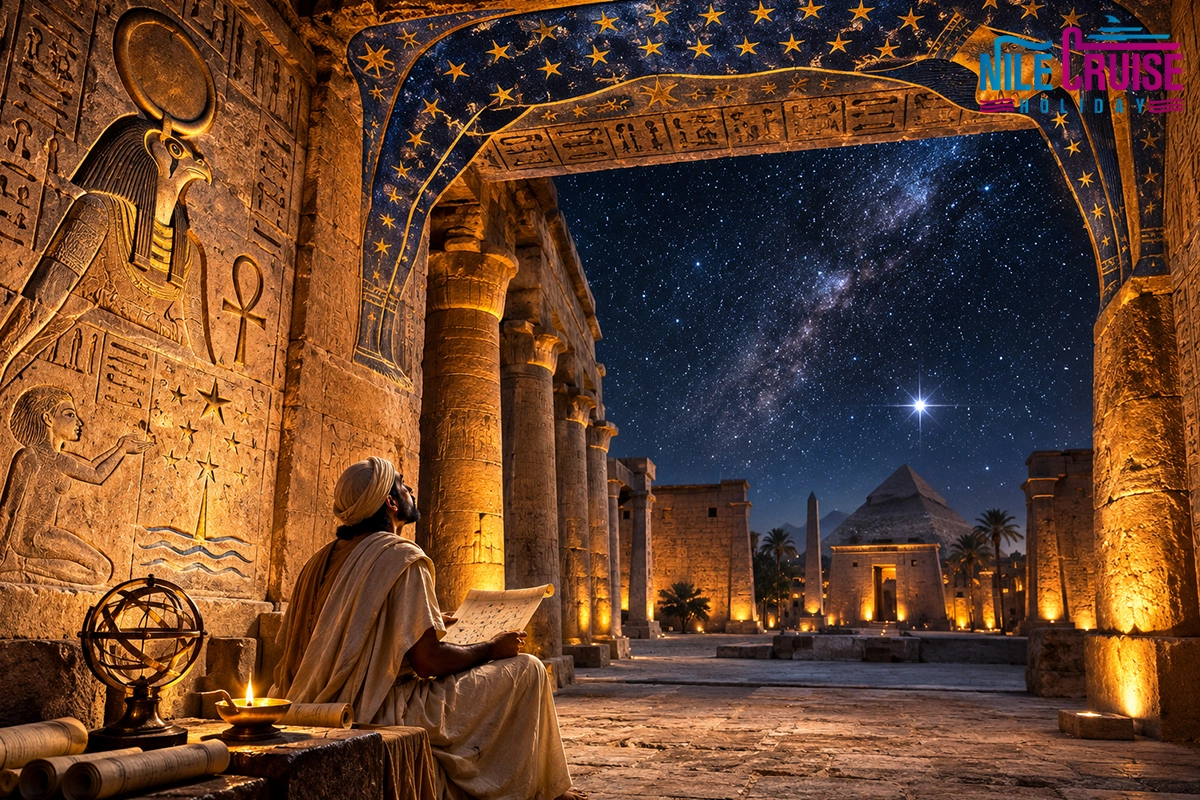
Stargazing in Egypt is also a journey into history, because the sky shaped Egyptian religion.
Sirius and the Egyptian Calendar
The Egyptians watched for the heliacal rising of Sirius, which they called Sopdet, the first dawn each summer when the star reappeared after weeks hidden in the sun's glare. It came shortly before the Nile flood and marked the start of the new year. The pyramids at Giza are also aligned almost exactly to the cardinal points, an achievement that relied on careful observation of the stars.
The Sky on Temple Ceilings
Temples carried the heavens indoors. The ceiling of Dendera Temple shows the sky goddess Nut swallowing the sun each evening and giving birth to it at dawn, and Dendera's famous zodiac maps the constellations. The Temple of Khnum at Esna has astronomical ceilings recently cleaned to reveal their colours, as our Esna Temple restoration guide explains, and our article on the Edfu texts describes Edfu's sky ceilings.
Ancient Sites at Night
You can see the Giza Pyramids at night during the sound and light show, although Cairo's light pollution limits what you can see in the sky. At Abu Simbel, staying overnight in the village gives a much darker sky over the temples. In Luxor, our guide to Luxor at night covers floodlit temples and evening shows.
Which Stargazing Experience Fits Your Trip?

Quick Comparison
| Experience | Sky Darkness | Effort | Best For |
|---|---|---|---|
| Nile cruise sun deck | Moderate | None | Classic first-time trips |
| Dahabiya cruise | Good | Low | Couples and small groups |
| Lake Nasser cruise | Very good | Low | Comfort with dark skies |
| White Desert camping | Excellent | High | Adventurers |
| Siwa Oasis | Excellent | High | Culture and remoteness |
| St Catherine and Mount Sinai | Excellent | Medium to high | Hikers |
| Red Sea desert safari | Good | Low | Beach holidays |
| Giza at night | Poor | Low | Monuments over stars |
Practical Stargazing Tips
- Check the moon phase and aim for nights near the new moon.
- Pack warm layers, a hat and gloves for desert nights from November to February.
- Use a red torch to protect your night vision, and give your eyes 20 to 30 minutes to adjust.
- Download a star map app before you travel, as desert camps rarely have signal.
- For photos, bring a tripod and a camera that allows long exposures; many recent phones have a night mode.
- Leave your drone at home, because drones need special permission in Egypt, as our guide to Egypt drone rules for tourists explains.
Combining Stargazing With a Nile Cruise
The simplest plan is a Nile cruise or dahabiya for the river and temples, followed by two or three nights in the White Desert or on the Red Sea. Our Egypt tour packages with a Nile cruise and Nile cruises from Hurghada make this easy to arrange.
Enjoy the Sight of the Heavens With Us
Egypt stargazing can be as simple as stepping onto your cruise ship's sun deck or as adventurous as a night among the chalk towers of the White Desert. Choose the Nile for comfort, a dahabiya or Lake Nasser cruise for darker skies, the desert or Sinai for the full Milky Way, and the Red Sea for stars after a beach day.
Wherever you go, you will be looking up at the same eternal sky that guided the pharaohs, their calendar and their dreams of the afterlife. To build stargazing into your journey, ask our team for a tailor-made itinerary.


