The Edfu Texts are the thousands of hieroglyphic inscriptions that cover the walls, columns and ceilings of the Temple of Horus at Edfu, the best-preserved temple in Egypt. Carved between 237 and 57 BC, they record how the temple was built, how the world was created, how Horus defeated his enemy Seth, and how priests performed the rituals that kept the god alive. Walking through Edfu is like walking inside a stone book, with every surface still speaking after more than 2,000 years.
This guide explains what the Edfu Texts say and where to find them. It covers the temple's history, the building texts and creation myth, the sacred drama of Horus and Seth, the festivals, library and laboratory recipes, how scholars translated the inscriptions, and how to read the walls yourself on a Nile cruise visit.
The Temple of Horus at Edfu: Setting the Scene
A Ptolemaic Temple on an Ancient Site
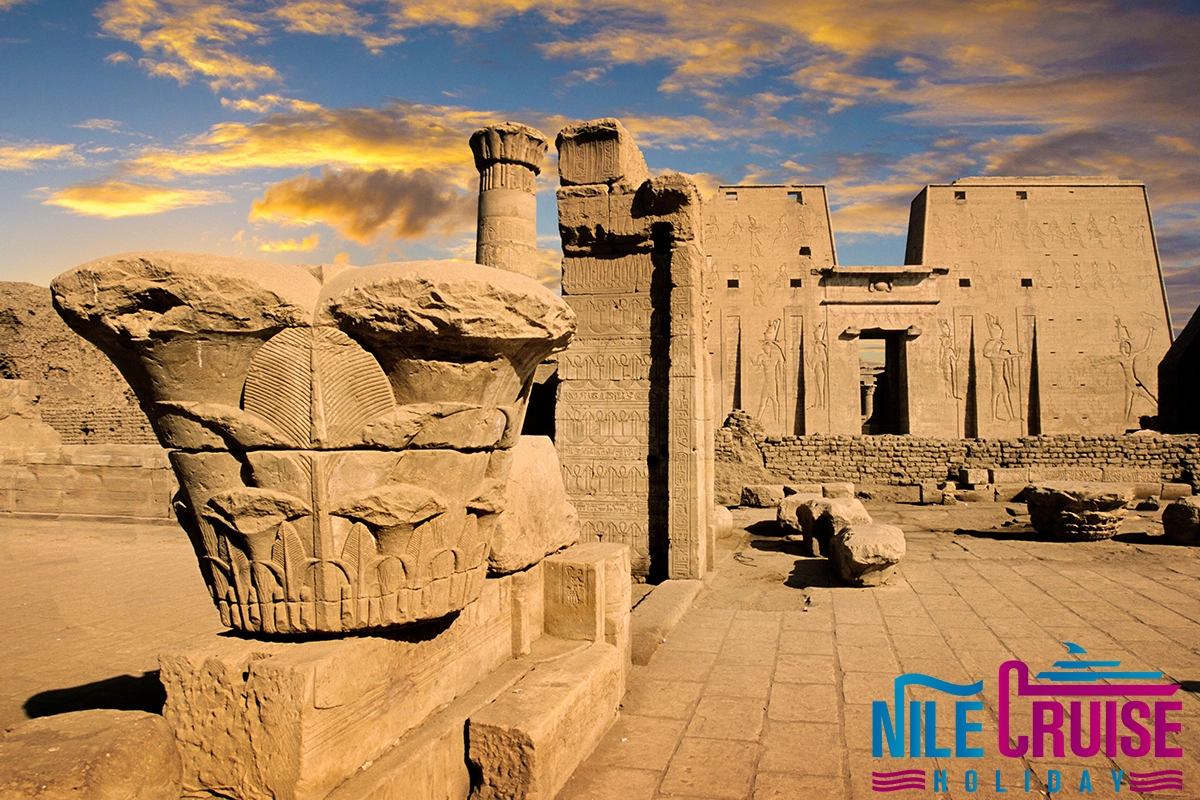
Edfu Temple stands on the west bank of the Nile, about 100 kilometres south of Luxor. The town, called Behdet by the Egyptians and Apollonopolis Magna by the Greeks, had worshipped Horus since the Old Kingdom, and a smaller New Kingdom temple once stood here. The present temple was founded by Ptolemy III Euergetes on 23 August 237 BC and finished under Ptolemy XII, the father of Cleopatra, in 57 BC.
How the Temple Was Built Over 180 Years
The core of the temple, from the sanctuary to the festival hall, was completed by about 212 BC under Ptolemy IV. The hypostyle hall followed under Ptolemy VIII, the 36 metre pylon under Ptolemy IX, and the final decoration under Ptolemy XII. Uprisings in Upper Egypt slowed the work, which is why the building texts record several stages and dedications.
Why the Texts Survived
After the end of pagan worship, the temple was gradually buried by sand and river silt up to 12 metres deep, with houses built on its roof. This protected most of the walls. French scholars recorded it in 1798, and Auguste Mariette cleared it from 1860. Some reliefs in reachable areas were deliberately defaced by early Christians, but the inscriptions themselves are remarkably complete.
The Building Texts and the Creation Myth

The Edfu Texts begin by explaining why the temple exists at all.
The Building Inscriptions
Long bands of text around the outer walls, known as the building texts, record the dates of each stage, the name of every room and its purpose, and the measurements of the building. They are one of the most detailed descriptions of an ancient building anywhere, and they describe the temple as a perfect copy of the first temple created by the gods.
The Temple as the Island of Creation
The creation texts tell how the world began as dark primeval water. An island of land rose, reeds grew on it, and Horus landed there as a falcon. The serpent Apophis tried to stop creation but was defeated by a sacred harpoon, a form of the god Ptah. The gods Thoth and Seshat then designed the first temple, made of reed, which every later temple, including Edfu, was meant to reproduce.
The Primeval Ones
The texts name groups of creator spirits, such as the Shebtiu, who shaped the island and built the first shrines. In 1969, Egyptologist Eve Reymond studied these passages in The Mythical Origin of the Egyptian Temple. Some popular writers have read them as memories of a lost civilisation, but Egyptologists see them as religious mythology written by Ptolemaic priests.
Founding the Temple
Reliefs show the king and Seshat performing stretching the cord, the ritual that marked out the ground plan with stakes and rope. Further scenes show the king moulding bricks, purifying the site and finally handing the finished temple to Horus, while 60 gods form a protective wall around it.
The Myth of Horus and Seth: A Drama in Stone

The most famous of the Edfu Texts is a play carved on the temple's enclosure walls.
Where to Find It
The Triumph of Horus, also called the Sacred Drama, is inscribed on the inner face of the western enclosure wall, in the corridor between the temple and the outer wall. Each scene is illustrated with a relief, and the text dates to around 110 BC, although the story itself is much older.
The Story
The play retells the war between Horus of Behdet and his uncle Seth, who murdered Osiris. Seth takes the form of a hippopotamus, and Horus, standing in his boat, strikes him with ten harpoons, each hitting a different part of the body, while Isis encourages her son. In the reliefs, the hippo is shown tiny beneath Horus's boat, a reminder that chaos has been made harmless.
Acts, Actors and a Hippo Cake
The drama has a prologue, three acts and an epilogue, with speaking parts for Horus, Isis, Thoth, the king and queen, a chorus and young harpooners. It was performed by priests at a festival, and at the end a cake shaped like a hippopotamus was cut up and eaten, symbolically destroying Seth. Scholars A. M. Blackman and H. W. Fairman published the first full English translation in the 1940s.
Festivals, Rituals and Daily Temple Life
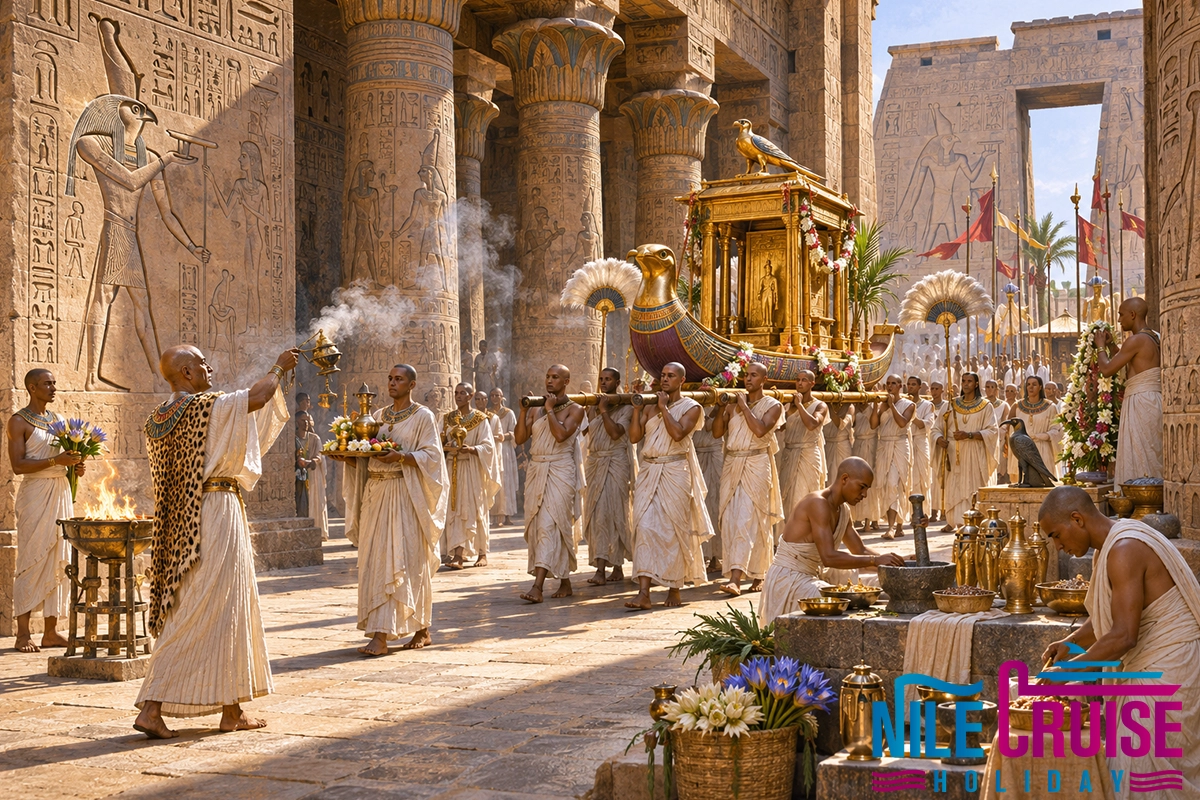
The Edfu Texts also work as a priests' manual, recording when and how each ritual took place.
The Festival of the Beautiful Meeting
Every year, the statue of Hathor sailed about 160 kilometres upstream from Dendera Temple to visit her husband Horus at Edfu. Reliefs in the court and on the pylon show the fleet, the meeting and the two weeks of celebrations, offerings and feasting that followed, before Hathor returned home.
The Coronation of the Sacred Falcon
Each year, a living falcon was chosen to act as Horus's representative on Earth. The texts describe how it was presented to the people and crowned in a ceremony that also renewed the king's own right to rule.
The New Year Festival
Reliefs on the two staircases show priests carrying the statue of Horus up to the roof at the New Year to be recharged by the rays of the sun, then down again. The ceiling of the New Year chapel shows the sky goddess Nut stretched across it.
The Birth House
In front of the temple, the Mammisi, or birth house, celebrated the divine birth of Horus's son, Harsomtus. Its reliefs show Hathor nursing the child and the gods attending the birth.
The Library, Laboratory and Other Inscribed Rooms

The Library
To the right of the entrance to the hypostyle hall is a small room that served as the temple library. Its walls list the titles of the papyrus books once stored there in chests, on rituals, protection and temple administration, and show Seshat, goddess of writing.
The Laboratory
In the northwest corner of the festival hall, the laboratory walls carry recipes for incense, perfumes and sacred oils, including kyphi, a blend of resins, wine, honey and spices burned in rituals. They are among the most detailed recipes to survive from ancient Egypt.
The Sanctuary and Chapels
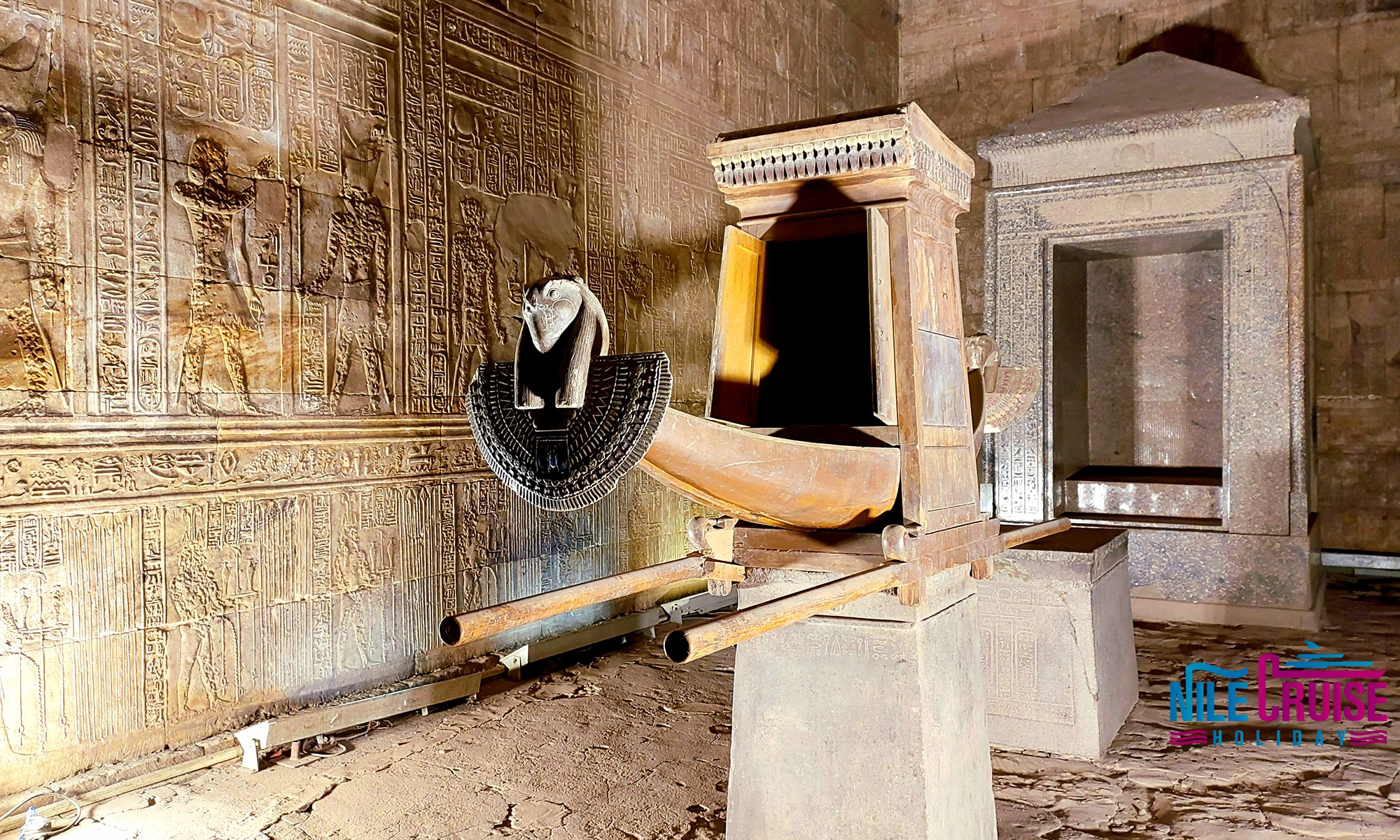
The sanctuary holds a black granite shrine dedicated by Nectanebo II in the 4th century BC, older than the temple around it. The surrounding chapels carry texts and reliefs dedicated to Osiris, Min, Hathor and other gods, as well as a life-size model of Horus's sacred barque.
The Nilometer
A passage from the east side leads to a Nilometer, a stairway down to the water table. Priests used its marks to measure the flood and set taxes, and the texts around the temple record the offerings that came in.
Translating the Edfu Texts and Reading Them Today
From Chassinat to the Edfu Project
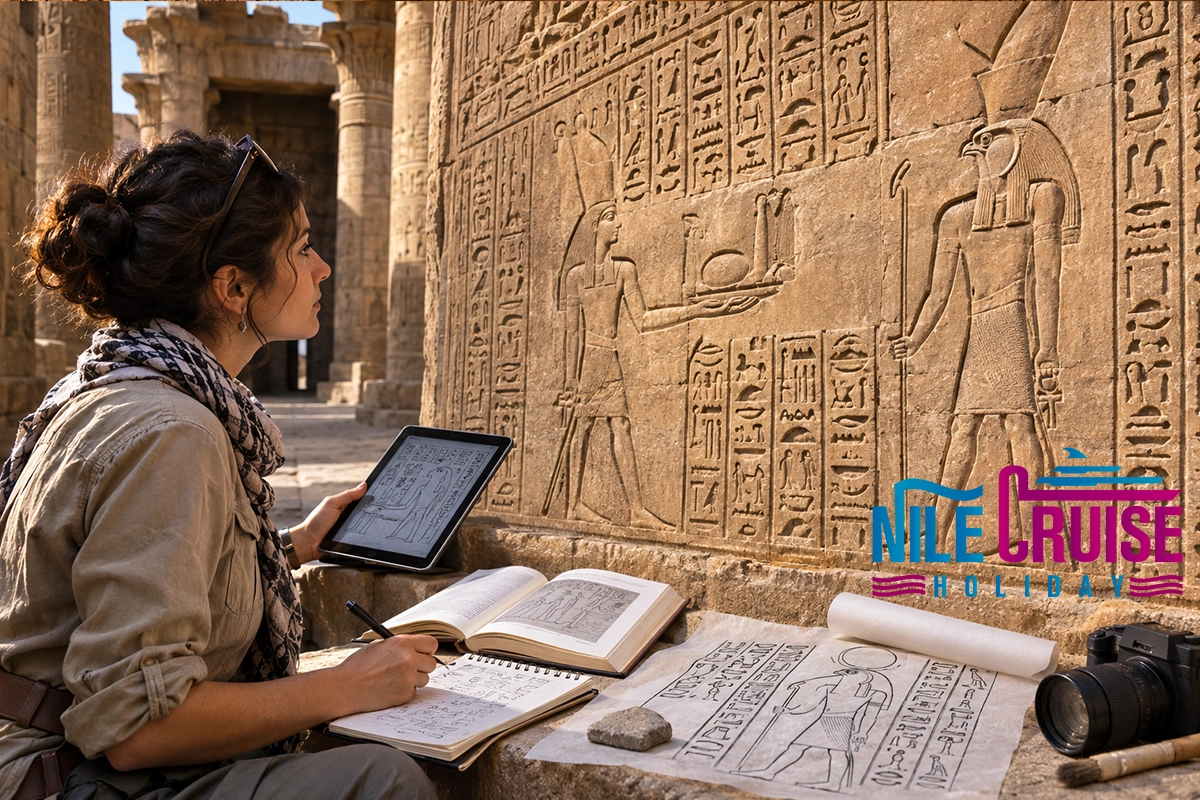
French Egyptologists Maxence de Rochemonteix and Émile Chassinat copied the inscriptions and published them in 14 volumes, Le Temple d'Edfou, between 1892 and 1934. Translating them took far longer. The Edfu Project, led by Dieter Kurth and supported by the German Research Foundation and later the Göttingen Academy of Sciences and Humanities, translated and digitised the texts and was completed in 2017.
Why the Texts Are So Hard to Read
The Edfu Texts are written in Ptolemaic hieroglyphs, a late form of the script in which priests invented thousands of new signs and wordplays. As a result, even trained Egyptologists need specialised dictionaries to read them, and the texts are one of the largest collections of hieroglyphic writing from the Ptolemaic period.
Seeing the Texts on a Nile Cruise
Almost every Luxor and Aswan Nile cruise stops at Edfu, usually early in the morning, with a horse carriage ride from the quay. Ask your guide to show you the Triumph of Horus in the western corridor, the library and laboratory beside the halls, and the Beautiful Meeting reliefs in the court. Our 4-day and 5-day Nile cruise itineraries show where Edfu falls, and our comparison of Luxor to Aswan vs Aswan to Luxor explains how the direction changes your Edfu stop. Smaller dahabiya cruises often allow a longer visit.
Comparing Edfu With Other Temples
The same Ptolemaic style of writing covers Kom Ombo Temple, Philae Temple, whose rescue is told in how Philae Temple was moved, Dendera and the Temple of Khnum at Esna, whose cleaned ceilings are described in our Esna Temple restoration guide. For older texts, compare Karnak Temple and Abydos Temple. Objects inscribed in the same script fill the museums in our guide to ancient Egyptian artifacts. Just north of Edfu, the El Kab tombs hold inscriptions 1,300 years older.
Enjoy a Meaningful Holiday Across the Golden Edfu Temple
The Edfu Texts turn a beautiful temple into a complete record of how Egyptian priests understood their world: how it was created, how order defeated chaos, and how the gods were fed, crowned and celebrated each year. When your cruise stops at Edfu, look beyond the great pylon to the corridors and side rooms, where Horus still harpoons Seth and the recipes for sacred incense wait to be read. Few places let you hear the voice of ancient Egypt so clearly carved in eternal stone.
To include Edfu, Dendera and the temples of the Nile in your journey, see our guide to the best temples to see on a Nile river cruise or ask our team for a tailor-made trip.