
El Kab is one of the quiet and unique treasures of the Nile Valley. On the east bank between Esna and Edfu, a line of rock-cut tombs looks down from a sandstone hill over the ruins of Nekheb, the city of the vulture goddess Nekhbet and one of the oldest settlements in Egypt. Here, in a small painted chamber, a soldier named Ahmose left the only first-hand account of how Egypt drove out the Hyksos, and his words still speak from the wall some 3,500 years later.
This guide explains what to see at the El Kab tombs and how to visit them. It covers the site's history, the five most important tombs, the great mudbrick walls and desert temples of Wadi Hilal, how to get there from Edfu, Esna or Luxor, tickets and timing, and whether El Kab deserves a place on your Nile cruise journey.
El Kab Tombs Quick and Important Facts

Where Is El Kab?
El Kab lies on the east bank of the Nile, roughly 20 kilometres north of Edfu Temple and around 30 kilometres south of Esna, at the mouth of Wadi Hilal. Luxor is about 80 to 90 kilometres to the north. Across the river stands Hierakonpolis (ancient Nekhen), the early royal city of the falcon god Horus.
Quick Facts
| Detail | Information |
|---|---|
| Ancient name | Nekheb (Greek: Eileithyiaspolis) |
| Patron goddess | Nekhbet, the vulture goddess of Upper Egypt |
| Main tombs | Early 18th Dynasty to 20th Dynasty |
| Key monuments | Rock tombs, town walls, temples of Nekhbet, chapel of Amenhotep III |
| Ticket | About EGP 200 adult, EGP 100 student |
| Time needed | 1 to 2 hours for the tombs; add 1 to 1.5 hours for Wadi Hilal |
| Crowds | Very few visitors |
Ancient Nekheb and the Vulture Goddess Nekhbet
Nekheb was the cult centre of Nekhbet, the white vulture goddess who protected Upper Egypt and the king. She and the cobra goddess Wadjet of Lower Egypt formed the "Two Ladies", and the vulture and cobra worn on the royal brow, including the famous mask from the tomb of Tutankhamun, represent this pair. In the New Kingdom, Nekheb was a provincial capital of the third nome of Upper Egypt.
The Special History of El Kab

From Stone Age Campsites to a Sacred City
In 1967, Belgian archaeologist Pierre Vermeersch found campsites at El Kab dating to about 6400 to 5980 BC, which gave their name to the Elkabian stone tool culture. The site was later home to one of Egypt's earliest towns, and temple remains run from the Early Dynastic period through to the Ptolemaic era. James Quibell carried out the first scientific excavation in the late 19th century, and a Belgian mission has worked here since 1937.
El Kab and the Expulsion of the Hyksos
El Kab's great moment came at the start of the New Kingdom. Its governors and soldiers fought for the Theban kings in the wars against the Hyksos, foreign rulers of the north, and against the kingdom of Kush to the south. Around 1550 BC, Pharaoh Ahmose I reunited Egypt, and the local families who served him carved their tombs into the hill above their city.
Later Centuries
In the Late Period, the town was enclosed by massive mudbrick walls, probably under Nectanebo II of the 30th Dynasty. Under the Ptolemies and Romans it was known as Eileithyiaspolis, after the Greek goddess of childbirth, and the town was abandoned around the late 4th century AD.
The El Kab Tombs: What to See

The tombs are cut into a sandstone hill north of the town, reached by a short climb up steps. Four are usually open, and a guardian unlocks them on arrival. Unlike the royal tombs in the Valley of the Kings, covered in our guide to Valley of the Kings tombs and tickets, these belong to local governors, priests and soldiers, and their walls show both history and everyday life.
Tomb of Ahmose, Son of Ebana
This small tomb is the most historically important at El Kab. Ahmose, son of Ebana was a naval officer who served under three kings, Ahmose I, Amenhotep I and Thutmose I. His long autobiographical inscription describes the siege of the Hyksos capital Avaris, the capture of Sharuhen and campaigns in Nubia, and he lists the slaves and gold he received as rewards. It is the only first-hand account of the expulsion of the Hyksos to survive.
Tomb of Paheri
The Tomb of Paheri is the most beautiful at El Kab. Paheri was mayor of Nekheb and Esna in the early 18th Dynasty, tutor of a royal prince, and the grandson of Ahmose son of Ebana. His chamber, about 8.3 metres long and 3.8 metres wide, is decorated with painted reliefs of ploughing, harvesting, wine making, fishing, cattle, a family banquet and the funeral procession, with colours still remarkably fresh. At the back, a niche holds statues of Paheri, his wife and his mother.
Tomb of Renni
Renni was overseer of the priests of Nekhbet under Amenhotep I, and his tomb is one of the few to survive from this early reign. Look for the scene of the Muu dancers, ritual performers in tall headdresses who appear at funerals, and the lively farming and pig herding scenes.
Tomb of Setau
Setau was high priest of Nekhbet in the 20th Dynasty, from the reign of Ramesses III. His tomb is later and less well preserved than the others but shows the festival barque of Nekhbet, and it rounds off a remarkable span of about 400 years of local history.
Tomb of Sobeknakht
The tomb of Sobeknakht II, a 17th Dynasty governor, gained fame in 2003 when a British Museum team uncovered an inscription describing a major Kushite raid on Upper Egypt and the Egyptian counter-attack. It is not always open, so ask the guardian.
Beyond the Tombs: Walls, Temples and Wadi Hilal
The Great Mudbrick Walls
The most striking sight at El Kab is the town enclosure, a mudbrick wall about 12 metres thick that surrounds an area of roughly 550 by 450 metres. Inside lie the ruins of the main Temple of Nekhbet, a temple of Thoth and a sacred lake, but these are heavily ruined and usually closed to visitors.
The Chapel of Amenhotep III
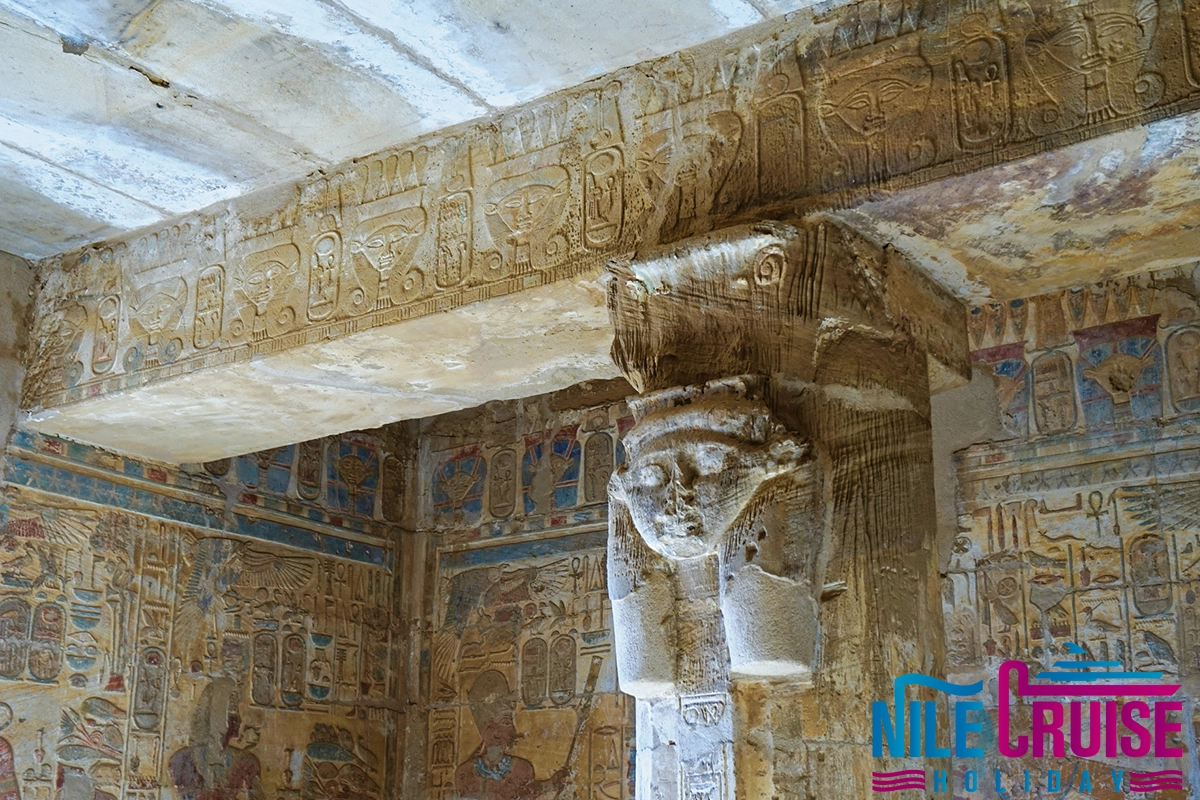
About 3.5 kilometres into Wadi Hilal stands a small chapel built by Amenhotep III for Nekhbet and Hathor, used as a resting place for the goddess's sacred boat during processions. Its reliefs were damaged under Akhenaten and restored by Seti I. It is small but beautifully coloured.
The Ptolemaic Temple and El Hammam
Closer to the road, a Ptolemaic rock temple has a stairway, columned halls and a chapel cut into the cliff. Nearby, the small chapel known as El Hammam was built by another Setau, Viceroy of Kush under Ramesses II, and is unrelated to the tomb owner of the same name.
Vulture Rock
In the wadi, a large outcrop known as Vulture Rock is covered in inscriptions and graffiti from predynastic times to the Old Kingdom, many naming local officials and priests of Nekhbet.
How to Visit El Kab

From Edfu, Esna or Luxor
The easiest way to reach El Kab is by private car or taxi from Edfu, about 30 minutes away. Many travelers combine it with Edfu Temple and the Temple of Khnum at Esna, freshly cleaned to reveal its painted ceiling, as our guide to the Esna Temple restoration explains. From Luxor, a full-day private trip covering Esna, El Kab and Edfu is possible. There is no convenient public transport to the site.
On a Nile Cruise or Dahabiya
Most large cruise ships sail past El Kab without stopping. Dahabiyas, the traditional sailing boats with only a few cabins, often moor nearby and include it as a guided stop. Our dahabiya Nile cruise guide and comparison of dahabiya vs Nile cruise explain the difference. On a standard Luxor to Aswan or Aswan to Luxor cruise, you can ask about a private excursion from Edfu during the stop there.
Tickets, Hours and Time Needed
The ticket costs about EGP 200 for adults and EGP 100 for students, bought at the office near the tombs. The site is generally open during daylight hours, roughly 8am to 4pm, but confirm locally. If you want to visit the Wadi Hilal temples, tell the ticket seller; a guardian will accompany you, and you need a vehicle that can handle desert tracks. Allow at least 1 to 2 hours for the tombs and walls, and another 1 to 1.5 hours for the wadi.
Best Time to Visit
October to April is the most comfortable season. The site has almost no shade, so go in the early morning, when the light also suits the painted tombs. Our guide to the best time to cruise the Nile covers the seasons.
Practical Tips
- Carry cash in small notes for tickets and a tip for the guardian who opens the tombs.
- Bring water, a hat and sunscreen.
- Wear sturdy shoes for the steps to the tombs.
- Photography rules in tombs change, so ask before using a camera or phone inside.
Is El Kab Worth Visiting?

For anyone who loves history and quiet places, yes. El Kab has none of the crowds of Luxor, and its tombs tell the human story of the New Kingdom in a way the royal valleys cannot.
Who Will Love It
- History lovers who want to read the Hyksos war in an eyewitness account.
- Travelers who enjoyed the noble tombs at Luxor, such as the Tombs of the Nobles and Deir el-Medina, or the Beni Hassan tombs in Middle Egypt.
- Dahabiya passengers and repeat visitors looking beyond the main sights.
Who Might Skip It
- First-time visitors with only a few days, who will get more from Karnak, the Valley of the Kings and Edfu.
- Travelers with limited mobility, because of the steps and uneven ground.
Pairing El Kab With Other Sites
El Kab fits neatly between Luxor and Aswan. Combine it with Edfu and Kom Ombo Temple to the south, or with Esna to the north. In Luxor, the Luxor Museum displays objects from the reign of Ahmose I, and Karnak Temple was the great temple of the Theban kings Ahmose served. Our guides to the best temples to see on a Nile river cruise, things to do in Luxor and things to do in Aswan help you plan the rest of the route.
Explore One of the Rarest Pieces of Art With Our Grand Trips
The El Kab tombs reward travelers who look beyond the famous names of the Nile. In a few small chambers, you meet a soldier who fought to free Egypt, a mayor who painted his harvest and his family, and the priests of a vulture goddess whose image crowned every pharaoh. Add the great walls and the desert chapels of Wadi Hilal, and El Kab becomes one of the most rewarding quiet stops between Luxor and Aswan, where the timeless voices of Nekheb still speak from the rock.
To include El Kab, Edfu and Esna in your journey, browse our Nile cruises from Luxor and Nile cruises from Aswan or ask our team for a tailor-made trip with a private excursion.


