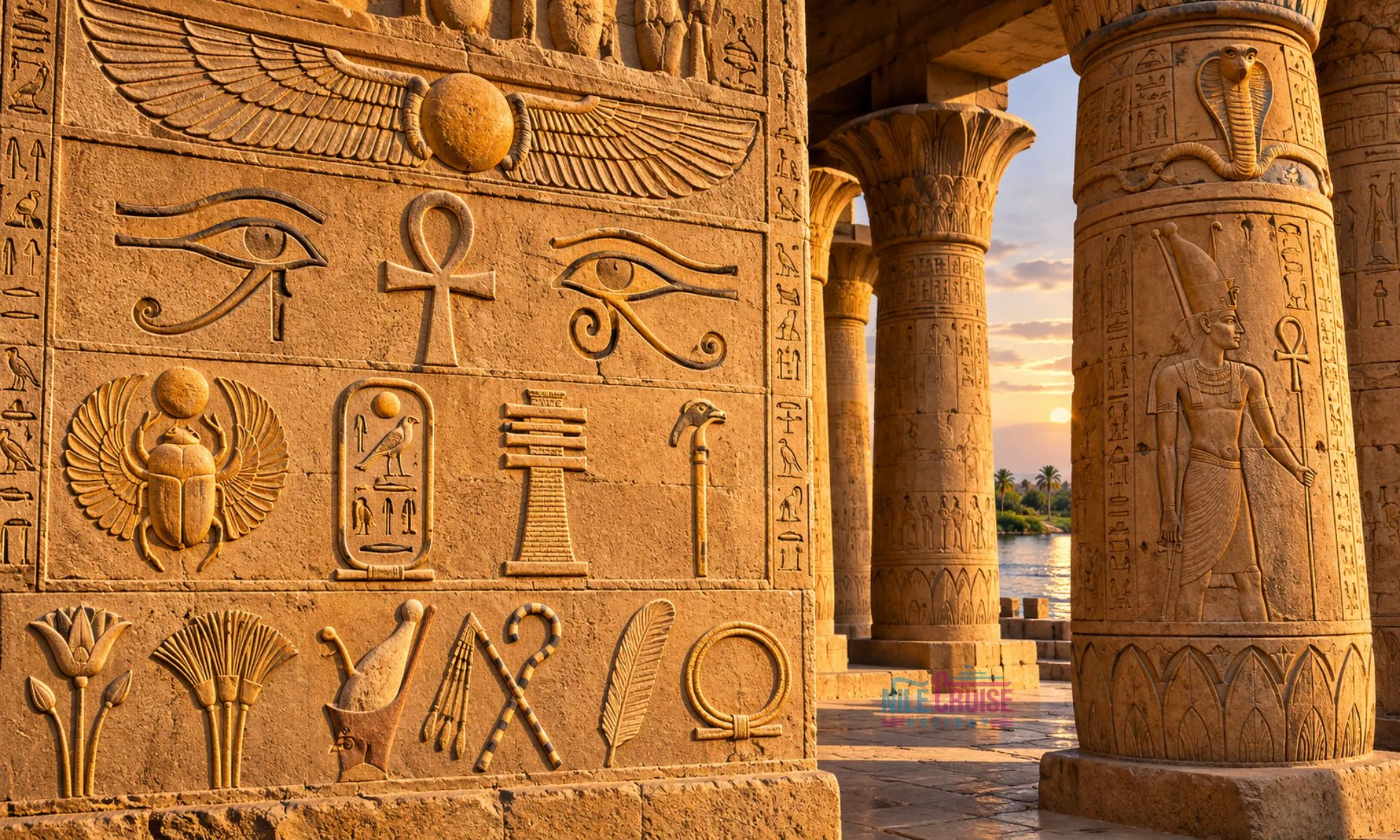
Ancient Egyptian artisans were the skilled hands behind every pyramid, painted tomb, gold mask and linen shroud that survives from the age of the pharaohs. Stone masons, sculptors, painters, carpenters, jewellers, potters and weavers worked mostly for the king and the temples, passing their skills from father to son over thousands of years. Their names were rarely written on their masterpieces, yet their work has outlived every empire that followed.
This guide explains who the artisans of ancient Egypt were, what they did and which tools they used, the daily life of a craftsman in the village of Deir el-Medina, the famous ancient Egyptian artisans whose names survive in tombs and papyri, and where you can see their work today on a Nile cruise and in Cairo.
The Identity of Artisans of Ancient Egypt

Defining an Artisan in Egypt
An artisan was a trained specialist who made objects by hand, from colossal statues to tiny beads. In ancient Egypt, most artisans worked in organized workshops attached to the palace, a temple or a noble estate, under a master craftsman and the watchful eye of scribes. Their work served religion and the afterlife as much as daily life.
Social Status
Artisans ranked above farmers and unskilled labourers but below scribes, priests and officials. The best, especially those who decorated royal tombs, enjoyed steady rations, good houses and respect in their communities. Skilled men could even rise to become overseers and architects.
Training and Apprenticeship
Crafts usually passed down within families, with boys learning from their fathers and uncles. Apprentices practised on limestone flakes and pottery shards called ostraca, copying figures and hieroglyphs until their lines met the strict standards of Egyptian art. Sculptors' workshops kept limestone models showing each stage of carving a statue.
Artists Bound by Rules
Egyptian art followed fixed rules of proportion based on a grid, with figures shown in combined profile and frontal views. These rules expressed maat, the ideal order of the universe, so artisans valued skill and precision more than personal style. Our guide to Egyptian symbols and meanings explains much of the imagery they repeated.
The Types and Duties of All Artisans in Ancient Egypt

Stone Masons and Sculptors
Stone masons quarried and shaped limestone, sandstone and granite for pyramids, temples and obelisks, while sculptors carved statues and reliefs. The abandoned Unfinished Obelisk in Aswan still shows how they pounded granite with dolerite balls. Read how the pyramids were built to see their work on the largest scale.
Draughtsmen and Painters
In royal tombs, plasterers smoothed the walls, draughtsmen sketched scenes in red ink, a master draughtsman corrected them in black, sculptors carved the lines and painters added colour. The vivid results can be seen in the tomb of Seti I and across the Valley of the Kings.
Carpenters and Boat Builders
Carpenters made coffins, shrines, beds, chairs, chests, chariots and boats from local acacia and sycamore and imported cedar from Lebanon. Their joinery, including mortise and tenon joints and dovetails, was so precise that furniture from the tomb of Tutankhamun still stands firm after 3,300 years.
Jewellers and Goldsmiths
Jewellers worked gold from the Eastern Desert and Nubia with carnelian, turquoise and lapis lazuli from Afghanistan. They mastered inlay, granulation and lost wax casting, producing collars, pectorals and protective amulets for the living and the dead.
Potters, Faience and Glass Makers
Potters shaped everyday jars on a wheel and fired them in kilns, while specialists made faience, a glazed blue green ceramic used for amulets, beads and tiles. From around 1500 BC, glass makers produced coloured glass vessels and inlays, a luxury for the elite.
Weavers, Leatherworkers and Others
Weavers, often women, spun flax into linen of remarkable fineness for clothing, sails and mummy wrappings. Leatherworkers made sandals and quivers, basket makers wove reeds and palm leaves, and wig makers and embalmers completed a wide world of crafts. Our guide to Egyptian mummification shows how linen and craft served the afterlife.
Tools, Materials and Techniques Of Ancient Egyptian Artisans

Tools of the Trade
Artisans used copper and later bronze chisels, saws, adzes, axes, bow drills, wooden mallets, set squares, levels and plumb lines. Painters worked with reed brushes and palettes holding red and black ink. Because tools for royal projects belonged to the state, scribes weighed copper tools before and after use to prevent theft.
Natural Pigments
Colours came from minerals: red and yellow ochre, green malachite, carbon black, white gypsum and the famous Egyptian blue, the world's first synthetic pigment, made by heating sand, copper and natron. Each colour had meaning, with green for rebirth and blue for the heavens.
Precious and Imported Materials
Gold, silver, ivory, ebony, cedar and lapis lazuli came through trade with Nubia, the Levant and distant lands such as Punt, as told in our guide to Hatshepsut and the Land of Punt. Our article on ancient Egyptian artifacts highlights the finest results.
Daily Life of a Craftsman in Ancient Egypt

Deir el-Medina: The Village of Tomb Builders
The best record of daily life comes from Deir el-Medina on Luxor's West Bank, home to the men who cut and decorated the royal tombs from about 1550 to 1080 BC. The walled village had around 70 houses along a single main street, with chapels and family tombs on the hillside. Its workers held the title "Servant in the Place of Truth".
Work Crews and the Working Week
The tomb workers were divided into two gangs, the "left side" and the "right side", each led by a foreman and recorded by a scribe. The Egyptian week lasted ten days, and the crews usually worked eight days, sleeping in huts near the tomb, before two days at home. Ostraca record absences for reasons such as illness, a scorpion sting, brewing beer or a family celebration.
Pay, Food and Homes
There were no coins, so workmen were paid in kind. A typical workman received about four sacks of emmer wheat and one and a half sacks of barley each month, with extra fish, vegetables, oil and firewood. Houses were built of mud brick on stone foundations, with an entrance room, a living room, a kitchen and a roof terrace. Our guide to ancient Egyptian food describes their bread and beer.
Women and Family Life
Women ran the households, wove linen, baked bread and brewed beer, and many held the religious title "chantress of Amun". Family letters, legal disputes and even love poems written on ostraca show a lively, literate community.
The First Recorded Strike in History
In year 29 of Ramesses III, around 1155 BC, the rations of the Deir el-Medina workers arrived weeks late. The crews downed tools and sat outside the mortuary temples of the West Bank, protesting "we are hungry". The scribe Amennakhte recorded the event in the Turin Strike Papyrus, and the protest ended when the grain was delivered.
Protection and Their Own Tombs
The village was guarded by the Medjay, the police of ancient Egypt. In their spare time, the artisans built and painted their own tombs, smaller than royal tombs but often just as colourful, filled with family scenes and prayers.
Famous Ancient Egyptian Artisans and Their Names

Most ancient Egyptian artisans names are lost, but tomb inscriptions, stelae and papyri preserve a remarkable few.
Architects and Masters of Stone
- Imhotep, architect of King Djoser in the 3rd Dynasty, built the Step Pyramid at Saqqara, the first great stone building. Read who was Imhotep.
- Hemiunu, nephew of Khufu, is credited with designing the Great Pyramid of Giza.
- Ineni cut the first tomb in the Valley of the Kings for Thutmose I, boasting that it was made with "no one seeing, no one hearing".
- Senenmut, steward of Hatshepsut, directed works at her temple at Deir el-Bahari.
- Amenhotep son of Hapu oversaw the statues of Amenhotep III, including the Colossi of Memnon, and was later worshipped as a sage.
Famous Ancient Egyptian Artists and Sculptors
- Irtysen, a Middle Kingdom craftsman under Mentuhotep II, left a stela now in the Louvre describing his skill in carving, painting and making pigments, the oldest known artist's autobiography.
- Men and his son Bak were chief sculptors of Amenhotep III and Akhenaten, and they carved a rock inscription of themselves at Aswan.
- Thutmose, sculptor to Akhenaten, worked at Amarna, where the famous painted bust of Nefertiti was found in his workshop in 1912. See our guides to Akhenaten and Nefertiti and how to visit Tell el-Amarna.
- Nebamun and Ipuky, sculptors of the 18th Dynasty, show artisans at work in their tomb among the Tombs of the Nobles.
Names From Deir el-Medina
- Kha, architect and overseer of works under Amenhotep III, whose intact tomb (TT8) was found in 1906 with his furniture, food and tools, now in Turin.
- Sennedjem, a Servant in the Place of Truth, whose richly painted tomb (TT1) was found intact in 1886.
- Pashedu, a workman whose tomb (TT3) shows him drinking from a stream beneath a palm tree.
- Paneb, a notorious foreman accused of theft and violence in a complaint known as the Salt Papyrus 124, proving the village was far from perfect.
Where to See the Work of Ancient Egyptian Artisans

Luxor and the West Bank
Luxor holds the greatest concentration of artisans' work in Egypt. Visit Deir el-Medina, where tickets cost about EGP 220 for foreign adults and include the tombs of Sennedjem and Pashedu, then the Valley of the Kings, the Valley of the Queens and Karnak Temple. Our guide to the Valley of the Kings tombs and tickets and the Luxor Museum complete the picture.
Cairo's Museums
The Grand Egyptian Museum displays Tutankhamun's furniture, jewellery and chariots, while the Egyptian Museum in Tahrir holds Old Kingdom statues and painted coffins. At Giza, the tombs of the pyramid builders, discovered in 1990, show they were paid workers, not slaves.
Artisan Egypt Today
Egypt's craft traditions live on. In Cairo's Khan El Khalili, metalworkers, glassblowers and jewellers still work in small workshops, and on the West Bank of Luxor, alabaster carvers shape vases by hand. Our guide to what to buy in Egypt helps you choose genuine handmade souvenirs, and a Luxor and Aswan Nile cruise brings you to the greatest sites.
Cast Your Eyes on the Grand Artistic Allure of Ancient Egypt With Our Holidays
The artisans of ancient Egypt turned stone, gold, wood and pigment into the images that still define the civilisation. From the masons of Giza and the tomb painters of Deir el-Medina to named masters like Imhotep, Thutmose and Sennedjem, their lives reveal skill, discipline and a strong sense of community.
Their timeless craft waits for you on every temple wall along the Nile. To walk in the footsteps of the tomb builders, Book one of our masterful Egypt tour packages with a Nile cruise or ask for a tailor-made itinerary.