The Narmer Palette is a shield shaped slab of greywacke carved around 3100 BC for Narmer, the king traditionally credited with uniting Upper and Lower Egypt. Found in 1898 at Hierakonpolis in southern Egypt, it shows the king wearing the White Crown on one side and the Red Crown on the other, smiting enemies, inspecting the headless dead and breaking down a city wall in the form of a bull. More than 5,000 years after it was carved, it still reads like the opening page of Egyptian history.
This guide explains what the Narmer Palette is, how it was discovered, what each scene on both sides shows, the meaning and translation of its symbols, what it was used for and why it matters, and where you can see it in Cairo today, including whether it is in the Grand Egyptian Museum.
Learn What Exactly Is the Narmer Palette
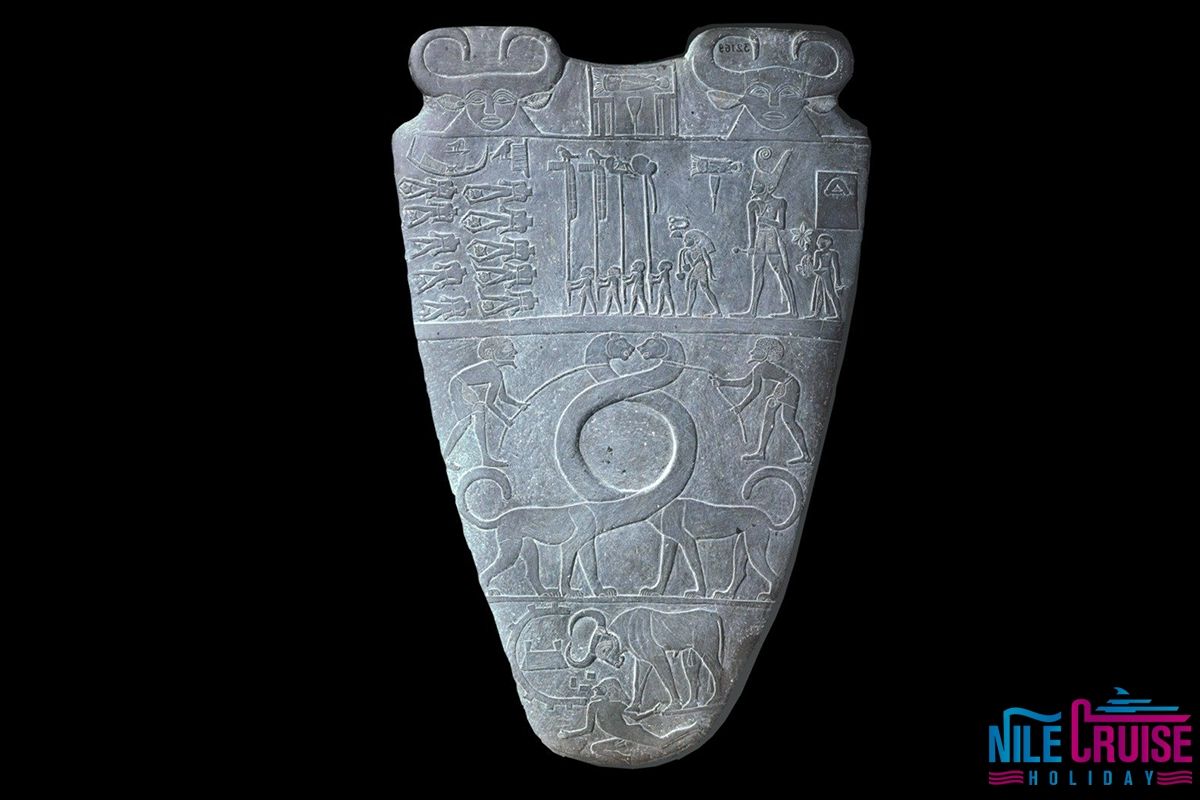
Narmer Palette at Display
| Fact | Detail |
|---|---|
| Date | About 3100 BC (31st century BC) |
| Age | About 5,100 years old |
| Material | Greywacke (siltstone) from Wadi Hammamat |
| Size | About 64 cm high and 42 cm wide |
| Found | 1898, Main Deposit, temple of Horus at Hierakonpolis (Nekhen) |
| Discoverers | James Quibell and Frederick Green |
| Location today | Egyptian Museum, Tahrir Square, Cairo (JE 32169) |
Narmer Palette Pronunciation
Narmer is pronounced NAR-mer, with the stress on the first syllable, and palette is pronounced PAL-it, like "pallet". The name is a modern reading of the two hieroglyphs in the king's name, so the original ancient pronunciation is not known for certain.
A Ceremonial Cosmetic Palette
Stone palettes were common in late prehistoric Egypt, used for grinding green malachite or dark galena into eye paint. The Narmer Palette follows the same shape, with a shallow circular dish on one side, but at about 64 cm tall it is far too large and finely carved for everyday use. It belongs to a small group of decorated ceremonial palettes made for temples.
Narmer Palette Dynasty and Date
The Narmer Palette date is usually given as about 3100 BC, which puts the Narmer Palette age at roughly 5,100 years. Narmer ruled at the boundary between the late prehistoric period, often called Dynasty 0, and the 1st Dynasty. Many Egyptologists see him as the first king of the 1st Dynasty, and some identify him with Menes, the legendary founder of Egypt named in later king lists, while others link Menes with his successor Hor-Aha. Narmer was buried at Umm el-Qa'ab near Abydos, the royal cemetery of Egypt's first kings.
The Narmer Palette Discovery at Hierakonpolis
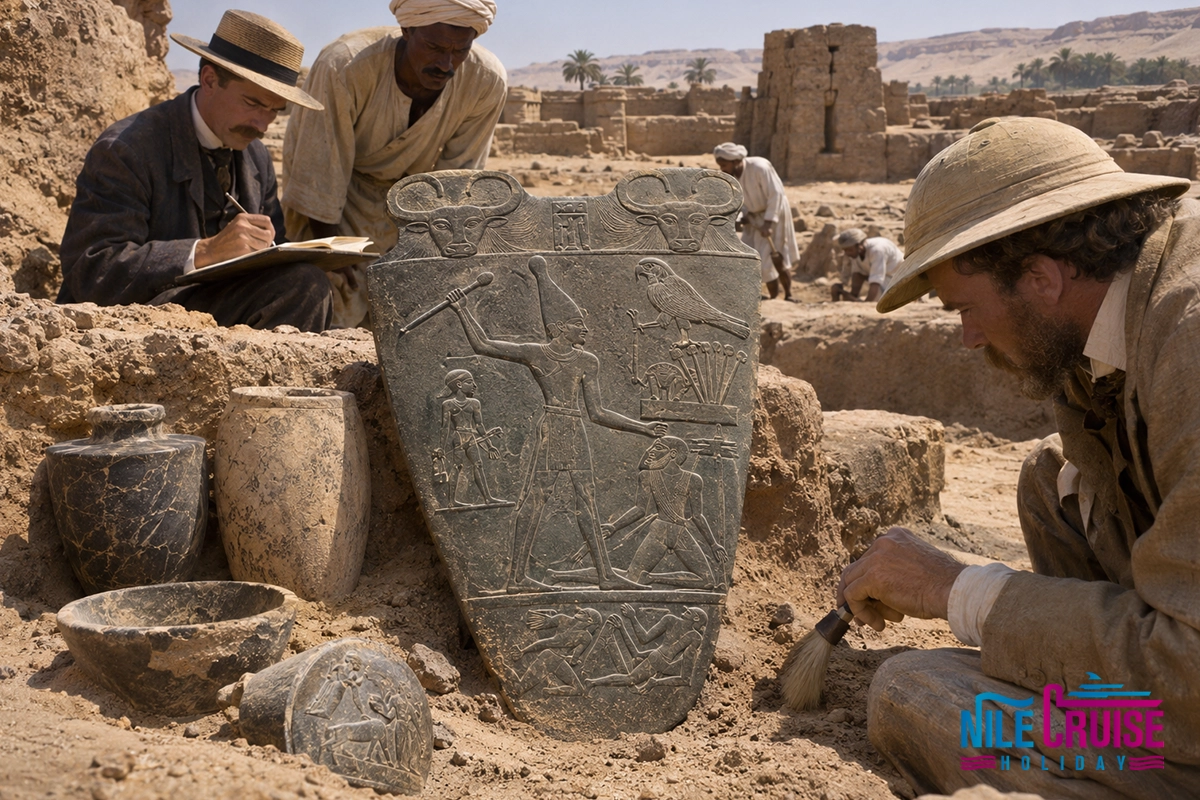
Hierakonpolis, City of the Falcon
Hierakonpolis, ancient Nekhen, lies on the west bank of the Nile about 20 km north of Edfu, opposite the town of El Kab, ancient Nekheb. It was one of the most important centres of late prehistoric Egypt and the cult home of the falcon god Horus, protector of the king. The nearby temple of Horus at Edfu, whose Edfu texts preserve later myths of the falcon god, continues the same tradition. Our guide to the El Kab tombs covers the site across the river, which some Nile cruises and dahabiyas visit.
Quibell and Green's Excavation
The British archaeologists James Quibell and Frederick Green excavated the early temple of Horus at Hierakonpolis in 1897 and 1898. In a pit of buried temple offerings now called the Main Deposit, they found the palette alongside other royal objects. Quibell's notes and Green's later report place it in slightly different spots, but most scholars follow the original field records.
Finds From the Main Deposit
The same deposit produced the Narmer Macehead and the Scorpion Macehead, carved stone mace heads of Narmer and an earlier king known as Scorpion, as well as ivories and vessels. Together they suggest that early kings donated these prestige objects to the temple of Horus, where they were later buried when the temple was rebuilt.
Narmer Palette Drawing: Both Sides Explained
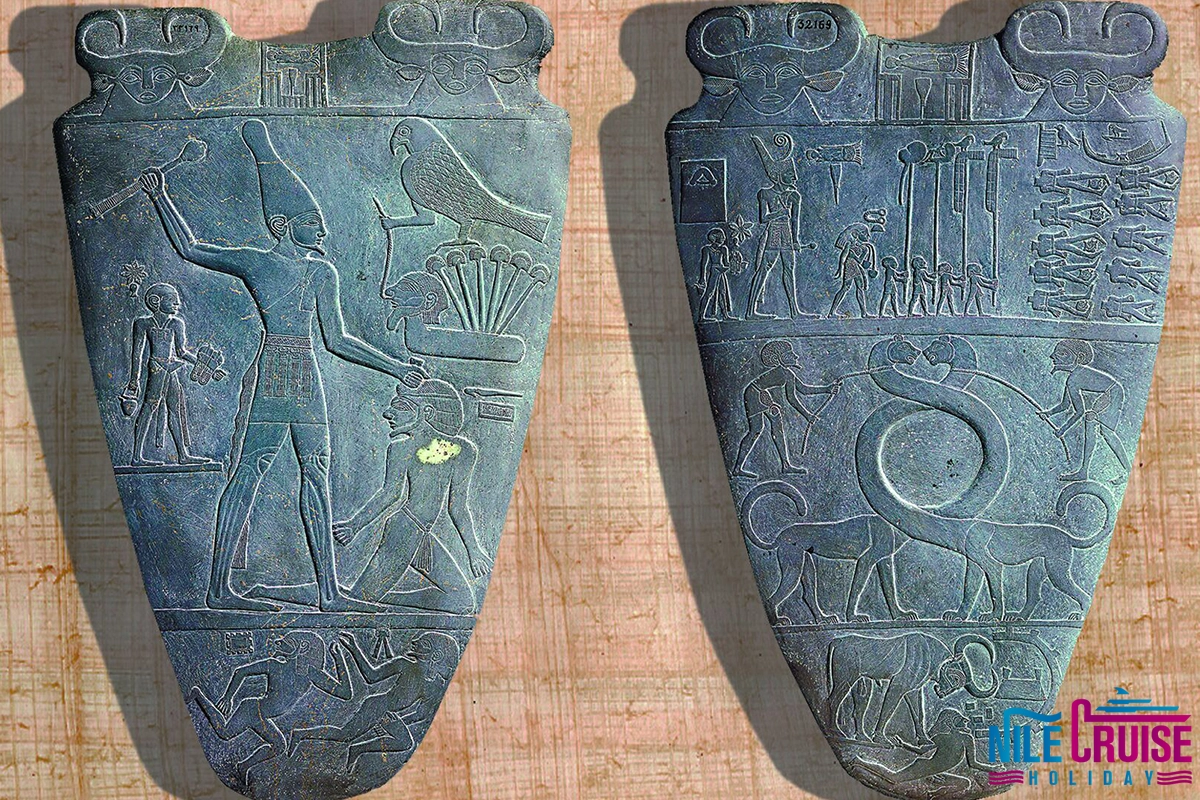
How to Read the Palette
Each side is divided into horizontal bands called registers, read from top to bottom. The king is shown much larger than everyone else, a convention called hierarchical scale, and his body combines a profile head and legs with a frontal chest and shoulders. Line drawings published by Quibell in 1900 are still the easiest way to follow the details, and most textbooks reproduce them.
The Top of Both Sides
At the top of both faces, the king's name is written inside a serekh, a rectangle representing a palace facade, the forerunner of the later cartouche. It is flanked by two cow heads with human faces and curved horns, thought to represent the cow goddess Bat, whose traits later merged with Hathor.
The White Crown Side
On this side, Narmer wears the tall White Crown of Upper Egypt and raises a mace above a kneeling captive he grips by the hair. Behind him walks his sandal bearer, and above the captive the falcon Horus stands on a clump of papyrus growing from a human headed piece of land, holding a rope tied to the man's nose. In the lowest register, two naked enemies lie fallen or flee.
The Red Crown Side
The other side shows Narmer in the Red Crown of Lower Egypt, holding a mace and flail, following four standard bearers and an official named Tjet. They approach two rows of ten decapitated enemies, with their heads placed between their legs. In the middle register, two men restrain a pair of serpopards, lions with long serpent necks, whose intertwined necks frame the grinding dish. At the bottom, a bull, standing for the king, breaks into a walled town and tramples a fallen man.
Narmer Palette Symbolism and Translation
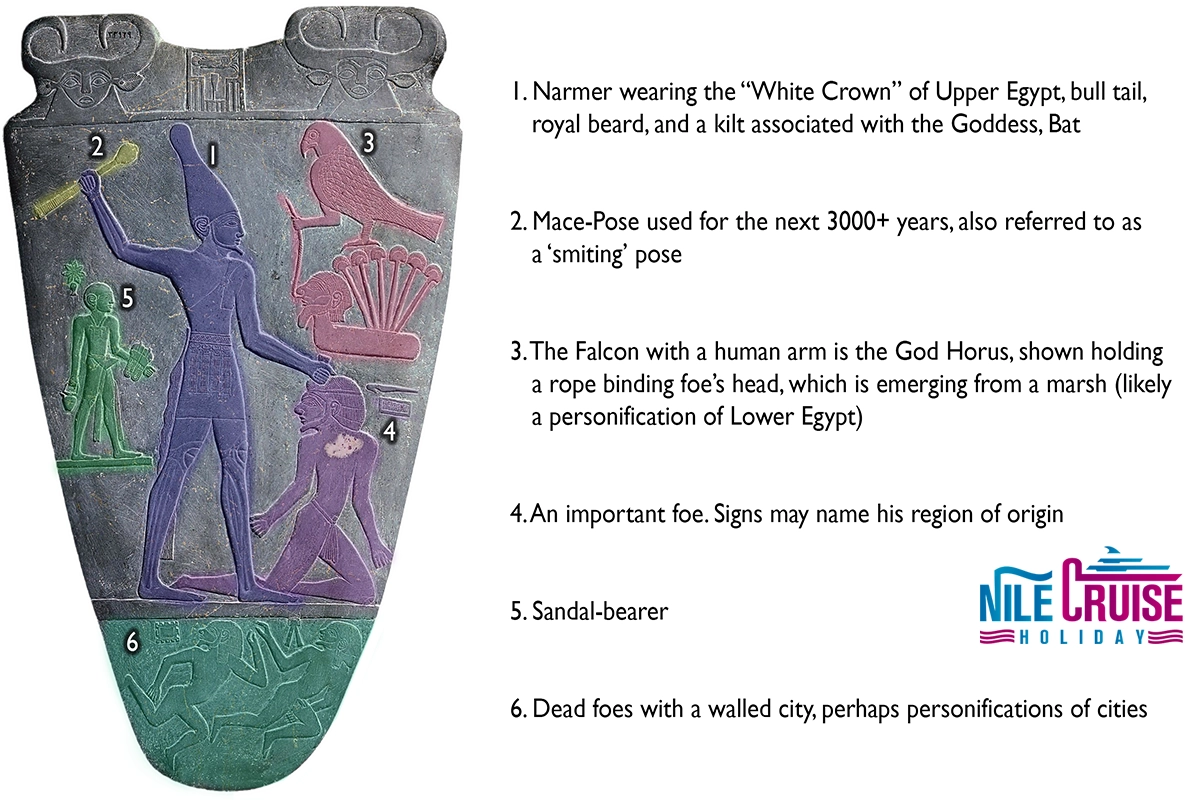
The King's Name
The serekh holds two signs: a catfish, read nar, and a chisel, read mer. Together they spell Narmer, and the name is often translated as "striking catfish" or "fierce catfish". This rebus style of writing, using pictures for their sound, is one of the earliest steps toward the hieroglyphic script.
The Two Crowns
The palette is the earliest known image of one king wearing both the White Crown of the south and the Red Crown of the north. Later pharaohs combined them in the double crown, the pschent, and the idea of a king of the "Two Lands" lasted for 3,000 years. Our guide to Egyptian symbols and meanings explains other royal emblems.
Horus and the Papyrus
The falcon on the papyrus is usually read as Horus, or the king as Horus, controlling the marshy north, since papyrus was the plant of the Delta. Some scholars also read the six papyrus stems as the number 6,000, as one papyrus sign later meant 1,000, suggesting 6,000 captives. The falcon god's story is told in our article on the story of Isis and Osiris.
Captives, Labels and Cities
Small signs next to figures act as labels, an early form of writing. The captive on the White Crown side is labelled with a harpoon and a lake sign, sometimes read as "Wash" or as a Delta region. Above the headless bodies are a ship, a falcon with a harpoon and a door, possibly naming a town or a victory. The sandal bearer and Tjet carry titles that show the court already had organized officials.
Bull, Serpopards and Order
The bull breaking the city wall symbolises the king's power, an image repeated in later royal titles such as "mighty bull". The serpopards are often seen as a symbol of union, their necks bound together by the king's men. Overall, the scenes express a central idea of Egyptian kingship: the king defeating chaos and maintaining maat, cosmic order.
What Was the Narmer Palette Used For and Why It Matters
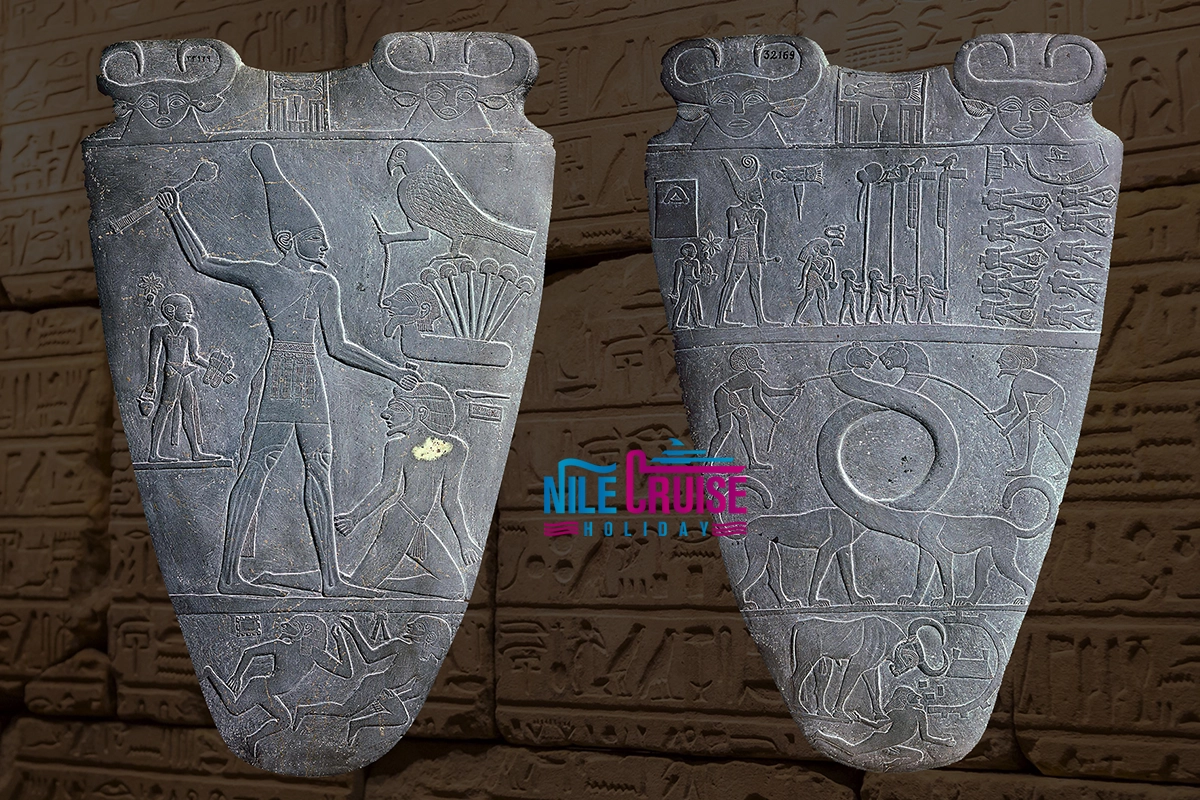
A Votive Gift to the Gods
The palette was most likely a votive object, given to the temple of Horus to honour the god and record the king's power. Some scholars suggest it may have been used to grind cosmetics for adorning the cult statue of the god during rituals, which explains the grinding dish at its centre.
Record of Unification or Royal Ideology
Early Egyptologists such as Kurt Sethe read the palette as a record of Narmer conquering the north and uniting Egypt. Many modern scholars see it differently, as a statement of ideal kingship rather than a report of one battle, and some think it marks a specific year or ritual. Either way, it shows a single ruler claiming authority over the whole Nile Valley.
The Birth of Egyptian Art
The palette already shows the rules that guided Egyptian art for three millennia: registers, hierarchical scale, the combined profile and frontal figure, and the smiting king. The same smiting pose appears on temple pylons at Edfu, Karnak and Abu Simbel thousands of years later. Our guides to ancient Egyptian ruins and ancient Egyptian artifacts place it among Egypt's greatest treasures.
The Significance of the Narmer Palette
The Narmer Palette is often called the first historical document in the world. It combines early hieroglyphs with images, names a king and his officials, and marks the transition from prehistoric chiefdoms to a unified state with a capital at Memphis. Visit the site of Memphis and nearby Saqqara, where the officials of the first dynasties built their tombs and where Imhotep later raised the first pyramid, to follow what came next.
Where to See the Narmer Palette Today
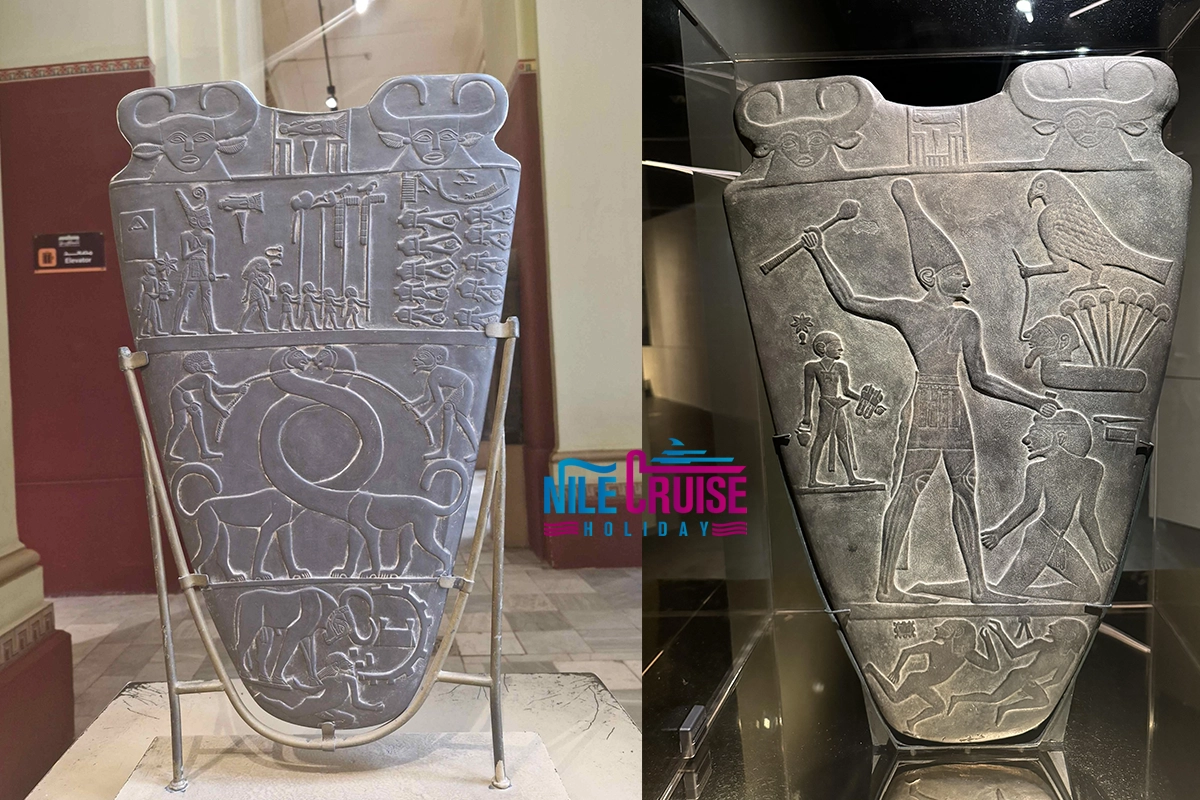
The Egyptian Museum in Tahrir
The original Narmer Palette is displayed at the Egyptian Museum in Cairo on Tahrir Square, catalogued as JE 32169. It stands near the entrance on the ground floor, among the first objects visitors see. The museum is usually open daily from 9 am to 5 pm, and visitors should check the current ticket price on arrival.
Is the Narmer Palette in the Grand Egyptian Museum (GEM)?
No. Although Tutankhamun's treasures and many famous pieces moved to the Grand Egyptian Museum near Giza, which fully opened in November 2025, the Narmer Palette has remained in the Tahrir museum. Plaster casts and replicas of it can be seen in several museums abroad, but the original never leaves Cairo.
Planning Your Visit
Allow two to three hours at the Egyptian Museum and combine it with the Giza Pyramids and the GEM over two days, using our guide to things to do in Giza, and end a museum day in the lanes of Khan El Khalili. Then continue south on a Luxor and Aswan Nile cruise, passing close to Hierakonpolis and El Kab between Luxor and Edfu. Our guide to the Cairo to Luxor flight and our Cairo and Nile cruise tours make the connection easy.
Witness One of the Rarest Pieces of Archaeology Through Our Grand Trips
The Narmer Palette captures the moment Egypt became a kingdom: a king in two crowns, the falcon Horus at his side, enemies defeated and order restored. Its discovery at Hierakonpolis, its early hieroglyphs and its lasting artistic rules make it one of the most important objects in the world. Standing before it in the Egyptian Museum, you meet the first chapter of a timeless story that you will follow all the way down the Nile. To see the Narmer Palette and the temples it inspired, book our Egypt tour packages with a Nile cruise or ask for a tailor-made itinerary.