Sneferu was the founder of Egypt's 4th Dynasty and the greatest pyramid builder in history, ruling around 2600 BC for at least 30 years, during which he was one of the lucky few in the history of the world to achieve immortality. In that time, he raised three major pyramids at Meidum and Dahshur, moving more stone than any other pharaoh, and turned the stepped tombs of his predecessors into the smooth sided true pyramid. Without his experiments in the desert south of Memphis, his son Khufu could never have built the Great Pyramid of Giza.
This guide explains the meaning and pronunciation of Sneferu's name, his cartouche and titles, his reign and campaigns, the Sneferu pyramids, his family and famous son, the mystery of the Sneferu mummy, his statue and legends, and how to visit his pyramids today.
The Identity of Pharaoh Sneferu
Sneferu Meaning
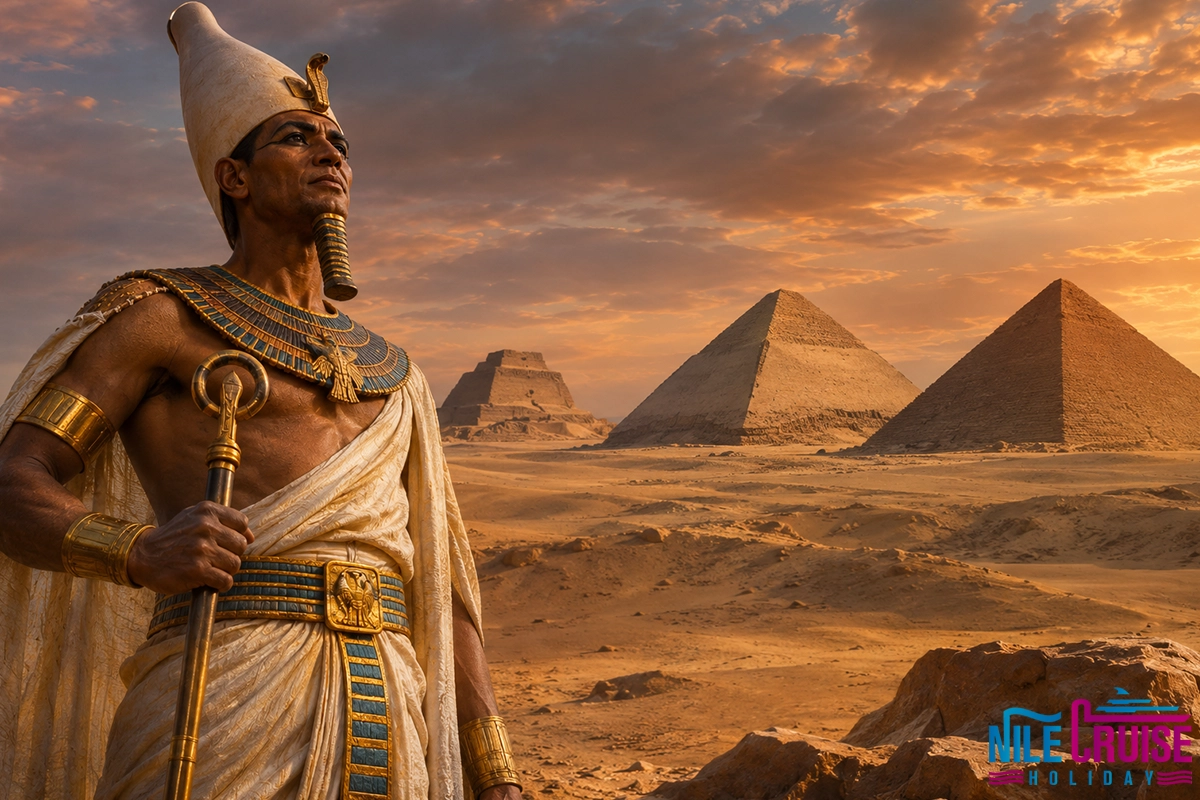
The name Sneferu, written snfr-wj, means "He has perfected me", a short form of "Horus, Lord of Maat, has perfected me". It can also be read as "to make beautiful", which may explain why later Egyptians remembered him as a kind and beneficent king. The Greek historian Manetho called him Soris.
Sneferu Pronunciation
Sneferu is usually pronounced SNEF-roo, with the stress on the first syllable. You will also see the spellings Snefru and Snofru, because hieroglyphs did not record vowels and Egyptologists add them by convention.
Sneferu Cartouche and Royal Titles
Sneferu is one of the first pharaohs whose name regularly appears inside a cartouche, the oval loop that later enclosed every king's name. His titulary included:
- Horus name: Nebmaat, "Lord of Maat".
- Nebty name: Nebmaat, "He of the Two Ladies, Lord of Maat".
- Golden Horus name: Bik-nebu, "Golden Falcon".
- Cartouche name: Snefru, "He has perfected me".
Our guide to Egyptian symbols and meanings explains the cartouche and the idea of maat.
Origins and Accession
Sneferu followed Huni, the last king of the 3rd Dynasty. Whether Huni was his father is uncertain, and his mother was probably a lesser queen named Meresankh I. Britannica suggests he came from a family in Middle Egypt and strengthened his claim by marrying Hetepheres I, a royal heiress.
Sneferu Reign: Dates, Campaigns and a Golden Age

How Long Did Sneferu Reign?
The Sneferu reign is usually dated to about 2613 to 2589 BC, although scholars disagree on its length. The Turin King List and Manetho give 24 years, but cattle count records at Meidum and the Red Pyramid, and the Palermo Stone, suggest at least 28 to 30 years. Some Egyptologists argue for as many as 48 years, while Britannica gives 33.
Campaigns in Nubia, Libya and Sinai
The Palermo Stone records a great raid into Nubia, bringing back 7,000 captives and vast herds of livestock, and a campaign in Libya that took 11,000 prisoners and 13,100 cattle. Rock reliefs in the turquoise mines of Wadi Maghara in Sinai show Sneferu as protector of the mining expeditions, and later miners honoured him as a patron.
Cedar Ships and Trade
The same annals describe 40 ships arriving with timber, most likely cedar from Lebanon, and the building of a 100 cubit cedar ship called "Praise of the Two Lands", one of the first named ships in history. This timber was used for royal boats, doors and building works. A later example of such royal boats is the Khufu ship built for his son.
A Strong Royal Administration
Royal princes held the highest offices, and the post of vizier grew in importance under Sneferu and his sons. Excavations at his valley temple at Dahshur revealed the earliest known list of Egypt's provinces, or nomes, showing a well organised state.
Remembered as a Good King
In the Middle Kingdom, Sneferu was remembered as an ideal, kindly ruler, and many estates and places bore his name. His cult continued at Dahshur for centuries, and kings of the 12th Dynasty built their own pyramids nearby.
Sneferu Pyramids: From Steps to a True Pyramid

The Meidum Pyramid
At Meidum, about 100 km south of Cairo, Sneferu completed or rebuilt a pyramid that began as a seven step structure like Djoser's at Saqqara. It was later enlarged to eight steps and finally cased to form a true pyramid. Part of the outer casing later collapsed, leaving the tower like core, about 65 m high, that stands today. Some scholars think it was begun by Huni.
The Bent Pyramid
At Dahshur, about 40 km south of Cairo, Sneferu built the first pyramid designed from the start as a true pyramid. Its base measures about 188 m on each side and it rises about 101 m. Partway up, the angle changes from about 55 degrees to about 43 degrees, probably because the structure began to crack. Our guide to the Bent Pyramid explains its unusual shape and two entrances.
The Red Pyramid
The Red Pyramid, named after its reddish limestone, was the first successful smooth sided true pyramid. It rises about 104 m with a base of about 220 m on each side, built at the gentler angle of about 43 degrees, and is the third largest pyramid in Egypt after the two great pyramids of Giza. It was probably Sneferu's final burial place.
Smaller Pyramids
Sneferu is also linked with a small step pyramid at Seila on the edge of the Fayum, and a satellite pyramid about 18 m high stands beside the Bent Pyramid. Together, his pyramids are often estimated to contain more stone than Khufu's Great Pyramid.
Why the Sneferu Pyramids Matter
Each project solved a problem: the stepped core of Meidum, the changing angle of the Bent Pyramid, and the stable, corbelled chambers of the Red Pyramid. These lessons led directly to Khufu's pyramid at the Giza Pyramids. Read how the pyramids were built and inside the Great Pyramid to follow the story.
Sneferu's Family: Wife, Son and Children
Queen Hetepheres I
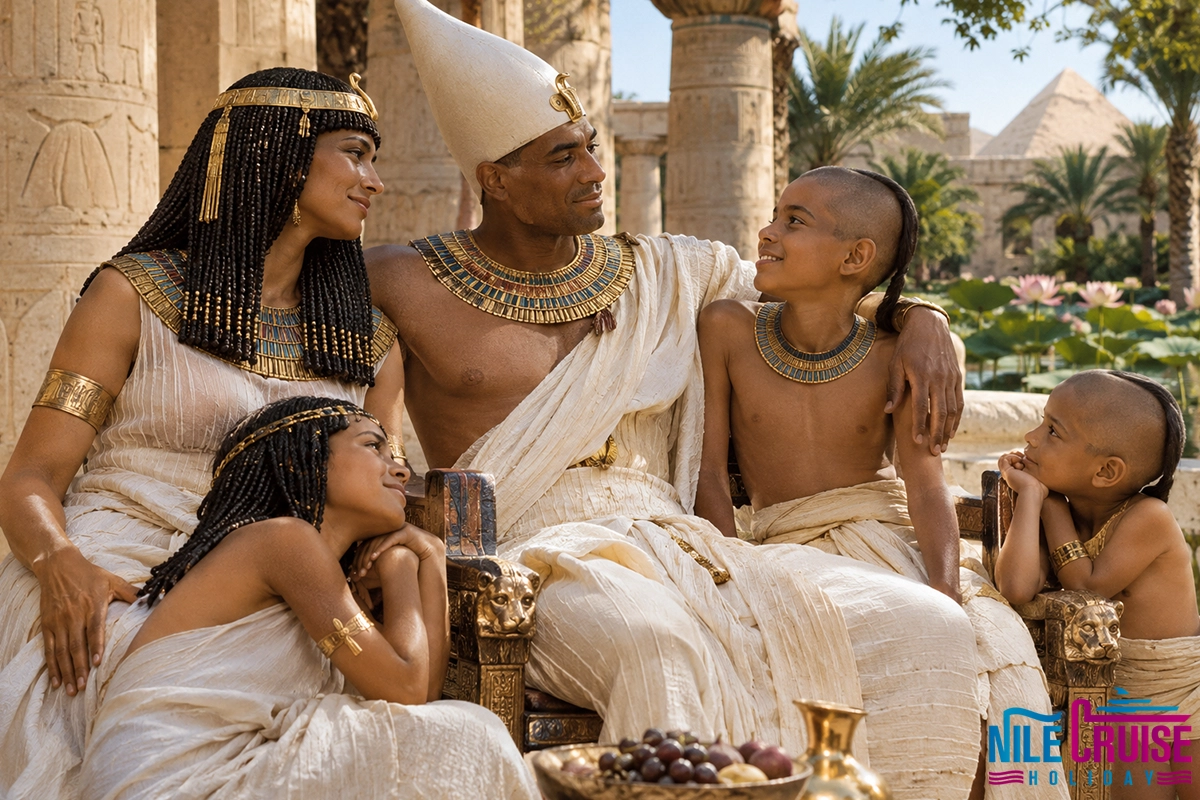
Sneferu's principal wife was Hetepheres I, mother of Khufu. Her burial shaft near the Great Pyramid was discovered in 1925, holding gilded furniture, a canopy, a carrying chair and an empty sarcophagus, now displayed in Cairo.
Sneferu Son: Khufu
Sneferu's most famous son, Khufu, succeeded him and built the Great Pyramid of Giza. Khufu's sons, Djedefre and Khafre, continued the line, and Khafre's monuments include the Valley Temple of Khafre and, most scholars believe, the Sphinx. Our article on what happened to the Sphinx's nose tells that story.
Other Sons of Sneferu
- Nefermaat, vizier, buried at Meidum with his wife Itet, whose tomb produced the famous painting of the Meidum geese.
- Rahotep, high priest of Heliopolis, whose painted statues with his wife Nofret are among the finest of the Old Kingdom.
- Kanefer, vizier, buried at Dahshur.
- Ankhhaf, vizier under Khafre, whose painted bust is in the Museum of Fine Arts, Boston.
- Netjeraperef, Ranefer and Iynefer, buried near their father's pyramids.
Daughters of Sneferu
His daughters included Hetepheres A, Nefertkau I, Nefertnesu, Nefertiabet, and Meritites I and Henutsen, both of whom married their half brother Khufu.
Sneferu Mummy, Statue and Legends

The Sneferu Mummy
The Sneferu mummy has never been positively identified. In 1950, fragments of human remains were found in the Red Pyramid and studied by the anatomist Ahmed el Batrawi, and they appear consistent with Old Kingdom mummification, but no one can prove they belong to the king. Some researchers believe hidden chambers may still lie within his pyramids. Our guide to Egyptian mummification explains how early mummies were made.
Sneferu Statue
The best known Sneferu statue is a limestone figure found in the valley temple of the Bent Pyramid, showing the king wearing the tall White Crown of Upper Egypt. Long displayed in Cairo, it now stands in the Grand Egyptian Museum. The statues of Rahotep and Nofret and the Meidum geese can be seen at the Egyptian Museum in Cairo.
The Westcar Papyrus Tale
A Middle Kingdom story in the Westcar Papyrus, now in Berlin, shows Sneferu as a bored king rowed across a lake by 20 young women dressed in fishing nets. When one drops her turquoise pendant into the water, the magician Djadjaemankh folds the lake in half to recover it, a tale that shows how fondly later Egyptians remembered him.
Wisdom of Kagemni
The Instruction of Kagemni, preserved on the Papyrus Prisse, is set at the end of Huni's reign and the start of Sneferu's, naming Kagemni as vizier. It is one of the oldest pieces of wisdom literature, alongside the later teachings of Imhotep and Ptahhotep.
Visiting Sneferu's Pyramids Today

Dahshur
Dahshur lies about 40 km south of Cairo and 10 km south of Saqqara, and is far quieter than Giza. You can enter the Red Pyramid by a steep 63 m passage to its corbelled chambers, and since July 2019 the Bent Pyramid has also been open, reached by a 79 m tunnel from its north entrance, for the first time since 1965.
Meidum
Meidum lies about 100 km south of Cairo near the Fayum, and is usually visited by private car. Visitors can descend into the burial chamber, and the nearby mastabas of Nefermaat and Rahotep complete the site.
Combining Sneferu's Pyramids With Your Trip
Visit Dahshur with Saqqara and Memphis in one day, then Giza and the museums the next, using our guide to things to do in Giza. Most cruises sail between Luxor and Aswan, as our guide on whether Nile cruises visit the pyramids explains, so book a few days in Cairo first, or choose Nile cruises from Cairo or our Cairo and Nile cruise tours.
Witness Greatness With Nile Cruise Holidays
Sneferu transformed Egypt with ambition and experiment, leading campaigns to Nubia and Libya, importing cedar from Lebanon and building the pyramids that perfected the form. His name, "He has perfected me", fits a reign that turned steps into smooth slopes and paved the way for Giza.
Standing beside the Red Pyramid at Dahshur, you feel the quiet genius of the king who taught Egypt how to touch the sky. In order to cast your eyes on Sneferu's pyramids and the wonders of the Nile, book one of our Egypt tour packages with a Nile cruise or ask for a tailor-made itinerary.