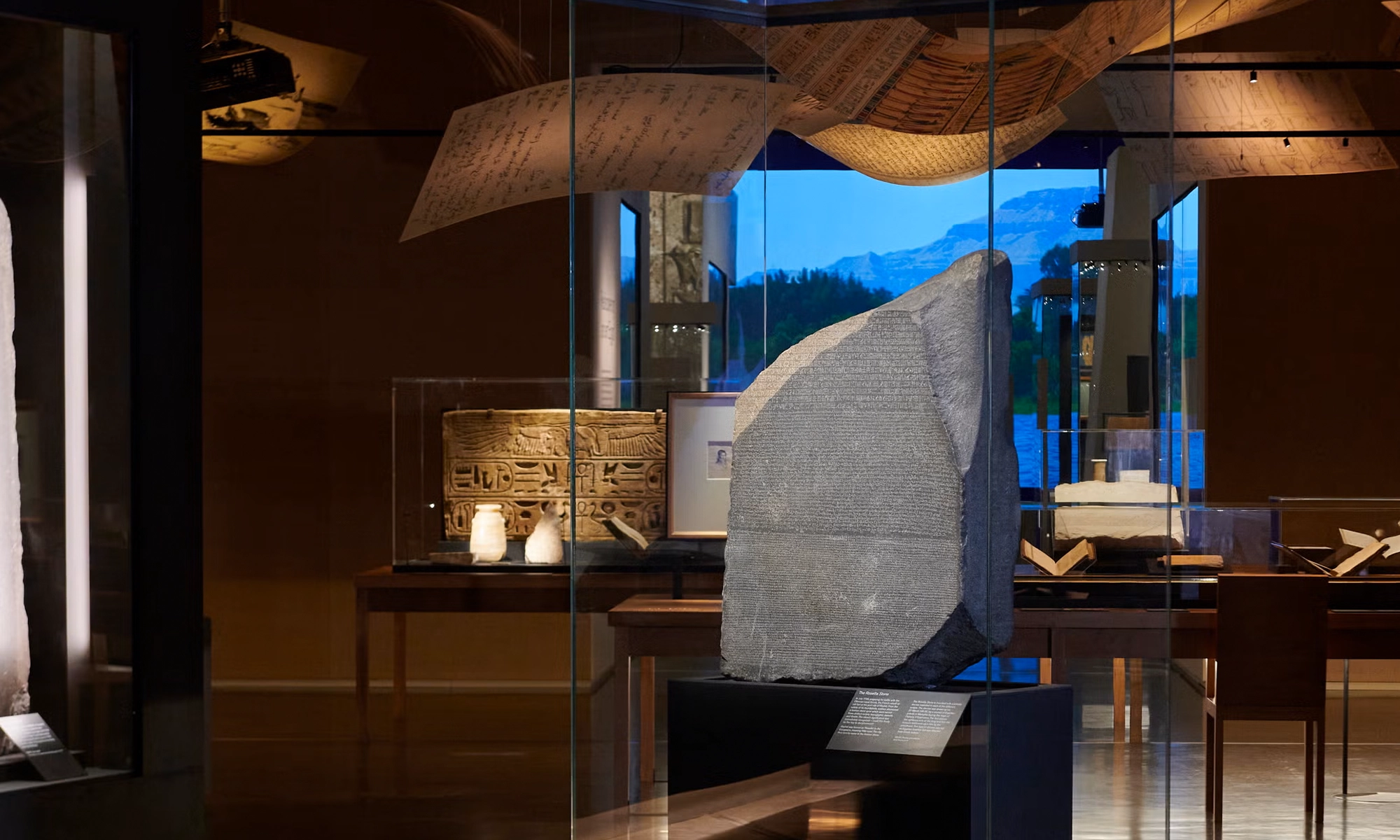
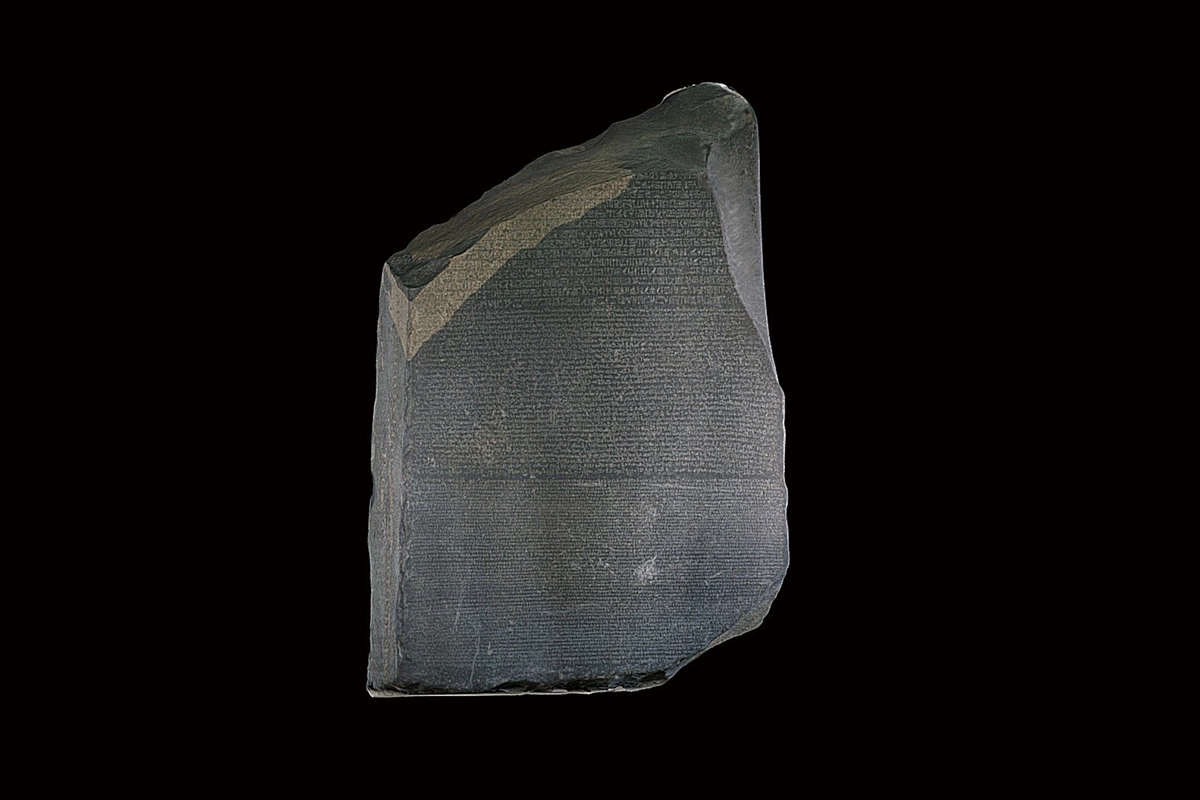
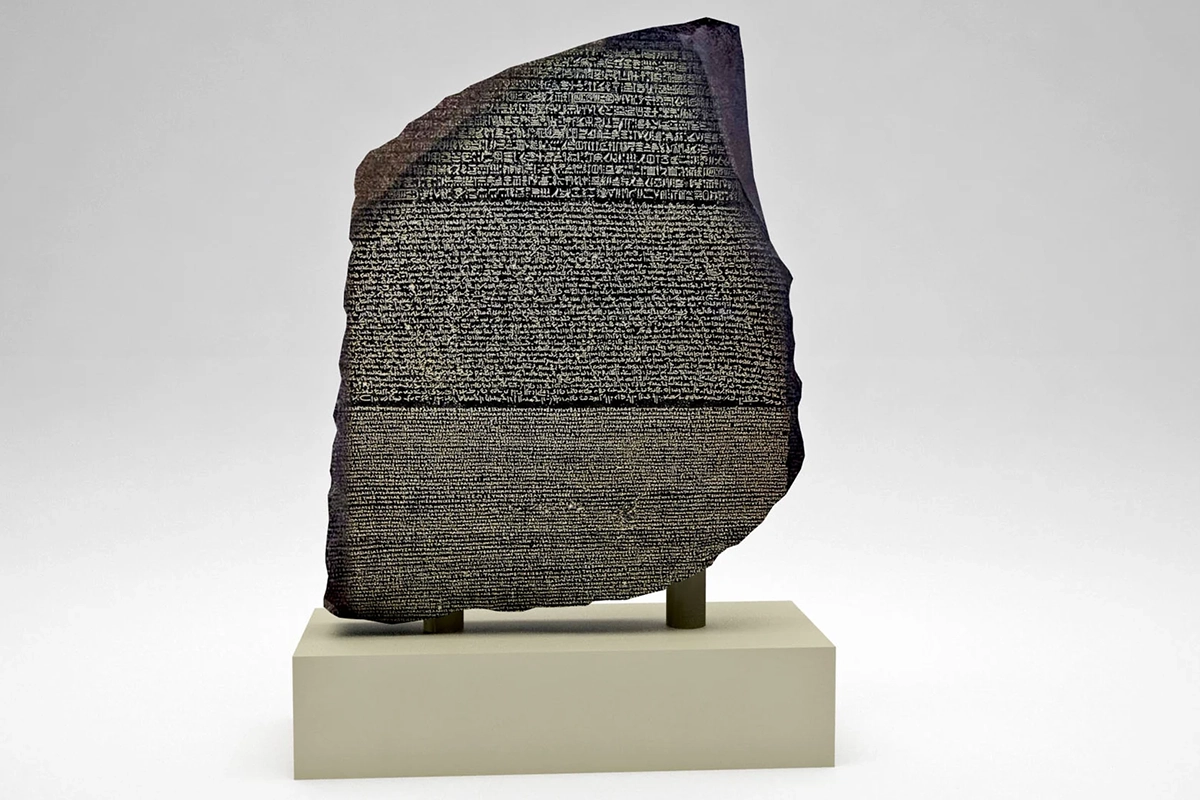
The Rosetta Stone is a golden key that uncovered a whole new world of wonders and ancient knowledge. It is a broken slab of dark granodiorite, a little over a meter tall, carved with the same priestly decree in three scripts. It was found in the Nile Delta in July 1799. Twenty-three years later, it gave scholars the key to Egyptian hieroglyphs, a writing system no one had been able to read for about 1,400 years.
For centuries, the temple walls of Egypt spoke to no one, until one stone taught the world to hear them again. This guide explains what the Rosetta Stone is, the languages on it, what the Rosetta Stone says, and where the rest of it might be. It also covers why the Rosetta Stone is so important, how it was deciphered, where it is today, and why Egypt wants it back. Finally, it shows how you can read its legacy on the temple walls along the Nile.
Discover the Characteristics of the Rosetta Stone
Facts at a Glance
- Material: granodiorite, long mistaken for basalt. Cleaning in 1999 revealed a dark grey stone with a pink vein.
- Size: 112.3 cm high, 75.7 cm wide and 28.4 cm thick.
- Weight: about 760 kilograms.
- Date: 27 March 196 BC, in the ninth year of King Ptolemy V.
- Found: July 1799, at Fort Julien near Rashid, which Europeans called Rosetta.
- Now: the British Museum in London, Room 4, where it is catalogued as object EA24.
Where It Came From
The Rosetta Stone is a fragment of a much larger stela, an inscribed stone slab that stood in an Egyptian temple. Its text is a decree issued by a council of priests at Memphis, the ancient royal city near modern Cairo. The decree ordered that a copy be set up in every major temple in Egypt.
The stone probably stood in a temple further inland, possibly at Sais in the Delta. After the temples were closed in the late fourth century AD, it was reused as building material. In the 15th century, it ended up in the walls of a fort built at Rashid by the Mamluk sultan Qaitbay, where French soldiers found it more than 300 years later. You can still walk among the remains of Memphis, as our guide to Memphis, Egypt's first capital explains.
The Languages and Translation of the Rosetta Stone

The Rosetta Stone Languages
The Rosetta Stone carries one text in two languages, written in three scripts:
- Hieroglyphs (top): the sacred script of the priests, used on temples and monuments. Only 14 lines survive, and this is the most damaged section.
- Demotic (middle): a fast, cursive script used for everyday documents. It has 32 lines and is the best preserved part.
- Ancient Greek (bottom): the language of the Ptolemaic rulers and their government, descended from Alexander the Great's general Ptolemy I. It has 54 lines.
Hieroglyphs and Demotic both write the Egyptian language, while Greek is a different language altogether. This is why the stone was so useful: scholars in 1799 could read the Greek.
What the Decree Says
The text honors Ptolemy V, who had become king as a child around 204 BC. At the time, Egypt was torn by a long revolt in the south. In plain terms, the Rosetta Stone translation reads like a thank you letter between the king and the priests.
The decree lists the king's good deeds. He gave silver and grain to the temples, cut taxes and freed prisoners. He controlled the Nile flood and restored order after the rebellion. In return, the priests declared him a living god, set up statues of him in every temple, and promised festivals each year on his birthday and on the anniversary of his coronation.
Much of the text was copied from an older decree, with new names and dates added. It is a political document as much as a religious one. A Macedonian king was using Egypt's ancient priesthood to strengthen his rule.
Where Is the Rest of the Rosetta Stone?
The stone's two top corners and its lower right corner are broken away. Experts estimate the original stood about 149 cm tall, with a rounded top that probably showed the king with the gods. Around 14 or 15 lines of hieroglyphs are missing from the top.
The missing pieces have never been found, and they may have been destroyed when the stone was reused as building rubble. Scholars can still fill the gaps, because other copies of the same decree survive. The British Museum counts 28 known copies of this decree, 21 of them still in Egypt. Similar bilingual decrees, such as the Canopus Decree of 238 BC, also help reconstruct the lost lines.
Learn Why the Rosetta Stone Is Important
A Lost Script
Hieroglyphs were used for more than 3,000 years. The last known inscription was carved at the island temple of Philae, near Aswan, in AD 394. After that, the knowledge died out. For the next 1,400 years, scholars guessed that hieroglyphs were mystical symbols with no connection to sound.
Discovery in 1799
During Napoleon's invasion of Egypt, Lieutenant Pierre-François Bouchard was rebuilding the old fort at Rashid when his men uncovered the stone in a wall. He realized it might carry one text in three scripts and sent it to the scholars of the Institut d'Égypte in Cairo. When the French surrendered in 1801, the Capitulation of Alexandria handed the stone to Britain. It reached Portsmouth in February 1802 and has been on display in the British Museum almost ever since.
Thomas Young and Champollion
The English scholar Thomas Young made the first breakthrough in 1814. He showed that the oval rings called cartouches held royal names, and that the signs in Ptolemy's cartouche stood for sounds.
The French scholar Jean-François Champollion went further. He knew Coptic, the last stage of the Egyptian language, which was still used in church services. Using the Rosetta Stone and royal names copied from monuments, including an obelisk from Philae, he proved that hieroglyphs combined sound signs with picture signs. He announced his discovery in Paris on 27 September 1822, in his famous Lettre à M. Dacier. Legend says he ran into his brother's office, shouted "I've got it!" and fainted.
What It Unlocked
Champollion's work founded the modern science of Egyptology. Within a few decades, scholars could read the tombs in the Valley of the Kings, the war records of Ramses II, the myths of Isis and Osiris, and thousands of letters, prayers, and accounts. Today you can read that knowledge everywhere in Egypt.
At Saqqara, the Pyramid Texts in the pyramid of Unas are the oldest religious writings in the world. At Luxor Temple and the Temple of Hatshepsut, the walls record festivals, trade expeditions and royal claims to the gods. In the tomb of Tutankhamun, the painted texts guide the young king through the afterlife. The story of Ramses II and Nefertari is also known largely from their own inscriptions.
Even the zodiac ceiling of Dendera, explained in our guide to Egyptian zodiac signs, could only be understood once its hieroglyphs were read. Many visitors take a piece of that story home, as a papyrus or a silver cartouche with their name spelled in hieroglyphs. Our guide to what to buy in Egypt explains how to choose a genuine one. The phrase "Rosetta Stone" now means any key that unlocks a mystery.
The Current Location of the Rosetta Stone
At the British Museum
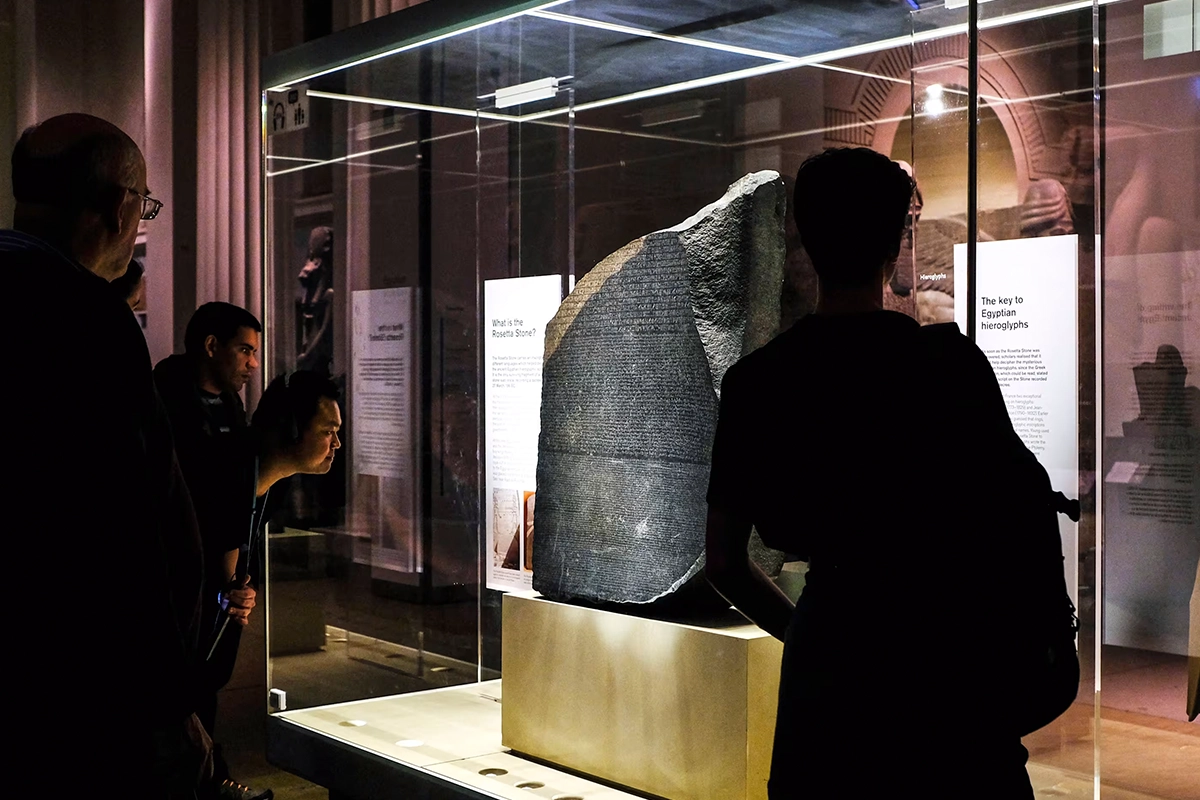
The stone is the most visited object in the British Museum. It sits in a protective glass case in Room 4, the Egyptian sculpture gallery, and entry to the museum is free. During the First World War, it was hidden 50 feet underground in a postal railway tunnel at Holborn from 1917 to 1919. It has left the museum only once in peacetime, for a month at the Louvre in 1972.
Should It Return to Egypt?
Egypt has long called for the Rosetta Stone to come home. In 2022, the bicentenary of Champollion's breakthrough, the archaeologist Monica Hanna started a petition calling for its return. A similar petition backed by former antiquities minister Zahi Hawass gathered more than 100,000 signatures. Supporters call it a spoil of war. The British Museum replies that the 1801 treaty was legally signed and that Egypt's government has not made a formal request. The debate remains open, but everyone & everything desires to return home.
The Rosetta Stone in Egypt
For travelers searching for the Rosetta Stone in Egypt, the answer is Rashid. In 2005, the British Museum gave Egypt a full-size replica. It is displayed in the Rashid National Museum, housed in an Ottoman merchant's mansion. Rashid lies about 65 kilometers east of Alexandria, where the Nile's western branch meets the sea. The town is famous for its brick Ottoman houses and the restored Citadel of Qaitbay, the fort where the stone was found.
Many visitors hoped to see the original in Egypt for the opening of the Grand Egyptian Museum, and Egyptian officials have asked for at least a temporary loan. For now, the Egyptian Museum in Cairo and the Grand Egyptian Museum hold thousands of inscriptions that the stone made readable.
The Rosetta Stone App and Login
Many people searching for the Rosetta Stone are looking for the language learning software. Rosetta Stone is an American company founded in 1992 in Virginia and owned by IXL Learning since 2021. It took its name from the stone as a symbol of unlocking languages. The Rosetta Stone app is sold in the app stores, and the Rosetta Stone login page is on the company's own website. They have no connection to the British Museum or to Egypt, other than the name.
Enjoy Reading the Temples Along the Nile With Our Grand Cruises
The Rosetta Stone is a priestly decree for a teenage king, yet it gave the world back the voice of ancient Egypt. Thanks to it, every carving you see on a Nile cruise can now be read. You can trace the work of Ptolemy V's own dynasty at Edfu, Kom Ombo and Dendera, where Ptolemaic temple walls carry hieroglyphs as dense as any in Egypt. Further back in time, there are the royal names that Champollion first read at Karnak Temple and Abu Simbel.
Stand before those walls with a guide, and the timeless words of the pharaohs speak again, just as they did for Champollion two centuries ago. Explore our Luxor to Aswan Nile cruises, our guide to the best temples to see on a Nile cruise, or our Egypt tour packages with a Nile cruise. You can also contact our team to plan a tailor made trip across all the attractions that you wish to explore.