Ahmose-Nefertari was the sister and wife of Ahmose I, the mother of Amenhotep I, and one of the most influential women in ancient Egyptian history. She stood beside her husband as he drove out the Hyksos and founded the New Kingdom, held the powerful priestly office of God's Wife of Amun, and after her death was worshipped as a goddess for some 500 years. Few queens of Egypt were so loved that ordinary workers prayed to them for generations.
This guide tells her story: her family, her role as queen and regent, the title that gave royal women real power, her cult as a goddess at Deir el-Medina, and what we know about the Ahmose-Nefertari mummy, coffin and DNA. It also clears up common confusion with Nefertiti and with Nefertari, the queen of Ramesses II, and shows where you can follow her story in Luxor and Cairo today.
Who Was Ahmose-Nefertari?

Quick Facts
| Detail | Information |
|---|---|
| Name meaning | Ahmose, "the Moon is born"; Nefertari, "beautiful companion" |
| Lived | Late 17th Dynasty to early 18th Dynasty, about 1570 to 1505 BC |
| Parents | Seqenenre Tao and Queen Ahhotep I |
| Husband | Her brother, Ahmose I |
| Children | Amenhotep I, Ahmose-ankh, Siamun, Meritamun, Sitamun and possibly Mutnofret |
| Key titles | Great Royal Wife, King's Mother, God's Wife of Amun |
| Age at death | About 70 |
| Mummy today | National Museum of Egyptian Civilization, Cairo |
A Royal Family at War
Ahmose-Nefertari was born in Thebes into the family leading the fight against the Hyksos, the foreign rulers of the Nile Delta. Her father, Seqenenre Tao, died violently in that war, and her mother, Ahhotep I, ruled as regent for the young Ahmose I. Her grandmother, Tetisheri, was so honoured that Ahmose built her a pyramid shrine at Abydos. Strong women were at the heart of this dynasty from the start.
Queen Ahmose-Inhapi and the Women of the Family
The family was large and closely related, and many princesses carried the name Ahmose. Queen Ahmose-Inhapi, probably a sister of Seqenenre Tao and a wife of that king, was Ahmose-Nefertari's aunt. Her tomb at Thebes later served as a hiding place for royal mummies, and her own mummy was found in 1881 in the coffin of Lady Rai, the nurse of Ahmose-Nefertari.
Great Royal Wife of Ahmose I

Marriage and Children
Following royal custom, Ahmose-Nefertari married her brother Ahmose I and became his Great Royal Wife. Their eldest son, Ahmose-ankh, died young, and their son Amenhotep I became king. Their daughters Meritamun and Sitamun also became royal wives, and some scholars believe Mutnofret, a wife of Thutmose I, was another daughter.
Partner in Founding the New Kingdom
Ahmose I's reign, about 1550 to 1525 BC, saw the fall of the Hyksos capital Avaris, the reunion of Egypt and the start of the 18th Dynasty. Ahmose-Nefertari appears beside him on monuments, and her name is often written in a cartouche, a sign of her unusually high status. Our guide to Ahmose I tells the full story of his wars.
Regent for Amenhotep I
When Ahmose I died, Amenhotep I may still have been young, and many Egyptologists believe Ahmose-Nefertari acted as his regent. She outlived her son and died early in the reign of Thutmose I, so she saw four kings on the throne.
God's Wife of Amun: A New Kind of Power

The most important part of her legacy was a title, and the wealth and influence that came with it.
The Donation Stela at Karnak
A stela found at Karnak Temple, known as the Donation Stela, records that Ahmose I bought the office of Second Prophet of Amun and gave it to his wife and her heirs, together with land, goods and staff. In exchange, she held the role of God's Wife of Amun, which she is the most famous holder of.
What the Title Meant
The God's Wife of Amun took part in temple rituals at Karnak, controlled a large estate and its income, and had her own officials. The office gave a royal woman independent wealth and a direct role in the religion of Amun, the god credited with Egypt's victory over the Hyksos.
A Path for Hatshepsut
Later queens and princesses held the same title, including Hatshepsut, who used it before she became pharaoh. The power Ahmose-Nefertari built into this role helped make Hatshepsut's reign possible.
Ahmose-Nefertari From Queen to Goddess

How Did Ahmose-Nefertari Die?
Ahmose-Nefertari probably died around the fifth year of Thutmose I, about 1505 BC. No cause of death is recorded. Her mummy suggests she reached about 70, a great age at the time, so most scholars assume she died of natural causes in old age. That is the answer to the common question about Queen Ahmose's age: she lived roughly seven decades and outlived her husband and her son.
Patron of Deir el-Medina
After her death, Ahmose-Nefertari and Amenhotep I were worshipped as the protectors of Deir el-Medina, the village of the craftsmen who built the royal tombs in the Valley of the Kings. They may even have founded it. She appears in around 50 private tombs on Luxor's West Bank, in scenes painted from her lifetime until the end of the Ramesside period, about 500 years later. She was called "Mistress of the Sky" and "Lady of the West", and an annual festival was held in her honour.
The Black-Skinned Queen
In many later images, Ahmose-Nefertari is shown with black or dark blue skin. Most Egyptologists read this as a sign of rebirth and fertility, the colour of the fertile Nile mud and of Osiris, rather than of her origins. Other images show her with red or yellow skin, and the earliest black-skinned portraits date to about 150 years after her death.
The Ahmose-Nefertari Mummy, Coffin and DNA
Her Tomb
Ahmose-Nefertari was probably buried at Dra Abu el-Naga on Luxor's West Bank, near a mortuary temple built for her. Her original tomb has not been identified with certainty.
The Royal Cache of 1881
Around 1000 BC, priests moved many royal mummies to protect them from robbers. In 1881, the hidden tomb known as DB320, near Hatshepsut Temple at Deir el-Bahari, was found to hold more than 50 mummies, including Ahmose I, Seqenenre Tao, Ahmose-Inhapi and Ahmose-Nefertari.
The Ahmose-Nefertari Mummy
The wife of King Ahmose's mummy was unwrapped in 1885 by Émile Brugsch. It was in poor condition and began to decay so quickly after exposure that it smelled strongly, and it was reburied for a time before being re-examined. The body is of an elderly woman with thinning hair, which had been supplemented with false braids, and the right hand is missing. As with several royal mummies from the cache, a few scholars have questioned the identification.
The Ahmose-Nefertari Coffin
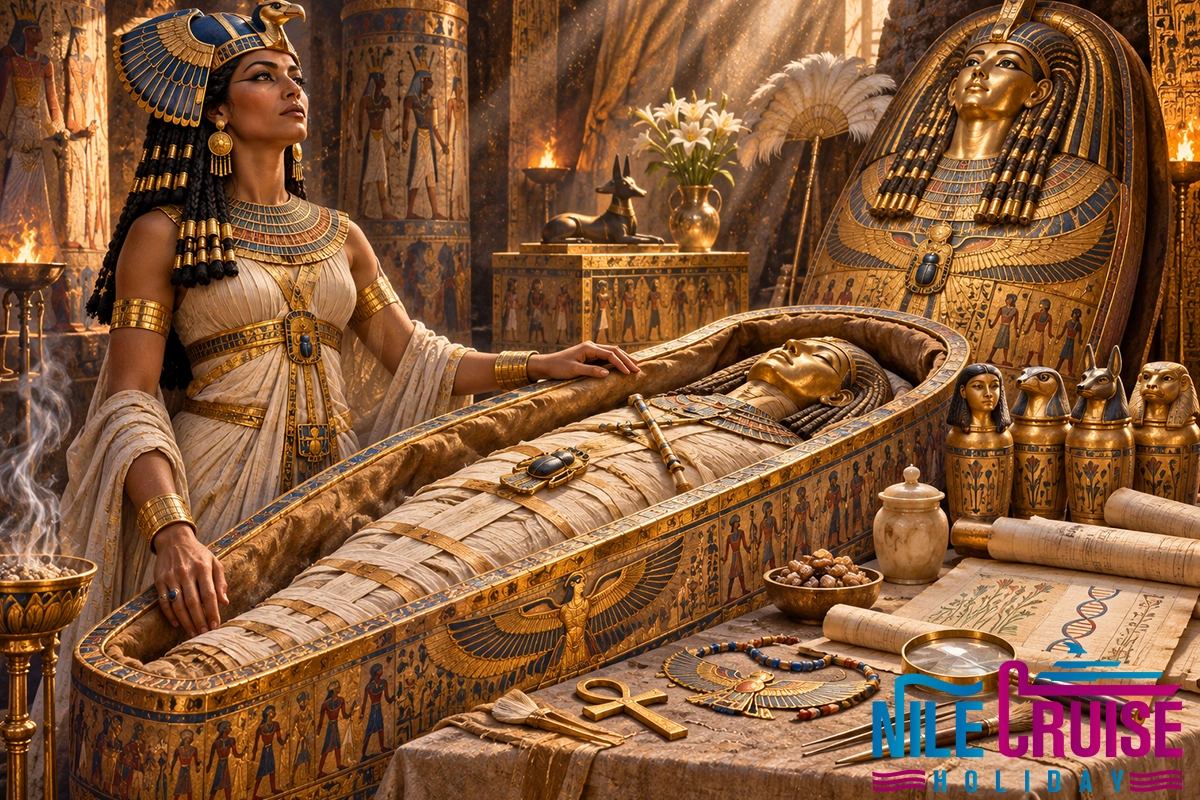
The Ahmose-Nefertari coffin is one of the most striking objects of the period. It is a giant cartonnage coffin, about 3.8 metres tall, showing the queen holding the ankh and the was sceptre, with a tall feathered crown. When the cache was found, the coffin also held the mummy of Ramesses III, placed there by the priests who reburied the royal dead. The coffin is displayed in Cairo; our guide to Egyptian mummification explains how such burials were prepared.
Ahmose-Nefertari DNA
No Ahmose-Nefertari DNA results have been published. The DNA projects on royal mummies so far have focused on Tutankhamun's family and a few others. CT scans of the 17th and 18th Dynasty mummies, including her father, have added much to what we know, and DNA work on this family could one day confirm her identity and relationships.
The Pharaohs' Golden Parade
On 3 April 2021, the Ahmose-Nefertari mummy was one of four queens among the 22 royal mummies carried through Cairo in the Pharaohs' Golden Parade to the National Museum of Egyptian Civilization in Fustat, where she now rests in the Royal Mummies Hall.
Where to Follow Ahmose-Nefertari's Story Today
Luxor's West Bank
Visit Deir el-Medina to see the tombs of the workers who worshipped her, and the Tombs of the Nobles, where she appears in private chapels. Our guides to the Valley of the Queens vs Valley of the Kings, Valley of the Kings tombs and tickets and the Luxor East Bank vs West Bank help you plan.
Karnak and the Luxor Museum
At Karnak you walk through the temple of Amun she served as God's Wife. The Luxor Museum displays the mummy of her husband, Ahmose I.
Cairo's Museums
Her mummy is at NMEC, her coffin in Cairo and early 18th Dynasty treasures across the city's museums. Our guide to ancient Egyptian artifacts covers the Egyptian Museum and the Grand Egyptian Museum.
Following Her on a Nile Cruise
A Nile cruise from Luxor covers Karnak and the West Bank, and our Cairo and Nile cruise tours add the Cairo museums. Between Luxor and Aswan, the El Kab tombs record the war her husband won.
Learn the Legacy of His Powerful Queen With Our Grand Holidays
Ahmose-Nefertari was far more than the wife of a great king. She helped found the New Kingdom, turned the title God's Wife of Amun into a source of real power for royal women, guided her son's early reign, and became a goddess loved by the workers who built the royal tombs. Her mummy rests in Cairo, but her story lives on in the painted chapels of Thebes, where she was remembered as an eternal mother of Egypt long after her dynasty had passed.
To explore her Thebes and the treasures of her family, browse our Luxor and Aswan Nile cruises or ask our team for a tailor-made journey.