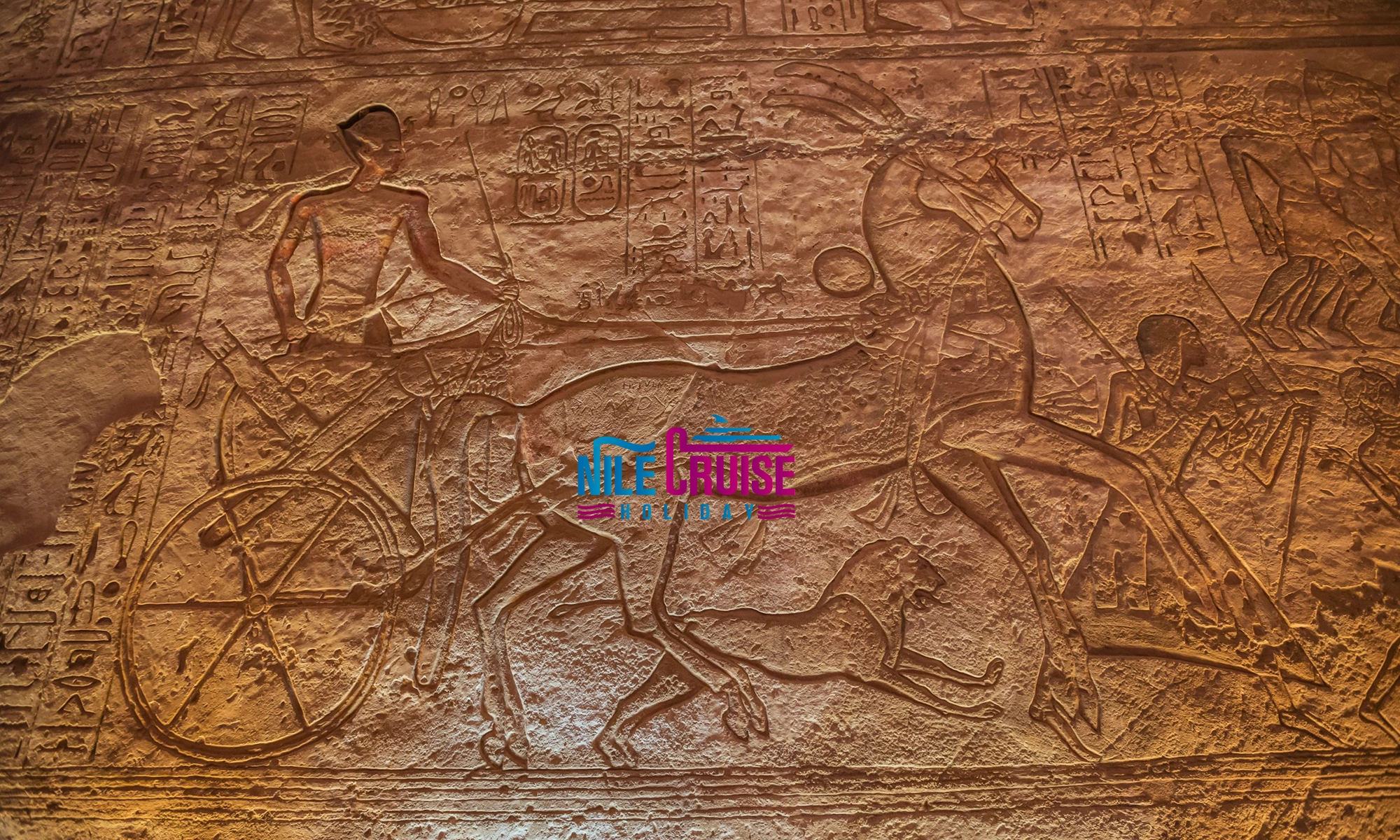
The ancient Egyptian vizier was the most powerful official in the land after the pharaoh, a chief minister, supreme judge and head of the administration rolled into one. For almost 3,000 years, from the first dynasties to the Ptolemies, viziers collected taxes, judged cases, managed granaries, organised pyramid and temple building and kept the king informed of everything that happened in his kingdom. Behind every great pharaoh stood a vizier, quietly turning royal will into order across the Two Lands.
This guide explains the meaning and pronunciation of the title, the relationship between the vizier and the pharaoh, what the vizier did in ancient Egypt, how viziers dressed and were drawn in tomb art, the most famous vizier names, and where you can still see their tombs on a trip along the Nile.
Ancient Egyptian Vizier Meaning and the Ideal Pronunciation

What the Title Means
The Egyptians called their chief minister tjaty, also written tjati or djat. Egyptologists translate it as "vizier", a word borrowed from the Arabic wazir, the chief minister of later Islamic states, because the two offices were so similar. The ancient Egyptian vizier meaning is therefore simply "the highest official after the king", a role often compared to a modern prime minister.
Vizier Ancient Egypt Pronunciation
The English word vizier is pronounced vih-ZEER, with the stress on the second syllable. The original Egyptian title tjaty is usually pronounced by Egyptologists as CHAH-tee, although, as with all ancient Egyptian words, its exact sound is uncertain because the script did not record vowels.
Guardians of Maat
The vizier's first duty was to uphold maat, the ancient Egyptian idea of truth, justice and cosmic balance. Maat was personified as a goddess wearing an ostrich feather, and viziers wore her image as a badge of office. Our guide to Egyptian symbols and meanings explains the feather and other sacred signs.
The Ancient Egyptian Vizier and Pharaoh

Second Only to the King
The pharaoh was seen as a living god, while the vizier was his chief servant, the link between the king and every official in Egypt. All government documents needed the vizier's seal to be valid, and lesser officials, from tax collectors to provincial governors, reported to him. The pharaoh, however, could overrule any decision the vizier made.
How Viziers Were Chosen
In the 4th and early 5th Dynasties, viziers were usually princes or close relatives of the king. From the later 5th Dynasty, kings chose loyal and capable officials, often trained as scribes, and in some periods the office passed from father to son. The appointment was normally for life, but a new pharaoh could replace his predecessor's vizier.
Two Viziers in the New Kingdom
From the 18th Dynasty, around 1550 BC, the office was split between two viziers of equal rank. The Vizier of the South governed Upper Egypt from Thebes, modern Luxor, while the Vizier of the North governed Lower Egypt from Memphis. The division eased the workload and stopped any one official from rivaling the king.
The Installation of the Vizier
The best source for the office is a New Kingdom text known as The Installation of the Vizier and The Duties of the Vizier, preserved in the tomb of Rekhmire at Thebes. In it, the king urges the new vizier to judge fairly, treat the known and the unknown alike and never act out of anger, describing the post as "copper enclosing the gold of his lord's house".
Women in the Office
Only two women are known to have held the title. Nebet, wife of a nobleman under Pepi I in the 6th Dynasty, was named vizier, although her husband may have done the work, and a woman of the 26th Dynasty held it much later. In Ptolemaic times, queens such as Berenice II and Cleopatra I were also linked with the title in temple texts.
Vizier Duties in Ancient Egypt

Chief Judge
The vizier presided over the high court, heard appeals from lower courts and settled disputes over land, inheritance and crime. Petitions were brought to his hall each day, and records of land, censuses and criminal cases were kept in his offices. Punishments for serious crimes could be severe, as the Medjay, Egypt's police, enforced his rulings.
Head of Administration and Treasury
The vizier supervised taxation, the treasury, the state granaries and the national archives. He kept track of herds, reservoirs, food supplies and the height of the Nile flood, which decided the size of each year's harvest, a system tied closely to the ancient Egyptian calendar. He even checked the water supply of the capital.
Master of Royal Building Works
Viziers organised the labour, stone and food needed for pyramids, temples, canals and dykes. Some were architects themselves, while others managed the royal tomb builders of Deir el-Medina, who cut the tombs of the Valley of the Kings. When their rations were late under Ramesses III, the striking workers appealed directly to the vizier.
Palace Security and the Army
The vizier controlled who entered the palace, appointed the chief of police and checked reports from frontier posts. He approved military officers and supplies, and in the king's absence he could act in his name.
Religion and Temples
Viziers helped appoint high priests, oversaw temple estates and ensured that festivals and offerings were carried out correctly at great sanctuaries such as Karnak. Some, like Imhotep, also held priestly titles.
A Vizier's Daily Routine
According to The Duties of the Vizier, each morning he reported to the king on the state of the country, then met the chief treasurer to confirm that the stores were sealed and secure. He then sat in his hall on a chair with a cushion, with 40 leather rolls of the law laid before him, his officials on either side, and heard the business of the day.
Ancient Egyptian Vizier Clothing and Drawing
The Vizier's Robe
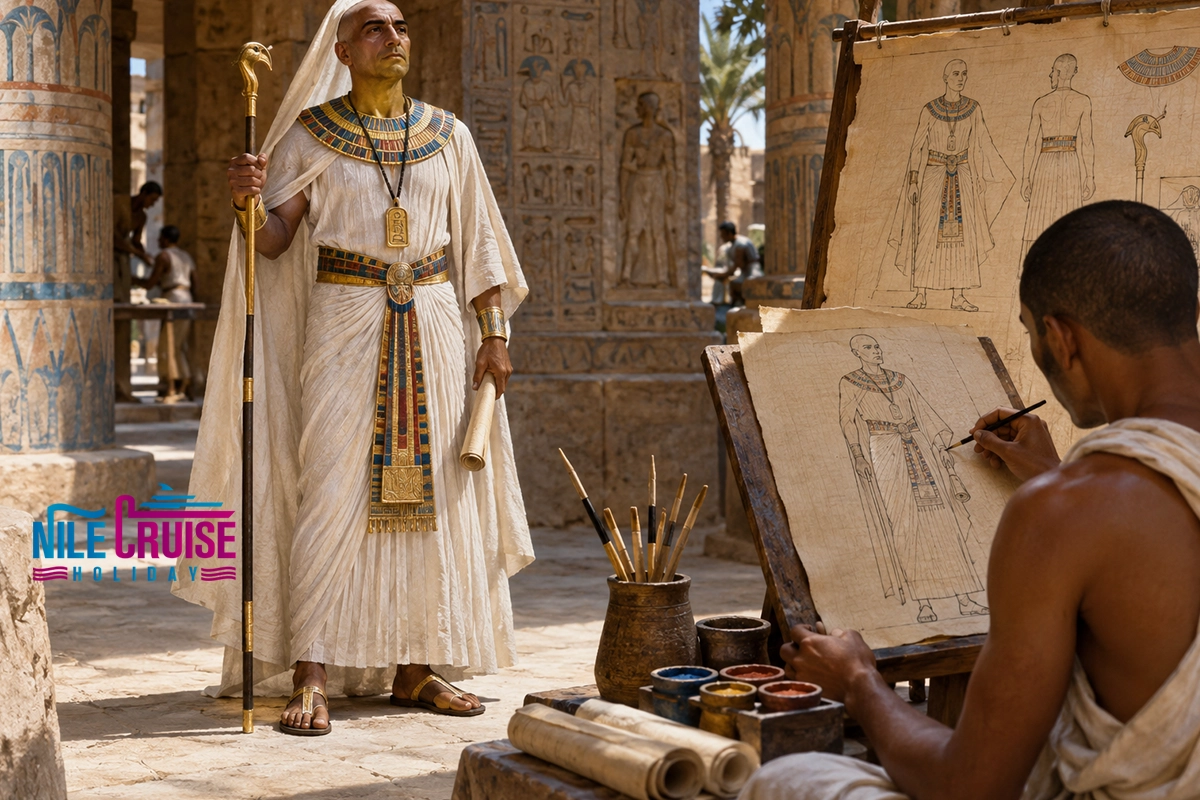
From the Middle Kingdom onward, viziers wore a distinctive costume: a long, plain white linen robe running from the chest to the ankles, fastened by a cord or two straps around the neck. Its simplicity set the vizier apart from other courtiers in pleated kilts and showed purity and seriousness.
Insignia of Office
Viziers wore an amulet of the goddess Maat on a chain around the neck, a symbol that they judged in her name. They often held a long staff and a sceptre, wore a short wig or shaved head and leather sandals, and on formal occasions added a broad collar of gold and stone beads.
Vizier Ancient Egypt Drawing and Tomb Art
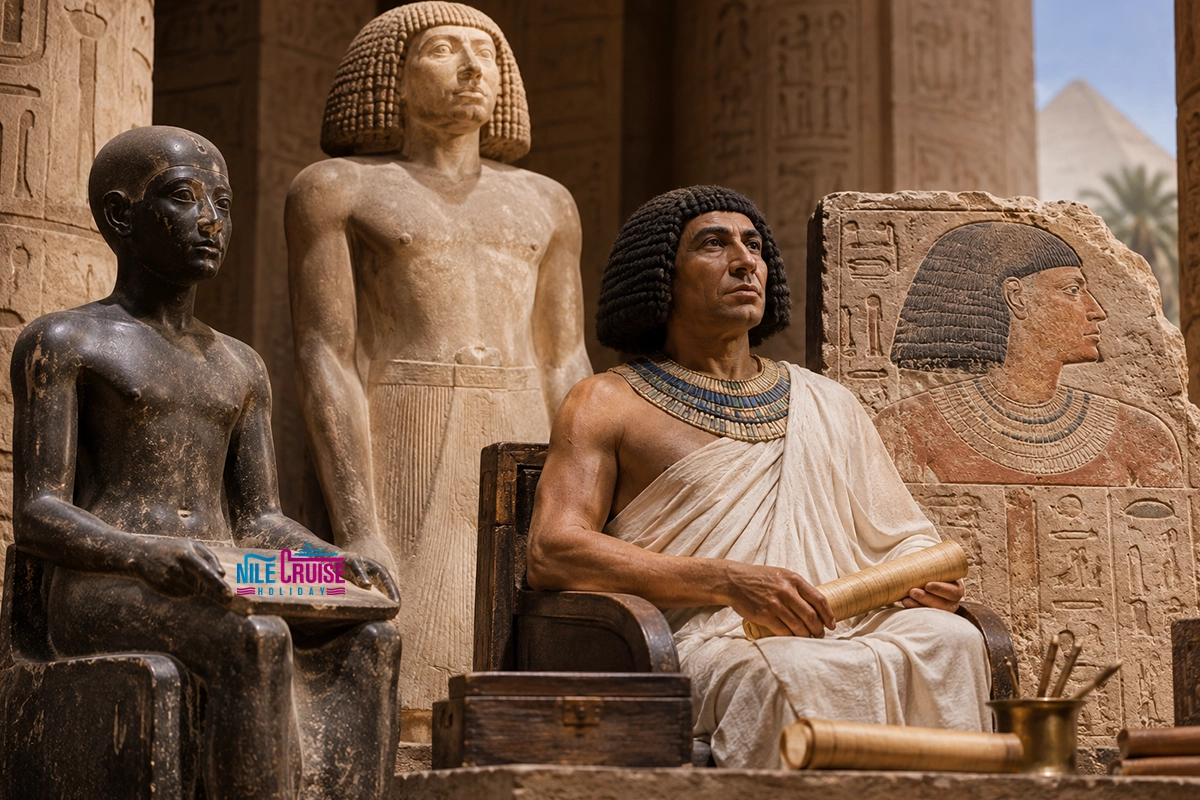
The best drawings of viziers come from their own tombs. The tomb of Rekhmire shows him receiving tribute from Punt, Nubia, Crete and Syria, inspecting craftsmen, and sitting in judgment, while the tomb of Ramose shows elegant relief portraits from the reign of Amenhotep III. Our guide to Akhenaten and Nefertiti covers the period when Ramose served. Statues such as the seated figure of Hemiunu, now in Germany, show the vizier as a heavy, well fed man, a sign of prosperity.
Famous Ancient Egyptian Vizier Names
Old Kingdom Viziers
- Imhotep, chancellor of King Djoser around 2670 BC, designed the Step Pyramid at Saqqara and was later worshipped as a god of medicine. Read who was Imhotep.
- Hemiunu, nephew of Khufu, is credited with planning the Great Pyramid at the Giza Pyramids. See how the pyramids were built.
- Ptahhotep, vizier of Djedkare Isesi in the 5th Dynasty, is the traditional author of the Maxims of Ptahhotep, one of the oldest books of wisdom.
- Kagemni and Mereruka, viziers of King Teti in the 6th Dynasty, built some of the finest mastaba tombs at Saqqara.
Middle Kingdom and Second Intermediate Viziers
- Amenemhat, vizier of Mentuhotep IV, became King Amenemhat I around 1991 BC and founded the 12th Dynasty.
- Ankhu served several kings of the 13th Dynasty, including Khendjer and Sobekhotep II, keeping the government stable as rulers came and went.
New Kingdom Viziers
- Rekhmire, Vizier of the South under Thutmose III and Amenhotep II, left the most complete description of the office.
- Ramose served Amenhotep III and the young Akhenaten.
- Ay, adviser to Tutankhamun, later became pharaoh himself.
- Paramessu, vizier of Horemheb, became Ramesses I, founder of the 19th Dynasty, and was succeeded by his son, Seti I.
- Khay served Ramesses II and announced his jubilee festivals across Egypt.
Later Periods
During the Third Intermediate Period, viziers of the South such as Herihor, also High Priest of Amun, held great power in Thebes. Under the Ptolemies, the office became largely ceremonial as Greek officials took over its duties.
Where to See the World of the Viziers Today

Saqqara and Giza
At Saqqara, the mastabas of Mereruka, Kagemni and Ptahhotep are among the most beautifully carved tombs in Egypt, showing farming, fishing, crafts and daily life on the vizier's estates. Mereruka's mastaba has more than 30 rooms. Combine them with the Step Pyramid and a visit to ancient Memphis, the northern vizier's capital.
The Tombs of the Nobles in Luxor
On Luxor's West Bank, the tombs of Rekhmire (TT100) and Ramose (TT55) lie among the Tombs of the Nobles. Rekhmire's tomb contains the famous Duties of the Vizier text and colourful scenes of foreign envoys. Use our guide to Luxor East Bank vs West Bank to plan your day.
Museums in Cairo
Statues and reliefs of viziers are displayed at the Egyptian Museum in Cairo and the Grand Egyptian Museum, where you can see the white robe and Maat amulet in stone.
Following the Viziers on a Nile Cruise
A Luxor and Aswan Nile cruise takes you from the Theban seat of the Vizier of the South to the temples he helped to manage, while our Cairo and Nile cruise tours add Saqqara and Memphis.
Feel the Royal Power of Ancient Egypt With Our Grand Holidays
The ancient Egyptian vizier held the kingdom together, judging cases, collecting taxes, building pyramids and temples and serving as the bridge between the pharaoh and his people. From Imhotep and Hemiunu to Rekhmire and Ramose, their names, robes and tombs reveal how Egypt was governed for three millennia.
Standing in their painted tombs today, you meet the timeless guardians of maat who kept the Two Lands in balance. To explore the tombs and temples of Egypt's great officials, book our Egypt tour packages with a Nile cruise or ask for a tailor-made itinerary.