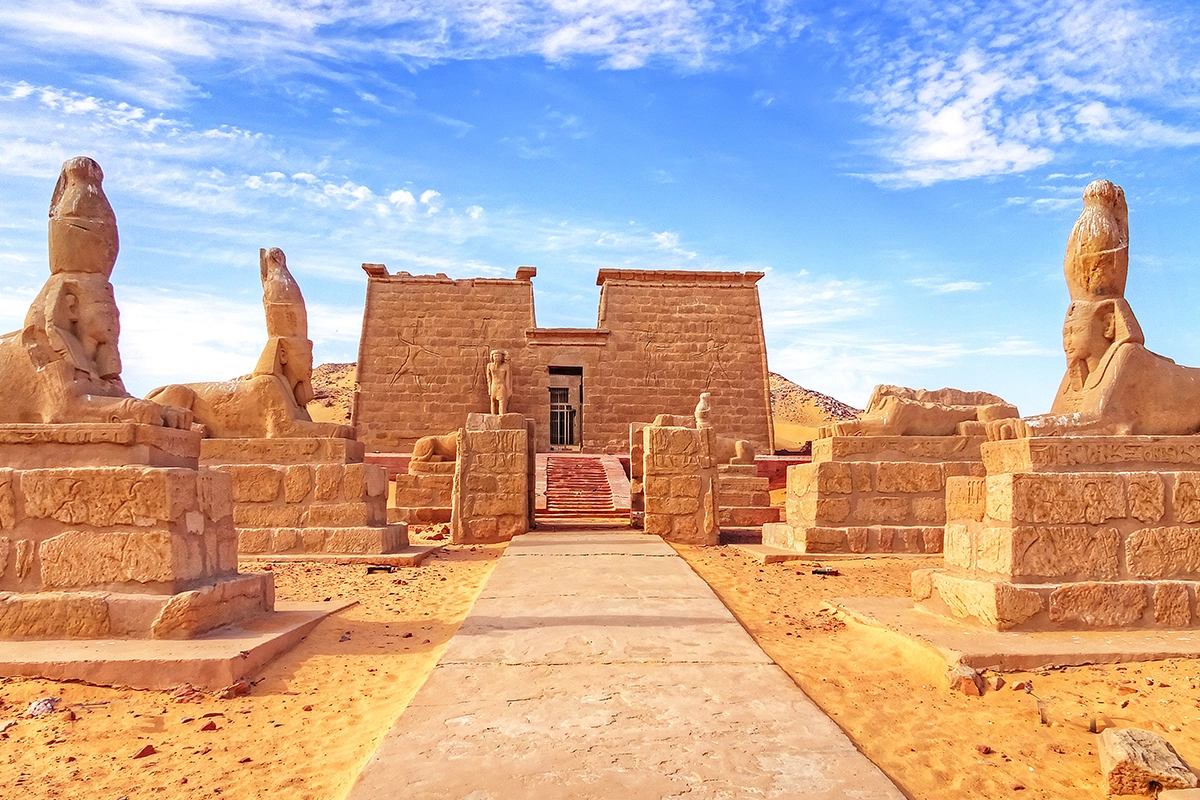
Wadi El Seboua is one of the most memorable stops on Lake Nasser. The name means "Valley of the Lions," after the sphinxes that line the way into its main temple. The site holds two New Kingdom temples, a small one started by Amenhotep III and a larger one built by Ramesses II, along with two later temples, Dakka and Maharraqa, that were rebuilt beside them in the 1960s. Together they cover more than 1,500 years of Egyptian, Nubian, Greek, Roman, and Christian history.
On the desert shore of Lake Nasser, rows of stone sphinxes still guard the road to a temple carved half into the rock, far from any town. This guide explains the history of the temples and the pharaohs who built them. It walks through the avenue of sphinxes and the temple layout, the rescue that moved the site, and the neighboring temples. It also covers how to visit on a Lake Nasser cruise, with hours, tickets, and practical tips.
The Essential Information of Wadi El Seboua Temple

Wadi El Seboua sits deep in Lower Nubia, where the only practical way in is by boat.
Where Is Wadi El Seboua?
The temples stand on the west shore of Lake Nasser, about 150 km south of Aswan and roughly 140 km north of Abu Simbel. They were originally built on the west bank of the Nile, about 4 km from where they stand today. Our Wadi es-Sebua temples attraction page shows where the site sits among the other Aswan attractions.
Why Is It Called the Valley of the Lions?
In Arabic, wadi means valley and seboua means lions. Local people named the place after the lion-bodied sphinxes that flank the approach to the temple of Ramesses II. Much of the site was still buried in sand when European travelers reached it in the early 19th century.
Wadi El Seboua Facts
| Fact | Detail |
|---|---|
| Main temple | Temple of Ramesses II, 19th Dynasty |
| Built | Years 35 to 50 of Ramesses II, about 1244 to 1229 BC |
| Older temple | Amenhotep III, 18th Dynasty |
| Gods | Amun-Ra, Ra-Horakhty, and the deified Ramesses II |
| Builder | Setau, Viceroy of Kush |
| Moved | 1964, about 4 km, with US support |
| UNESCO listing | 1979, as part of the Nubian Monuments |
Grand History of the Temples of Wadi El Seboua

Two pharaohs, one religious revolution, and a Christian community all shaped Wadi El Seboua.
The Temple of Amenhotep III
The oldest temple was built by Amenhotep III in the 18th Dynasty. It was small: a rock-cut sanctuary about 3 m by 2 m, with a brick pylon, a court, and a partly painted hall in front. It may first have honored a local Nubian form of Horus, whose images were later changed to Amun.
Akhenaten and the Amarna Damage
Under Akhenaten, who promoted the sun disk Aten above all other gods, images of Amun across Egypt were attacked. The small temple at Wadi El Seboua suffered the same fate, and its decoration was damaged. Read more about this period in our story of Akhenaten and Nefertiti.
Ramesses II and the Viceroy Setau
About a century later, Ramesses II restored the old temple and built a much larger one about 150 m away. The work was overseen by Setau, the Viceroy of Kush, who governed Nubia for the king. Setau also built the temple of Gerf Hussein, and texts suggest the workforce included prisoners of war. Ramesses II also built the great temples of Abu Simbel, which you can read about in Ramses II and Nefertari.
From Temple to Church of St Peter
After Nubia became Christian in the 6th century AD, the hypostyle hall of Ramesses II's temple was turned into a church. Christians covered the reliefs with plaster and painted saints on top. In the sanctuary, the figures of the gods were cut away and replaced with a painting of St Peter. When the plaster later fell away, it created one of Egypt's most curious scenes: Ramesses II appears to be offering flowers to St Peter.
The Golden Avenue of Sphinxes and Temple Layout

The temple of Ramesses II is part free-standing and part cut into the rock, like a smaller cousin of Abu Simbel. You walk from the open, sunlit avenue into dark rock-cut halls.
The Avenue of Sphinxes
The approach passes through two open courts lined with sphinxes. The first court has human-headed sphinxes with the face of Ramesses II, along with statues of the king. The second has falcon-headed sphinxes, representing forms of Horus, some holding a small figure of the king between their paws. It is a smaller, wilder version of Luxor's famous route, described in our guide to the Avenue of Sphinxes in Luxor.
The Pylons and Colossi
The temple once had three pylons. The first two were built of mud brick and have crumbled, leaving only their stone gateways. The third, stone pylon still stands, with scenes of Ramesses II striking his enemies and making offerings to the gods. Four colossal statues of the king once stood in front of it, and one remains upright. Visitors can climb the pylon for wide views of the lake and desert.
The Pillared Court
Behind the stone pylon is a large court lined with pillars, each once fronted by a statue of the king in the form of Osiris. The walls show long processions of the king's sons and daughters, a favorite theme of Ramesses II.
The Rock-Cut Hypostyle Hall and Sanctuary
The hypostyle hall is cut into the rock and has 12 square pillars. The six central pillars once held Osiride statues of the king, which were later chiselled away. Beyond lie an antechamber, two side chapels, and the sanctuary, where statues of Amun-Ra, Ra-Horakhty, and Ramesses II sat side by side. Bring a torch, since the best reliefs are in the dim inner rooms.
The Epic Rescue and the New Wadi El Seboua Site
Like Kalabsha Temple and Abu Simbel, Wadi El Seboua was saved from the rising water of Lake Nasser.
Moving the Temples
The building of the Aswan High Dam meant that Lake Nasser would flood the original site. In 1964, as part of UNESCO's International Campaign to Save the Monuments of Nubia, the Egyptian Antiquities Service dismantled the temples with support from the United States. They were rebuilt about 4 km away on higher ground, now called New Wadi es-Sebua. In 1979, the site became part of the UNESCO World Heritage Site of the Nubian Monuments from Abu Simbel to Philae.
The Temple of Dakka
The Temple of Dakka was moved here from about 40 km to the north. It was founded by the Meroitic king Arkamani in the late 3rd century BC and dedicated to Thoth. Ptolemaic kings and the Roman emperors Augustus and Tiberius later added to it. Its tall Roman pylon can be climbed for views over the whole site.
The Temple of Maharraqa
The small Temple of Maharraqa dates from the Roman period and was dedicated to Isis and Serapis. It was never finished. Its most unusual feature is a spiral staircase, a very rare design in an Egyptian temple.
Visiting Wadi El Seboua on a Lake Nasser Cruise

There is no regular road access for tourists, so almost every visitor arrives on a Lake Nasser cruise.
Which Cruises Stop at Wadi El Seboua?
Wadi El Seboua is a standard stop on Lake Nasser Nile cruises between Aswan and Abu Simbel. Ships such as the MS Nubian Sea, Movenpick MS Prince Abbas, and Steigenberger Omar El Khayam include it. You can sail the 5 days Lake Nasser cruise from Aswan to Abu Simbel or the 4 days cruise from Abu Simbel to Aswan. Our Lake Nasser cruise vs Nile cruise guide explains how this route differs from the classic Luxor to Aswan trip.
What a Typical Visit Looks Like
The ship moors near the site, and a short walk or a brief boat transfer brings you to the temples. Most cruises allow about one to one and a half hours to see all three temples with an Egyptologist guide. Many ships time the visit for the early morning or late afternoon, when the light on the sphinxes is softest.
Other Temples on the Same Cruise
On the same day or the next, cruises usually stop at the Temple of Amada, the oldest temple on Lake Nasser, and the Temple of Derr. Further south is the hilltop fortress of Qasr Ibrim. Abu Simbel is the grand finale, especially during the Abu Simbel Sun Festival each February and October.
Practical Tips for Visiting Wadi El Seboua
A little preparation makes this remote desert site far more comfortable.
Opening Hours and Tickets
The site is generally open from about 6am to 5pm. Tour operators list tickets at around EGP 150 for foreign adults and EGP 75 for students, covering all three temples. On most Lake Nasser cruises, entrance fees are already included in the price, but confirm this when you book, since prices in Egypt change often.
Best Time to Visit
October to April is the most comfortable season, with mild days and cool evenings. In summer, temperatures on Lake Nasser can pass 40°C, and visits are kept to early mornings. Our guide to the best time to cruise the Nile compares the months.
What to Wear and Bring
There is no shade, café, or shop at the site. Bring water, a hat, sunglasses, and sunscreen, and wear flat shoes with good grip for the sand and the boat transfer. A small torch helps inside the rock-cut rooms. Our list of what to pack for a Nile cruise covers the rest.
Photography
Photography is generally allowed, but flash is not permitted inside the temples. The Sphinx Avenue with the lake behind it is the classic shot, and the top of the pylon gives the widest view.
Before or After Your Cruise
Spend a day in Aswan to see Philae Temple, the Aswan High Dam, and the Nubian Museum, which displays many objects rescued during the UNESCO campaign. See our guide to things to do in Aswan for more ideas.
Explore the Beauty of Southern Egypt With Our Nile Cruises
Wadi El Seboua brings together Amenhotep III, Akhenaten's revolution, Ramesses II, Meroitic and Roman builders, and the early Christians of Nubia. Its avenue of sphinxes, rock-cut halls, and painting of St Peter make it one of the most varied sites on Lake Nasser. With Dakka and Maharraqa beside it, one stop gives you three temples and over a thousand years of history.
As the sun lowers over the desert, the stone lions of Wadi El Seboua seem to keep watch over the lake just as they once watched over the Nile. To add Wadi El Seboua to your trip, explore our Nile cruises from Aswan or contact us to plan your Lake Nasser journey.