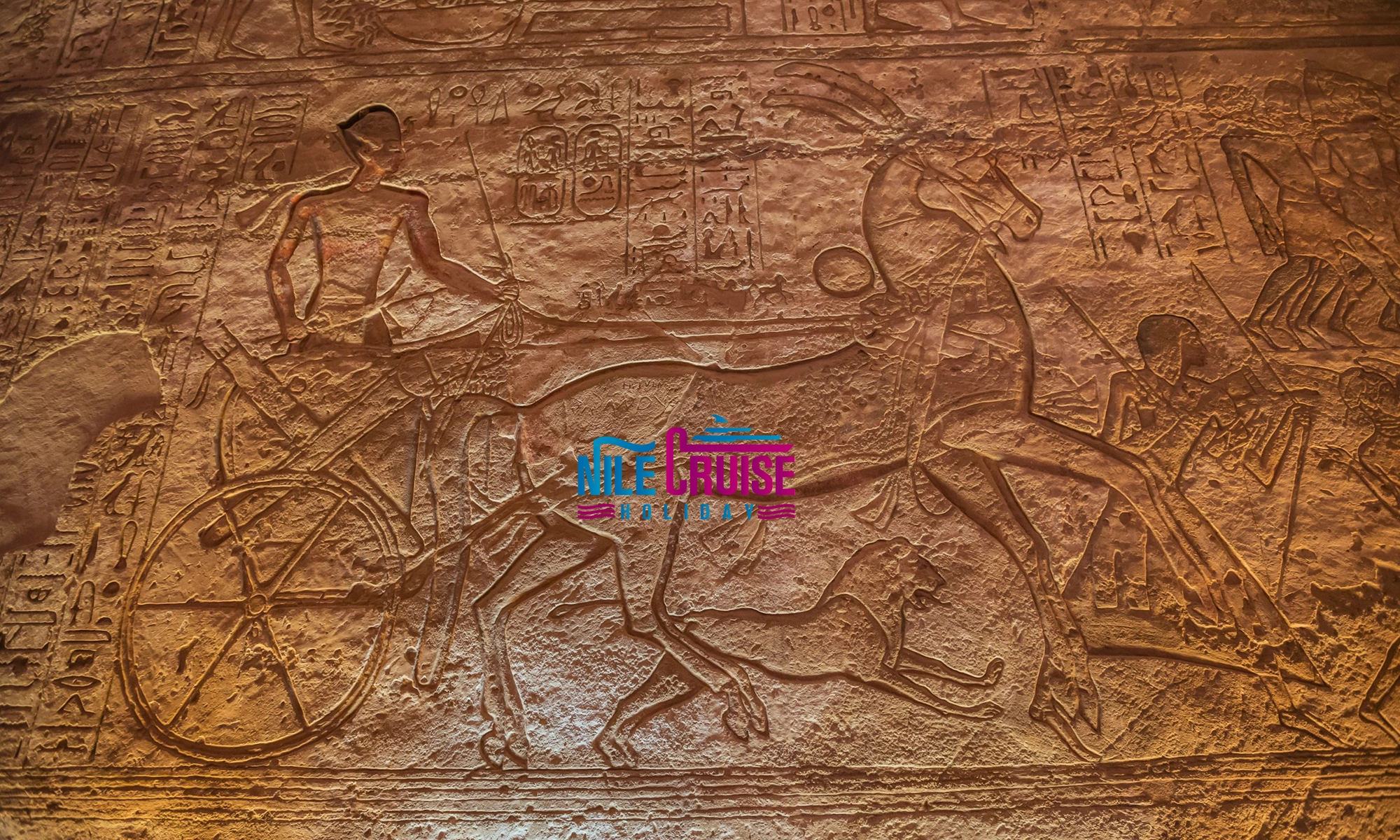
Amun-Ra was the king of the gods in ancient Egypt, a hidden creator joined with the blazing sun. He began as a minor deity of Thebes and became the god of empire. Pharaohs called themselves his sons, and his priests grew rich enough to rule Upper Egypt. Even today, his name rises from every column at Karnak, as if the sun of Thebes never fully set.
This guide covers the Amun Ra Egyptian god meaning, how Amun merged with Ra and whether they were the same god, his powers, his wife and family, the Amun Ra symbol, and whether he was ever seen as evil. It then traces his legacy from Nubia to Alexander the Great and modern pop culture, and shows where to stand in his temples on a Nile cruise.
Amun-Ra Egyptian God Meaning and Origins

The Hidden One
The name Amun (written imn, and also spelled Amon, Amen or Ammon) means "the hidden one" or "the invisible." The Pyramid Texts address him as the great god "whose name is unknown." That hidden nature made him a god of air and wind, felt everywhere but never seen.
From the Ogdoad to Thebes
Amun and his female partner Amaunet first appear in the Pyramid Texts of the Old Kingdom. They were counted among the Ogdoad, the eight primeval gods of Hermopolis who existed before creation. Under the 11th Dynasty, around the 21st century BC, Amun replaced the war god Montu as patron of Thebes, modern Luxor. In the 12th Dynasty, Senusret I began the precinct that grew into Karnak Temple.
How Amun Became Amun-Ra
The great turning point came in the 16th century BC. Ahmose I, a Theban prince, drove out the Hyksos and reunited Egypt, and the god of his city became the god of the whole land. Amun was fused with the sun god Ra to form Amun-Ra (also Amun-Re), uniting a hidden, unseen power with the visible sun. Some popular sources date the merger as early as 2040 BC, but most Egyptologists link the full rise of Amun-Ra to the New Kingdom.
Is Amun-Ra and Ra the Same God?
Not exactly. Ra was the ancient sun god of Heliopolis, worshipped since the Old Kingdom as the creator who sailed across the sky each day. Amun-Ra is a combined form, in which Amun takes on Ra's solar power while keeping his own hidden identity. Egyptian theology allowed one god to "dwell in" another without either disappearing. The Leiden Hymns even say "All gods are three: Amun, Re and Ptah," treating them as distinct yet united. So Ra continued to be worshipped on his own, for example as Ra-Horakhty, while Amun-Ra ruled as king of the gods.
Amun Ra Egyptian God Powers and Roles

The powers of Amun-Ra grew with the empire, until he touched almost every part of Egyptian life.
King of the Gods and Self-Created Creator
Amun-Ra carried the title "King of the Gods" and was seen as a self-created creator, who existed before all things and brought the world into being. A New Kingdom hymn calls him "Lord of truth, father of the gods, maker of men, creator of all animals."
Father of the Pharaoh
Every New Kingdom king claimed to be the "son of Amun." Hatshepsut carved her divine birth on the walls of her temple at Deir el-Bahari, showing Amun-Ra visiting her mother. Kings returned the favour by giving him the spoils of war, so his victories became their victories, from the expedition told in Hatshepsut and the Land of Punt to the wars of Ramses II.
Champion of the Poor and Protector of Travellers
Amun-Ra was not only a state god. Ordinary people prayed to him as the "vizier of the poor," a judge who could not be bribed. Workers at Deir el-Medina left stelae confessing their sins and asking his mercy, trusting that "the Lord of Thebes spends not a whole day in anger." Hymns also praise him for calming storms for sailors and protecting those on the road.
Fertility and Amun-Min
Amun absorbed the fertility god Min to become Amun-Min, also called Kamutef, "Bull of his Mother." In this form he is shown with a raised flail and an erect phallus, a sign of the endless renewal of life rather than anything crude.
Was Amun-Ra Evil?
No. Ancient Egyptians saw Amun-Ra as the upholder of Ma'at, the order of truth and justice. Like other gods he could punish wrongdoing, which is why worshippers confessed their faults, but he was never cast as a villain. Any image of an "evil" Amun-Ra comes from modern fiction and from the way Akhenaten's reign later attacked his cult, not from Egyptian belief.
Amun Ra Wife, Family and the Theban Triad
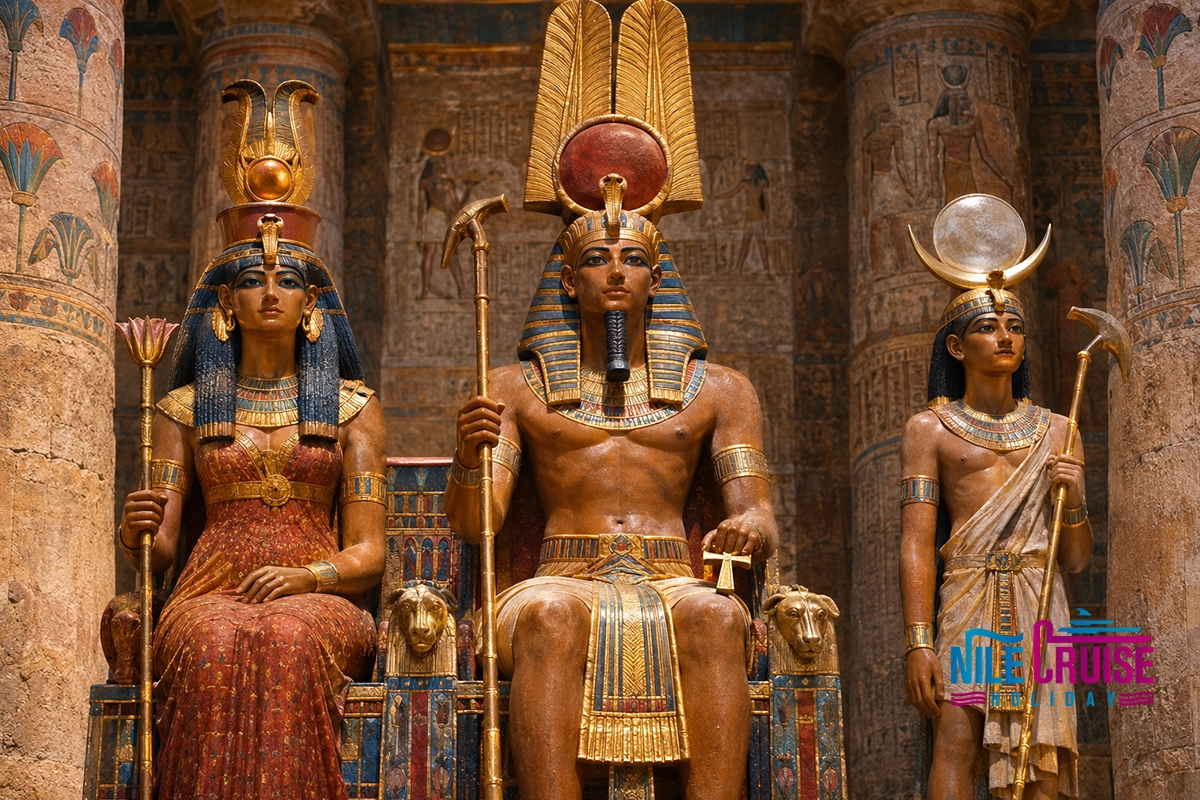
Amun-Ra's family shows how Egyptian theology could adapt one god to many places.
Amaunet, the First Wife
His earliest consort was Amaunet, the "hidden" female half of the Ogdoad pair. She kept a cult at Karnak, where she was served by priests and shown as a woman wearing the Red Crown.
Mut, the Great Wife
As patron of Thebes, Amun's main wife was Mut, the mother goddess often shown as a vulture or as a woman wearing the Double Crown. Her own temple precinct lies just south of Karnak, linked to it by an avenue of sphinxes.
Khonsu and the Theban Triad
Their son was Khonsu, the moon god of healing and time. Together Amun, Mut and Khonsu formed the Theban Triad, the holy family worshipped at Karnak and Luxor. Other texts name Wosret as a consort and, in Libyan tradition, Rhea.
The God's Wife of Amun
A royal woman held the title God's Wife of Amun, the god's earthly spouse. Ahmose-Nefertari was the first great holder of the office. By the Late Period these priestesses controlled vast wealth at Thebes.
Amun Ra Symbol and Depictions

The Double Plumed Crown
The most common Amun Ra symbol is his crown of two tall plumes, often with a sun disk at its base. In the New Kingdom he is shown as a man with red-brown skin. After the Amarna period, artists often painted him blue, a colour linked with air and the primeval waters of creation.
The Ram and the Criosphinx
The ram was Amun's sacred animal, a symbol of strength and virility, probably adopted from a Nubian ram god. The avenue at the entrance to Karnak is lined with criosphinxes, lions with ram heads, each guarding a small figure of the king between its paws. The curved "Horns of Ammon" later appeared on coins of Alexander the Great.
The Goose, Ankh and Was Sceptre
Amun was also linked with the Nile goose, the "Great Cackler" of creation. In his hands he usually holds the ankh, the sign of life, and the was sceptre, the sign of power, both explained in our guide to Egyptian symbols and meanings.
Amun Ra Egyptian God Facts: History and Legacy

The Power of the Priesthood
At its height, the temple of Amun reportedly owned about two thirds of all temple lands and most of Egypt's temple ships. By 1080 BC the high priest Herihor ruled Upper Egypt in all but name, and his successors held Thebes for well over a century.
Akhenaten and the Return of Amun
Akhenaten turned against Amun, promoted the sun disk Aten and moved the capital to Amarna, while his agents chiselled Amun's name off monuments. His successor changed his name from Tutankhaten to Tutankhamun, "living image of Amun," and restored the old cult, a story told in our article on the tomb of Tutankhamun.
Amun in Nubia and Kush
Amun was equally loved in the south. Kings of Kush based their power at Jebel Barkal, the holy mountain of Amun, and the Kushite 25th Dynasty ruled Egypt in his name. You can still see Amun temples on the shores of Lake Nasser, such as the Temple of Amada and the Wadi es-Sebua temples, and learn more at the Nubian Museum.
Siwa, Alexander and Zeus-Ammon
The oracle of Amun at Siwa Oasis became famous across the Greek world. In 332 BC Alexander the Great visited it and was hailed as the son of Amun. The Greeks identified Amun with Zeus as Zeus-Ammon, and the Romans with Jupiter Ammon, a link that later carried into the Ptolemaic age of Cleopatra.
Amun Ra Egyptian God Yugioh and Pop Culture
Many people meet the name through games and films. In Yu-Gi-Oh, the famous Egyptian God cards are Obelisk the Tormentor, Slifer the Sky Dragon and The Winged Dragon of Ra, and the Ra card draws on the sun god Ra rather than Amun-Ra himself. Searches for "Amun Ra Egyptian God Yugioh" usually mix the two. Amun's name also survives in English words such as "ammonia" and "ammonite."
Where to See Amun-Ra on a Nile Cruise

A Nile cruise passes through the heart of Amun-Ra's world, from Thebes to Nubia.
Karnak, the House of Amun
Karnak was the largest temple complex of the ancient world and the main home of Amun-Ra. Its Great Hypostyle Hall, with 134 columns, was mostly built by Seti I and Ramses II. Look for the sacred lake, the obelisks of Hatshepsut and the ram avenue at the entrance. Many visitors return in the evening for the Karnak sound and light show.
Luxor Temple and the Opet Festival
Luxor Temple was built for Amun of Opet, the god's southern sanctuary. During the annual Opet Festival, the statues of the Theban Triad travelled from Karnak to Luxor along the Avenue of Sphinxes, renewing the king's divine power.
The West Bank
In the Beautiful Festival of the Valley, Amun's boat crossed the river to visit the royal temples of the dead. Follow the same route to the Hatshepsut Temple, Medinet Habu and the Ramesseum, where Amun-Ra appears in scene after scene. Statues of Amun and royal works are also displayed at the Luxor Museum.
Abu Simbel
The Great Temple of Abu Simbel honours Amun-Ra alongside Ra-Horakhty, Ptah and the deified Ramses II. Twice a year, during the Abu Simbel Sun Festival, sunlight reaches the inner sanctuary and lights the statues, except Ptah, the god of darkness.
Choosing Your Cruise
Classic Luxor and Aswan Nile cruises cover Karnak, Luxor Temple and the West Bank, while Lake Nasser cruises reach Amada, Wadi es-Sebua and Abu Simbel. For more ideas, see our guide to the best temples to see on a Nile river cruise.
Listen to the Grand Tales of Ancient Egyptian Gods With Our Holidays
From a hidden breath of wind in the Ogdoad to the golden king of the gods, Amun-Ra carried Egypt's belief that unseen power and visible light were one. His temples still stand along the Nile, waiting for travellers to walk beneath the columns that once echoed with his hymns. Browse our Egypt tour packages with Nile cruise or plan a tailor-made trip through the land of Amun-Ra.